


Engineered gut bacteria could offer a new route for delivering GLP-1 therapies
Today in Science (TIS 001) | 23 November 2026
Indian researchers are exploring genetically engineered bacteria as living platforms to produce GLP-1-like therapeutic peptides within the gastrointestinal tract, potentially opening new possibilities for metabolic disease treatment.
The development
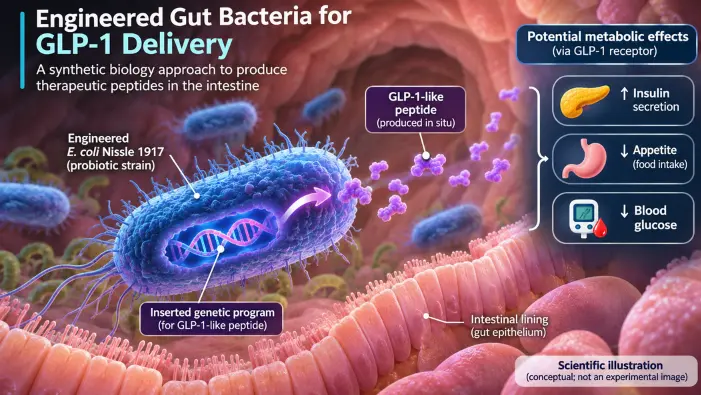
Researchers at the Translational Health Science and Technology Institute (THSTI), an institute under the Department of Biotechnology, Government of India, are developing genetically engineered Escherichia coli Nissle 1917 strains capable of producing GLP-1-like peptides.
The initiative was highlighted by the Ministry of Science and Technology on 20 November 2026. THSTI’s technology and licensing portfolio lists a provisional patent application titled “A Marker-Free Chromosomally Engineered Escherichia coli Nissle 1917 Strain for Synthesis and Gastrointestinal Delivery of GLP-1-Like Peptides”, filed by Bhabatosh Das and Bharti Kandiyal.
Understanding the science
Glucagon-like peptide-1 (GLP-1) is an intestinal hormone involved in regulating blood glucose, insulin secretion and appetite. GLP-1 receptor agonists have become important therapeutic agents for type 2 diabetes and obesity. However, peptide-based therapies face challenges including enzymatic degradation, limited gastrointestinal absorption and the need for specialised drug delivery approaches.
An emerging strategy is to engineer beneficial bacteria to produce therapeutic molecules within the gut. E. coli Nissle 1917, a well-characterised bacterial strain used in probiotic research, offers a potential microbial platform for this approach.
By engineering bacterial genomes to encode GLP-1-like peptides, researchers aim to explore whether microorganisms can act as local, living delivery systems. Chromosomal engineering, rather than relying exclusively on plasmid-based expression, is also an important design consideration for developing genetically stable microbial platforms.
Why does it matter?
If successfully developed, engineered bacteria could offer an alternative approach to delivering peptide-based therapeutics, potentially reducing some of the challenges associated with conventional drug administration.
The concept also represents a broader shift towards live biotherapeutics, in which engineered microorganisms are developed to perform specific therapeutic functions inside the human body.
What’s next?
The technology remains at the research and development stage. Human studies have been identified as a future step, but clinical safety, efficacy, bacterial containment, genetic stability and controlled therapeutic production will need to be established.
The work illustrates how synthetic biology and microbiome engineering could expand the future of drug delivery.
Source: Department of Science and Technology / Press Information Bureau, Government of India; Translational Health Science and Technology Institute (THSTI).
Original announcement: https://www.pib.gov.in/PressReleasePage.aspx?PRID=2339143
Institutional technology listing: https://thsti.res.in/en/patents-and-licensing