


A noncanonical role of the WASH complex in viral entry
Research Summary: We demonstrate that influenza virus exploits the WASH complex for cellular entry. Retromer sequesters WASH at endosomes, keeping it in a non-permissive state. TRIM62 limits this association, facilitating WASH-driven viral entry.
Researcher Spotlight
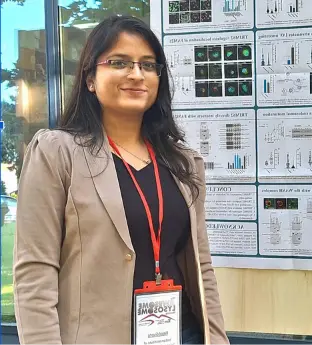
Kajal Gupta recently completed her Ph.D. in Cellular Virology at IISER Mohali, following bachelor’s and master’s degrees in Biochemistry from the University of Delhi. Her doctoral research focused on host-virus interactions.
LinkedIn: https://www.linkedin.com/in/kajal-gupta-b4708b158/
X: https://x.com/kajalGupta1995
Instagram: https://www.instagram.com/kajalgupta95/
Lab PI name: Dr. Indranil Banerjee
University: IISER Mohali
LinkedIn: https://www.linkedin.com/in/25550623/
What was the core problem you aimed to solve with this research?
The ultimate goal of a virus is to propagate its genetic material by migrating from infected cells to new, uninfected ones. Achieving this begins with a critical first step: gaining entry into the host cell. Yet, this is no simple feat – the virus must breach the cell membrane barriers while evading immune surveillance, leaving little trace of its covert invasion. Over the course of evolution, viruses have developed diverse strategies to overcome this challenge. One such strategy involves exploiting the host cell’s own endocytic machinery, which primarily facilitates the uptake and transport of extracellular material. By co-opting this machinery, viruses gain access to the cell interior and are transported towards the intracellular compartments where subsequent stages of infection take place. Influenza A virus (IAV), an important human respiratory pathogen, is one such virus that relies on the host endocytic machinery to gain entry into its target cells. IAV has long been known to rely on the clathrin-mediated pathway for its entry, but recent evidence suggests that the virus can also take alternative, non-clathrin routes. However, the molecular mechanisms underlying clathrin-independent IAV entry remain poorly understood. We, therefore, set out to investigate the molecular machinery underlying clathrin-independent IAV entry and uncovered some unexpected players: the WASH complex, retromer, and TRIM62. Our central objective was to understand how these components interact to regulate endosomal trafficking and, in turn, influence viral entry.
How did you go about solving this problem?
The starting point of our study was to investigate the role of TRIM family proteins in IAV infection. Using high-content screening, we identified TRIM62 as a positive regulator of viral endocytosis through a non-clathrin, lipid raft-dependent pathway. Interestingly, we found that although the E3 ubiquitin ligase activity of TRIM62 was dispensable for this process, its C-terminal PRY-SPRY domain was critical. As we explored the functions of TRIM62 further, we also uncovered its involvement in the recycling of cellular cargoes, including GLUT1. This observation prompted us to investigate whether the endosomal cargo-sorting and recycling machinery, particularly the WASH and retromer complexes, also played a role in viral entry.
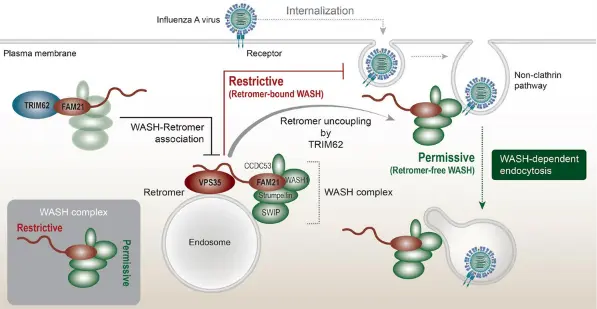
WASH is best known for its role in the cellular recycling machinery, where it facilitates the sorting and retrieval of cargoes that have been internalised and delivered to endosomes. Once cargoes reach the endosomal compartment, the retromer complex recognises and captures specific cargoes destined for recycling. The retromer subunit VPS35 then recruits the pentameric WASH complex to the endosomal membrane through its FAM21 subunit. Once recruited, WASH promotes the formation of branched actin networks, which drive the formation of narrow tubules extending from the endosomal membrane. These tubules selectively incorporate cargoes into transport carriers that, with the assistance of motor proteins, are transported to their destinations, including the plasma membrane and the Golgi apparatus. In this study, we surprisingly found that WASH can act upstream of its canonical function at endosomes to support viral entry and has a dual role in this process: while four of its subunits promote viral entry, its FAM21 subunit together with VPS35, acts antagonistically. This reveals an intriguing regulatory mechanism in which opposing functions are integrated within the same WASH complex, positioning it as a “dual regulatory hub”. Also, the antagonistic functions establish the FAM21-VPS35 axis as a “molecular checkpoint” that restricts WASH-dependent viral entry.
We further found that the association between FAM21 and VPS35 on endosomes is strengthened in TRIM62-deficient cells, suggesting that TRIM62 regulates the interaction between WASH and retromer. We found that TRIM62 interacts with the WASH complex through FAM21, mediated by its C-terminal PRY-SPRY domain. Interestingly, disrupting the endosomal association of WASH by depleting either VPS35 or FAM21 leads to increased enrichment of WASH at the plasma membrane, thereby facilitating viral endocytosis. Taken together, our findings suggest that WASH is a key driver of viral endocytosis, and that its subcellular localisation determines its functional outcome. While endosome-associated WASH restricts viral entry, its retromer-uncoupled form promotes it. TRIM62 plays a pivotal role in regulating this balance by disrupting the WASH-retromer association, thereby increasing the pool of WASH available to facilitate viral endocytosis.
“It was fascinating to discover that different components of the same WASH complex play opposing roles during viral entry” – Dr. Indranil Banerjee
How would you explain your research outcomes (Key findings) to the non-scientific community?
Understanding how viruses invade our cells is one of the most important steps towards finding ways to stop them. Every viral infection begins with an intricate interaction between the virus and its host, as the invading pathogen cleverly exploits the cell’s own machinery to establish infection. Over the years, scientists have discovered that viruses can exploit several distinct pathways to enter cells, revealing an unexpectedly complex world of cellular transport and communication. These discoveries are not only reshaping our understanding of how cells organise and transport materials internally, but also opening up new possibilities for developing therapies that intercept viruses before they take control of the cellular machinery. In this study, we uncovered yet another intriguing mechanism by which influenza virus, the causative agent for ‘flu’, invades human lung cells. We found that two cellular components, known as the WASH and retromer complexes, which normally work together to sort and recycle materials inside cells, also play an unexpected role in viral entry. When WASH remains associated with retromer, the flu virus entry is blocked. Therefore, WASH-retromer association represents a molecular “immigration checkpoint” at viral entry portals. However, when WASH is “freed” from the confines of the retromer, it migrates towards the cell membrane and drives viral internalization. We also identified another cellular protein, TRIM62, that regulates this interaction. By loosening the association between WASH and retromer, TRIM62 makes WASH more available to facilitate viral entry. Together, our findings reveal an unexpected connection between the cell’s recycling machinery and viral entry, and illuminates host-cell proteins that could potentially be targeted to develop new strategies against influenza and, possibly, other viruses that exploit them to establish infection.
What are the potential implications of your findings for the field and society?
Our study shows that WASH plays an important role in lipid raft-dependent endocytosis, as demonstrated by its involvement in the internalisation of cholera toxin B. The broader significance of our findings is that they point to a role for the WASH machinery in cellular uptake that may extend beyond IAV. We also observe that WASH and retromer have opposing effects on cholera toxin B uptake, suggesting that this regulation may act during the uptake of other molecules that enter cells through lipid raft-dependent routes. Our findings raise an interesting question about how the cell balances the uptake of external cargoes with the need to maintain control over what enters. WASH appears to function as a “dual regulatory hub” in this process, with different subunits exerting opposing effects. Our study suggests that the association of WASH with retromer can restrict its availability for endocytic uptake, whereas TRIM62 helps relieve this restriction by weakening the WASH-retromer association. This provides a new perspective on how cellular trafficking proteins can be repurposed during viral entry. From a broader perspective, identifying WASH and TRIM62 as facilitators of viral entry also opens up potential avenues for exploring host-directed antiviral strategies. An important direction for future research will be to determine whether other pathogens exploit similar WASH-dependent mechanisms during cellular entry. If so, this could further reveal shared host-dependency factors and help identify new strategies to counter a broader range of infections.
What was the exciting moment during your research?
The most exciting moment in this work was discovering an unexpected link between TRIM62 and the WASH-dependent cargo sorting and retrieval machinery. We were particularly excited to find that TRIM62 interacts with all components of the WASH complex, while directly binding the FAM21 subunit through its C-terminal PRY-SPRY domain. The excitement peaked when we complemented TRIM62-knockout cells with a truncation mutant lacking this domain. This mutant enhanced the association between WASH and retromer on endosomes but failed to rescue IAV entry. These findings provided strong experimental support for our proposed mechanism, linking the TRIM62-FAM21 interaction to the regulation of WASH-retromer association and, ultimately, influencing viral entry efficiency.
Paper reference/citation (with link): Gupta, K., Pal, S., Tyagi, A. et al. TRIM62 facilitates influenza A virus entry by regulating WASH-dependent endosomal trafficking. EMBO Rep 27, 5953–5990 (2026). https://doi.org/10.1038/s44319-026-00942-x