


FDA Reviews of Approved AAV Gene Therapies Reveal Key Regulatory Lessons for Future Developers
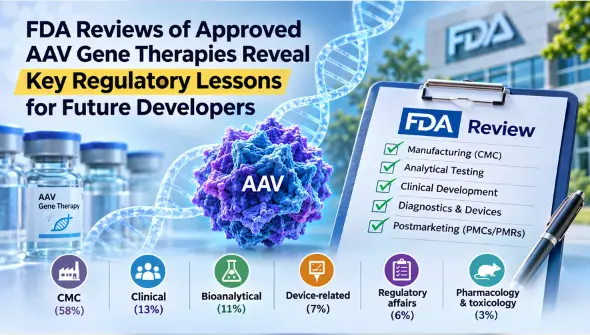
A new article in Nature Reviews Drug Discovery examines regulatory review patterns across approved adeno-associated virus (AAV) gene therapies, offering insights into manufacturing, analytical testing, clinical development and postmarketing requirements. The analysis highlights chemistry, manufacturing and controls (CMC) as the dominant area of FDA scrutiny, accounting for 58% of the information-request topics examined.
As AAV-based gene therapies advance through clinical development, understanding regulatory expectations is becoming increasingly important. A new publication, “Regulatory lessons from FDA review of approved AAV gene therapies,” brings together publicly available regulatory information and an anonymized analysis of FDA review communications to identify recurring challenges and lessons for future submissions.
Published in Nature Reviews Drug Discovery, the article is authored by Sojin Bing, Takele Argaw, Megha Kaushal and Ronit Mazor.
Learning from FDA reviews of approved AAV gene therapies
Between 2017 and 2025, the US Food and Drug Administration (FDA) approved eight AAV-based in vivo gene therapy products through biologics license applications (BLAs). By the end of 2025, the agency had also received more than 300 investigational new drug (IND) submissions involving AAV-based gene delivery.
Although these therapies use a shared viral delivery platform, they differ in capsid serotypes, therapeutic genes and manufacturing systems. The approved products include therapies based on AAV2, AAV5, AAV9, AAVrh74 and its engineered variant AAVrh74var.
To understand the regulatory challenges encountered during product review, the authors analysed FDA information requests (IRs) across seven AAV BLAs for which public information was available at the time of analysis.
The study examined 278 information-request communications covering 662 individual topics, providing a structured view of the scientific and regulatory questions raised during the review process.
Manufacturing and analytical testing dominate regulatory scrutiny
One of the most important findings was the prominence of chemistry, manufacturing and controls (CMC) in FDA reviews.
CMC-related issues accounted for 58% of all information-request topics, making manufacturing and analytical development the largest area of regulatory scrutiny.
The remaining topics were distributed across several disciplines:
- Clinical – 13%: Primarily focused on safety and adverse-event reporting.
- Bioanalytical – 11%: Included anti-AAV antibody assay validation, clinical correlations, viral shedding and biodistribution.
- Device-related – 7%: Addressed specialised administration devices and related regulatory considerations.
- Regulatory affairs – 6%.
- Pharmacology and toxicology – 3%.
These findings underline the importance of developing robust analytical methods, reliable product-characterisation strategies and consistent manufacturing processes early in AAV development.
For sponsors preparing future submissions, the results suggest that manufacturing readiness and analytical control strategies should be treated as central components of development rather than issues to be resolved shortly before regulatory filing.
Companion diagnostics and specialised devices require early coordination
AAV gene therapies may involve additional diagnostic tests or specialised administration devices that require regulatory coordination beyond the BLA itself.
The authors found that six of the eight approved products incorporated diagnostic assays or specialised devices requiring such coordination.
For example, anti-AAV antibody testing can be important for determining patient eligibility, while products such as Kebilidi involve custom surgical delivery devices requiring coordination between the FDA’s Center for Biologics Evaluation and Research (CBER) and Center for Devices and Radiological Health (CDRH).
The analysis highlights the value of integrating companion diagnostic development into early clinical planning rather than postponing it until the pre-BLA stage.
This is particularly relevant when patient selection, dosing safety or administration procedures depend on diagnostic testing or specialised equipment.
Postmarketing commitments: Regulatory work continues after approval
FDA approval does not necessarily mark the end of regulatory and development obligations. Postmarketing commitments (PMCs) and postmarketing requirements (PMRs) allow the agency to address remaining uncertainties and ensure continued product oversight.
The article distinguishes between the two:
- Postmarketing requirements (PMRs): Legally mandated studies or activities used when additional information is essential to verify or describe clinical benefit, assess known serious risks or identify unexpected serious risks.
- Postmarketing commitments (PMCs): Voluntary agreements between the applicant and FDA, often addressing manufacturing and analytical improvements that do not alter the established benefit–risk profile.
Across the seven BLA reviews, almost all approvals included multiple PMCs, with a median of six commitments per product.
Most commitments focused on CMC-related activities, including analytical method qualification, potency assay development and validation, and revisions to product acceptance criteria.
The median fulfilment timelines ranged from approximately two to four years, reflecting the technical complexity of these activities.
An important observation was that products with more CMC-related information requests before approval tended to have longer postmarketing commitment timelines. This suggests that analytical uncertainties identified during regulatory review can continue to influence development work after licensure.
Regulatory review patterns have evolved
The authors also observed a decline in the average number of information-request communications per application between the earliest and most recent BLA reviews, with the steepest reductions occurring in CMC-related topics.
This trend may reflect improved applicant readiness and changes in how multiple regulatory questions are consolidated into fewer communications.
However, the broader message remains clear: AAV gene therapy development requires close integration of manufacturing, analytical, clinical, quality, diagnostic and device-related activities.
What can future AAV developers learn?
The analysis offers several practical lessons for sponsors developing AAV-based therapies:
- Prioritise CMC early: Manufacturing consistency, product characterisation and analytical assay development are major regulatory considerations.
- Strengthen analytical strategies: Potency assays, analytical validation and product acceptance criteria require careful planning.
- Integrate diagnostics and devices: Companion diagnostics and specialised administration systems should be considered early in clinical development.
- Plan beyond approval: Postmarketing commitments and requirements should be incorporated into product lifecycle planning.
- Encourage cross-functional development: Manufacturing, clinical, quality, bioanalytical and regulatory teams need to work together throughout development.
A practical resource for the next generation of gene therapies
As the AAV gene therapy field expands, regulatory experience from approved products can provide valuable guidance for developers preparing the next generation of treatments.
By examining information requests and postmarketing obligations across multiple FDA reviews, this publication offers a useful perspective on the issues that can shape regulatory outcomes. Its findings also reinforce the importance of early analytical alignment, manufacturing readiness and lifecycle planning.
For researchers, biotechnology companies and regulatory professionals working in gene therapy development, the article provides a valuable resource for understanding how scientific and manufacturing decisions translate into regulatory expectations.
Read the publication:
Regulatory lessons from FDA review of approved AAV gene therapies – Nature Reviews Drug Discovery
The authors also highlight the Supplementary Information, which contains detailed discipline-level breakdowns, product timelines and postmarketing data.
Note: The analysis covers seven BLA reviews with publicly available information at the time of the study; its findings should not be interpreted as a complete account of every FDA review or as a universal checklist for all gene therapy products.