



Small peptide (miPEP408) orchestrating the bigger role of plant defense
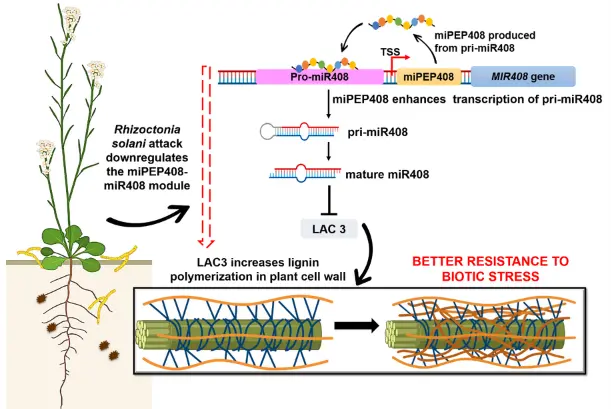
Research Summary: Rhizoctonia solani (R. solani) attack suppresses the miPEP408-mediated mature miR408 accumulation, upregulating the expression of its major target- Laccase 3 (LAC3) which reinforces plant cell walls with enhanced lignification to restrict the pathogen’s invasion.
Researcher Spotlight
Tapasya Datta is a plant molecular biology researcher focusing on small regulatory peptides, non-coding RNAs, and stress resilience modules to build climate- and disease-resilient crop systems.
Linkedin: www.linkedin.com/in/tapasya-datta-a021241b1
Twitter: @tapasya_datta
Instagram: tapasyadatta
Lab PI name: Dr. Prabodh Kumar Trivedi
University: CSIR-Central Institute of Medicinal and Aromatic Plants (CSIR-CIMAP), Lucknow, India
Lab social media: prabodhslab
What was the core problem you aimed to solve with this research?
While miPEPs are known to regulate developmental processes, primary and secondary metabolism, and abiotic stress responses, their specific roles against major biotic pathogens remained largely uncharacterized. miPEP408 was previously implicated in heavy metal tolerance and sulfur assimilation, raising a pivotal question: how does miPEP408 modulate host immunity during the Arabidopsis–Rhizoctonia solani interaction?
How did you go about solving this problem?
We employed an integrated molecular and genetic approach in Arabidopsis thaliana:
- DNA-Protein Interaction & Localization: Assayed the direct binding of miPEP408 to the MIR408 promoter using ChIP-qPCR, yeast one-hybrid (Y1H) assays, and EMSA, complemented by in silico molecular docking and FAM-labeled peptide uptake studies.
- Transgenic Functional Genetics: Generated and evaluated miPEP408 overexpression (miPEP408OX), CRISPR/Cas9 knockouts (miPEP408CR), LAC3OX, and lac3CR lines to monitor plant phenotypes under R. solani challenge.
- Biochemical & Cell Wall Profiling: Quantified mature miR408 levels via stem-loop RT-qPCR, monitored miPEP408 protein abundance by Western blotting, and examined lignin deposition using phloroglucinol and basic fuchsin staining, total thioglycolic acid lignin assays, and LC-MS monolignol precursor profiling.
- Pathology & Stress Assays: Assessed fungal colonization and biomass via EGFP-tagged R. solani confocal microscopy and ITS qPCR in the plants with modulated levels of miPEP408 and LAC3, paired with ROS detection (NBT/DAB staining) and lipid peroxidation (MDA) assays to study the R. solani induced ROS-build up in the respective lines.
“Uncovering this miPEP408-mediated regulatory switch reveals how plants dynamically balance growth trade-offs to erect rapid structural shields against destructive soil-borne pathogens.” – Dr. Prabodh Kumar Trivedi
How would you explain your research outcomes (Key findings) to the non-scientific community?
To understand our findings, we first need to recall the ‘Old Dogma’ of gene silencing. For decades, microRNAs, or miRNAs, have been known as the master post-transcriptional gene silencing factors. These small RNA molecules function by binding to a target messenger RNA, leading to its destruction or blocking its translation. Critically, the long primary transcript, the pri-miRNA, was seen only as a necessary precursor to the mature, functional miRNA.
What came as a ‘New Twist’ in gene regulation in plants: is the recent discovery by Lauressergues et al., 2015, that the pri-miRNA transcript houses a Small Open Reading Frame, or sORF in its upstream region that is translated by the ribosome to produce a small, functional peptide, miRNA-encoded peptide, or miPEP. These miPEPs enhance the transcription of their corresponding pri-miRNA, consequently increasing the overall accumulation of the mature microRNA, even when treated with synthetic miPEPs. Next the world of miPEPs in plants, exploded with reports of their roles in development e.g., At-miPEP165a in Arabidopsis thaliana or Mt-miPEP171b in Medicago truncatula, as well as in abiotic stress responses such as the salinity stress responsive miPEP172b in Oryza sativa. Emerging literature shows that certain peptides, like miPEP169 and miPEP396, enhance resistance against foliar pathogens like Botrytis cinerea. However, how such fungal pathogens interface with miPEP signaling remains largely uncharacterized. This led directly to look into the plausible role of miPEP408 in regulating responses towards biotic stress.
But, before we dived into miPEP408’s role into biotic stress, firstly we investigated the molecular mechanism governing the transcription of miR408. Therefore,
- Finding 1: Unravelling the Direct Molecular Switch: Using DNA–protein interaction assays (ChIP-qPCR, yeast one-hybrid, and EMSA), we showed that miPEP408 physically and directly binds to two specific DNA motifs in the MIR408 gene’s promoter, directly driving the transcription of pri-miR408.
- Finding 2: Pathogen-Triggered Downregulation of this Molecular Switch: Upon R. solani attack Western Blot data clearly indicated a significant reduction in miPEP408 protein levels in infected seedlings. Simultaneously, GUS staining revealed that the MIR408 gene’s promoter activity is also strongly suppressed by the fungal presence. This suggests the plant’s immediate and deliberate defensive action is to suppress the miPEP408-miR408 pathway.
- Finding 3: The Lignin Defense Shield: If the plant suppresses miPEP408, it must be doing so to activate a stronger defense. That defense is lignin. Lignin is a complex polymer that rigidifies the cell wall, acting as a physical shield that prevents fungal hyphae from penetrating the tissue. Results clearly showed that R. solani infection naturally induces this lignification defense.
- Finding 4: miPEP408 Acts as a NEGATIVE regulator, a ‘brake’ on this Shield: Normally, miPEP408 stimulates miR408 accumulation, which targets and degrades the mRNA of LACCASE 3 (LAC3)—a critical enzyme catalyzing lignin polymerization. Consequently, miPEP408OX plants produce less lignin and suffer severe tissue decay upon R. solani attack, whereas CRISPR knockouts (miPEP408CR) accumulate abundant lignin and display robust fungal resistance. This suggested that suppressing miPEP408 upon fungal attack releases the brake on LAC3, allowing rapid structural defense assembly.
What are the potential implications of your findings for the field and society?
This work unveils a previously unknown defense paradigm wherein an autoregulatory microRNA encoded peptide circuit is actively turned down upon infection to release target gene repression, driving rapid cell wall lignification.
Rhizoctonia solani being a devastating soil-borne pathogen responsible for severe damping-off and stem/root rot across critical food and cash crops is a major threat to global agriculture. Because conventional chemical fungicides carry substantial ecological and economic implications, targeting the miPEP408–miR408–LAC3 regulatory axis offers a promising target for engineering an inducible genetic loop that optimizes resource allocation during normal growth while ensuring robust, disease-resilience in crops.
What was the exciting moment during your research?
Among the several exciting moments through this roller-coaster ride, the defining breakthrough occurred when we observed the stark phenotype contrast after R. solani challenge: while the overexpressing lines of miPEP408 or miR408 succumbed to damping-off, the CRISPR-knockout plants stood resilient with heavily fortified cell walls. Further, directly proving via ChIP-qPCR and Y1H assays that a tiny peptide like miPEP408 of 35 amino acids physically binds to its own gene promoter to control cell-wall lignification brought the entire biological cascade into crisp focus.
Paper reference: Datta, T., Shromona, A., Kumar, R. S., Sinha, H., Dwivedi, A., Rai, T., Gupta, S., Ch, R., Srivastava, S., Singh, A. & Trivedi, P. K. (2026). The miPEP408-miR408 module regulates plant susceptibility to Rhizoctonia solani through LAC3-mediated lignin deposition in Arabidopsis. Plant Communications, 102127.