


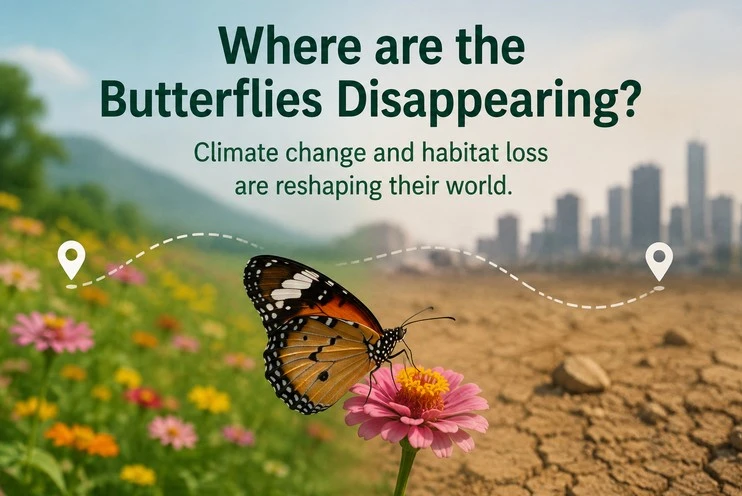
How climate change and habitat loss are reshaping butterfly ranges—and what these movements reveal about ecosystem health
Imagine that one day you see a beautiful butterfly in your garden, but it is a species that you have never seen before. At first, it may look exciting and interesting. But if that butterfly has reached your area because its natural habitat has become too hot, dry or unsuitable, then it is actually a warning sign for us. It shows that the balance of nature is changing or disturbed.
Butterflies are very sensitive to changes in their surroundings. They depend on particular plants for food and for laying their eggs. Therefore, even a small change in temperature, rainfall or vegetation can affect their survival. Climate change and the destruction of natural habitats are now forcing many butterflies to move away from their traditional areas.
This movement of species from one region to another is sometimes called ‘species range shift’. A recent global study of butterfly species found that many species are changing their geographical ranges. The study covered butterflies from 105 countries and around 1758 species. According to the findings, nearly 80% of the species studied have expanded their distribution, while about 27% have lost part of their previous range.
In my opinion, this is not simply a change in the location of butterflies. It tells us something important about the condition of our environment. Butterflies are closely connected with plants because their larvae often depend on particular plants, while adult butterflies need flowers for nectar. So, when plants disappear because of construction, deforestation or changes in climate, butterflies are also affected.
The common emigrant butterfly, which was traditionally found in the Indian subcontinent, has now been observed much earlier towards Southeast Asia and Australia. Scientists believe that climate change is an important factor behind such movements. However, cutting of forests, increasing cities and destruction of natural habitats are also playing a major role.
Therefore, conservation should not only mean protecting the places where animals live today. We should also think about the future movement of species. New suitable habitats should be protected and connected through wildlife corridors, so that animals and insects can move safely when environmental conditions change.
If we fail to do this, we may save the nature that exists today, but lose the natural world that future generations are supposed to experience. Protecting butterflies may seem like a small step, but in reality it is also a step towards protecting the balance of our entire ecosystem.
About the Author
Arti is a second-year B.Sc. Life Sciences student at D.A.V. College (Lahore), Ambala City. She is passionate about biology, nature, biodiversity, and environmental issues. Through her writing, Arti aims to share simple and meaningful perspectives on nature and encourage people—especially students—to develop greater awareness of environmental conservation.