



LncRNA TAAL Regulates TIE1 in Diabetic Retinopathy
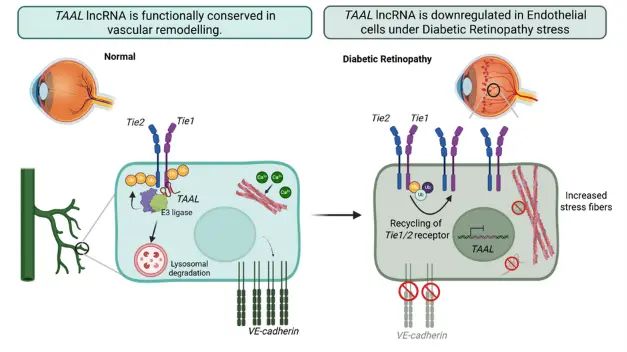
Research Summary: We identified a novel long noncoding RNA, TAAL, that regulates TIE1 protein stability and vascular integrity, emerging as a potential biomarker and therapeutic target for diabetic retinopathy.
Researcher Spotlight
Gyan Ranjan was a postdoctoral researcher in Dr. Rajender Motiani’s laboratory at the Regional Centre for Biotechnology (RCB), Faridabad, with a primary research focus on cardiovascular biology and zebrafish modelling.
Linkedin https://www.linkedin.com/in/gyan-ranjan-b0286228/
Twitter https://x.com/gyanranjan2197
Lab PI name: Dr. Rajender Motiani
University: Regional Centre for Biotechnology, Faridabad, India
Lab social media: https://www.linkedin.com/company/calciomicsgroup-rcb/posts/?feedView=all
What was the core problem you aimed to solve with this research?
Scientifically, our core challenge was uncovering the complex regulatory interactome and molecular mechanisms of long noncoding RNAs (lncRNAs) that govern TIE1, an essential endothelial receptor for vascular remodeling and diabetic retinopathy (DR). Because a lncRNA’s function is heavily dictated by its interacting partners, discovering and validating these meaningful biological connections is notoriously difficult and time-consuming.
Clinically and socially, this addresses a critical barrier: particularly in resource-limited settings and lower-income communities in India, screening for diabetic retinopathy is difficult and costly, which means the disease is frequently diagnosed late in life when patients’ vision is already at severe risk.
How did you go about solving this problem?
We performed a protein-centric RNA immunoprecipitation sequencing approach of TIE1 in human umbilical vein endothelial cells to identify interacting lncRNAs. We functionally characterised TAAL through knockdown and overexpression assays (examining migration, proliferation, tube formation, permeability, calcium homeostasis, cytoskeletal dynamics, and ubiquitin-mediated protein turnover). We also evaluated its functional conservation using zebrafish morpholino knockdown and human TAAL complementation. Finally, we investigated clinical relevance using human cadaveric retinal tissues, peripheral blood samples from diabetic retinopathy patients across multiple clinical stages, and a hyperglycemic zebrafish DR model.
“Our work reveals TAAL lnc-RNA as a potential biomarker and therapeutic target for Diabetes associated retinopathy” – Dr. Rajender Motiani
How would you explain your research outcomes (Key findings) to the non-scientific community?
Let’s think of our blood vessels as tubes that rely on specific control switches to stay strong and prevent leaking. We discovered a molecule called TAAL that acts as a key manager for one of these important switches (called TIE1).
When someone has diabetes, high blood sugar(hyperglycemia) shuts down TAAL in the cells that line our blood vessels (endothelial cells). This causes the vessels to become weak, damaged, and leaky, which is a major hallmark of diabetic retinopathy, a condition that can lead to blindness. Interestingly, while TAAL drops inside those vessel cells, we found it at higher levels in the circulating blood and retinal tissues of patients with diabetic retinopathy, meaning it could act as an early warning sign.
Most importantly, when we experimentally boosted TAAL levels in the back up in the endothelial cells in our laboratory and also in live zebrafish models, it successfully repaired the leaky blood vessels and protected their structural health.
What are the potential implications of your findings for the field and society?
TAAL has significant potential to serve as a minimally invasive, blood-based circulating biomarker for early detection and disease progression monitoring in diabetic retinopathy. Furthermore, it opens up avenues as a therapeutic target for RNA-based interventions designed to preserve vascular barrier integrity and prevent vision loss in diabetic patients.
What was the exciting moment during your research?
A particularly striking moment was discovering that despite a lack of linear sequence conservation between human and zebrafish TAAL, introducing human TAAL into zebrafish successfully rescued the severe angiogenic defects caused by zebrafish taal knockdown, demonstrating the deep evolutionary and functional conservation of this lncRNA in vivo. Another exciting milestone was finding that TAAL was significantly elevated in patient blood samples with high sensitivity and specificity for detecting diabetic retinopathy stages which can become a minimally invasive biomarker.
Paper reference: Ranjan, G., Arora, S., Sharma, S., Bhoyar, R.C., Senthivel, V., Narula, R., Scaria, V., Chakrabarti, S., Kaur, I., Sivasubbu, S. and Motiani, R.K., 2026. LncRNA TAAL Regulates TIE1-Mediated Vascular Remodeling and Is Associated With Diabetic Retinopathy. Arteriosclerosis, Thrombosis, and Vascular Biology. https://www.ahajournals.org/doi/10.1161/ATVBAHA.126.324094