


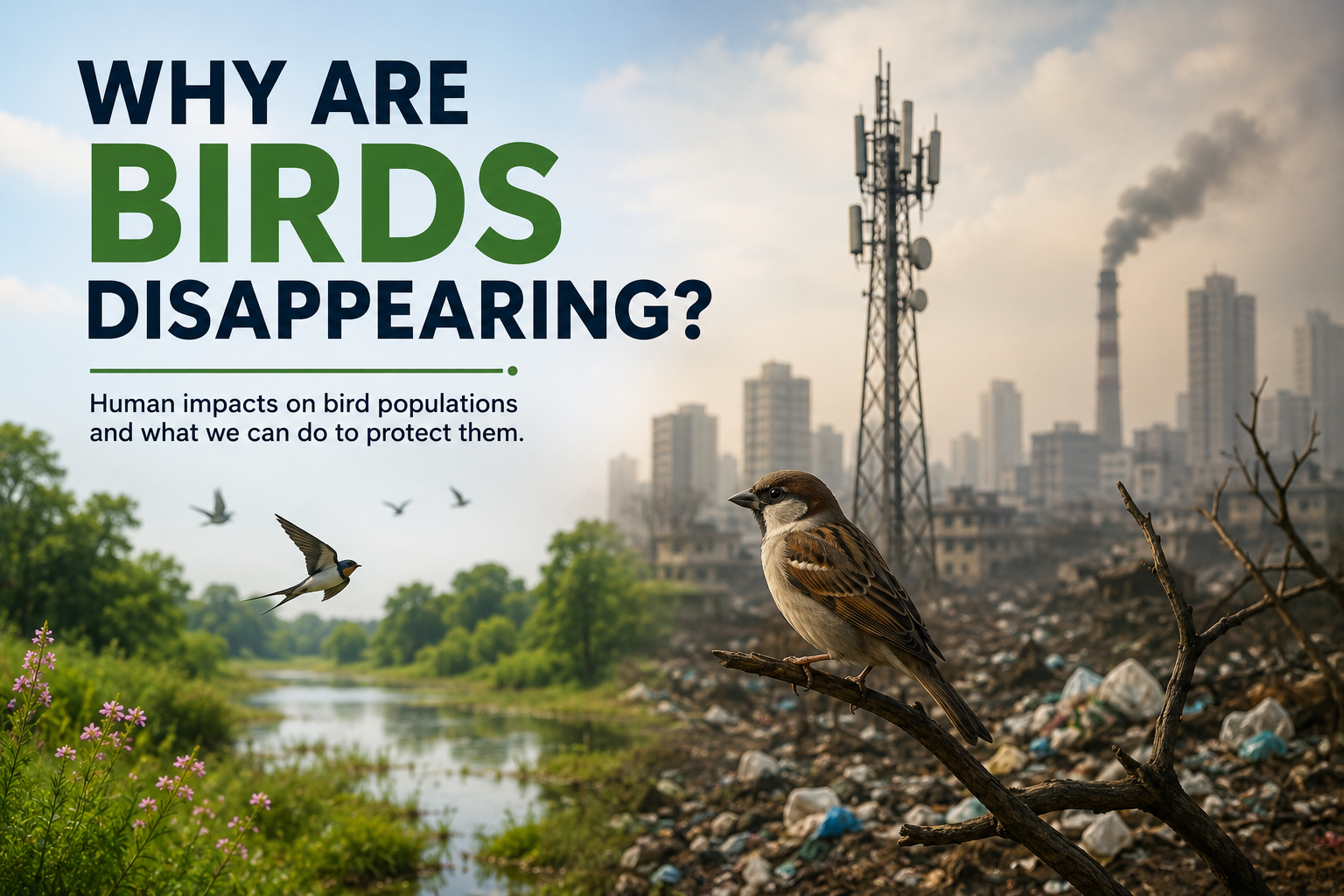
WHEN THE SKY FALLS SILENT : The Human Footprint Behind the Decline of Birds
There was a time when the morning sound of birds was almost impossible to miss. Sparrows around houses, mynas on rooftops, bulbuls in gardens and many other birds were a normal part of everyday life. Today, however, many people feel that these familiar sounds are becoming less common. The decline of bird populations is not simply a change in the number of birds we see around us; it is a warning about the condition of our environment.
Birds are considered important indicators of ecosystem health because they respond quickly to changes in their surroundings. The State of India’s Birds assessment, based on more than 30 million observations, has shown concerning long-term trends for many Indian bird species. Its findings also point towards several pressures, including land-use change, urbanisation, ecosystem degradation, infrastructure development, pollution and climate change.
So, why are birds disappearing from places where they were once common? The answer is not one single factor. Instead, it is a combination of changes that humans have introduced into the natural environment.
1. Loss of Habitat: Taking Away Their Homes
The most important reason for bird decline is the loss and degradation of natural habitats. Birds need specific places for feeding, nesting, breeding and resting. Forests, grasslands, wetlands, agricultural fields and even small patches of vegetation can provide these resources.
Rapid urbanisation has converted many open spaces, wetlands and green areas into buildings, roads and other infrastructure. Similarly, forests are cleared for agriculture, industries, mining and development projects. When a habitat disappears, birds lose much more than a place to live—they lose food sources, nesting sites and safe breeding areas.
Globally, habitat conversion and degradation are among the strongest pressures on threatened birds. Agriculture, logging and development have changed landscapes on a massive scale.
2. Modern Agriculture and Pesticides
Agriculture provides food for humans, but intensive agricultural practices can create problems for birds. Excessive use of pesticides and other chemicals can reduce insects and other organisms that form an important part of the diet of many birds.
When insects disappear, insect-eating birds may struggle to find enough food. Some chemicals can also enter food chains and affect birds directly or indirectly. India has already witnessed a dramatic example in the decline of vultures associated with the veterinary drug diclofenac. The State of India’s Birds report has also highlighted concerns regarding environmental toxins and pesticides.
The increasing replacement of diverse agricultural landscapes with monocultures can further reduce the variety of food and shelter available to birds.
3. Network Towers and Artificial Structures
Modern communication has connected the world, but some communication infrastructure can create risks for birds, especially migratory species.
The major concern with communication towers is not simply their existence but their height, location, supporting wires and lighting. Birds migrating at night can become attracted or disoriented by artificial lights. They may circle around illuminated towers and eventually collide with the tower, wires or nearby structures.
The U.S. Fish and Wildlife Service identifies communication towers as a significant collision hazard for migratory birds and recommends reducing unnecessary steady-burning lights because such lighting can increase collision risk.
There has also been scientific interest in whether radiofrequency electromagnetic fields can influence birds. Some studies have reported possible effects on behaviour or other biological processes, but the evidence is not yet strong enough to say that electromagnetic radiation from mobile towers is a proven major cause of bird population decline. More well-designed field research is required.
Therefore, it is more scientifically accurate to discuss network towers in terms of collision, lighting and habitat disturbance, while treating direct electromagnetic effects as a continuing research question.
4. Climate Change: Changing the Timing of Nature
Climate change is another growing pressure on bird populations. Rising temperatures, changing rainfall patterns, droughts, heatwaves, storms and wildfires can alter habitats and food availability.
Many birds depend on seasonal events. For example, a bird may migrate when food becomes available or breed when insects and other food resources are abundant. If climate change causes plants to flower earlier or insects to appear at different times, birds may arrive after the peak availability of food.
This mismatch can affect reproduction and survival. According to BirdLife International, climate change already affects a substantial proportion of threatened bird species, while extreme weather events are expected to increase the pressure on vulnerable populations.
5. Pollution: An Invisible Threat
Pollution affects birds in several ways. Plastic waste, polluted water, pesticides, industrial chemicals and air pollution can damage ecosystems and reduce the availability of safe food and water.
Light pollution is another less-discussed problem. Artificial lights from buildings, roads, advertisements and towers can disturb the natural day-night cycle. This is especially important for migratory birds that travel at night and use natural environmental cues for navigation.
Noise pollution can also interfere with bird communication. Birds use calls to attract mates, defend territories and warn others of danger. Continuous traffic, construction and urban noise may make these signals more difficult to hear.
6. Buildings, Glass and Roads
Our cities are becoming taller and more crowded, creating another danger for birds. Transparent or reflective glass can look like open sky or vegetation to a flying bird. As a result, birds may collide with windows at high speed.
Roads and other transport infrastructure create additional risks through collisions, habitat fragmentation and disturbance. Linear infrastructure such as roads, railways and power lines has been recognised as one of the pressures affecting birds.
These are often overlooked because individual incidents may appear small. However, repeated mortality across large populations can become significant.
7. Hunting, Trapping and Illegal Trade
Despite conservation laws, hunting and trapping continue to affect some bird species. Birds may be captured for the pet trade, food or other purposes. Migratory birds are particularly vulnerable because they cross several regions and countries during their journeys.
The problem becomes more serious when hunting is combined with habitat loss and other environmental pressures. A population that is already declining may have difficulty recovering from additional mortality.
8. Invasive Species and Diseases
Human activities can also introduce species into environments where they do not naturally occur. Invasive species may compete with native birds for food and nesting sites or alter ecosystems.
Diseases can create another challenge, particularly when birds are already stressed by habitat degradation and changing environmental conditions. Climate change may also alter the distribution of disease-causing organisms and their hosts.
Bird Decline Is a Warning for Humans Too
The disappearance of birds should not be considered only a problem for bird lovers. Birds perform important ecological functions. They control insect populations, disperse seeds, pollinate some plants and contribute to the functioning of food webs.
Birds can therefore be viewed as an ecological alarm system. If bird populations begin to decline, it may indicate that something is changing in the wider ecosystem.
The global situation is also concerning. BirdLife International reports that nearly half of the world’s bird species are in decline and identifies human-driven pressures such as agricultural expansion, logging, climate change and other forms of habitat degradation as major causes.
What Can We Do?
The decline of birds is serious, but it is not irreversible. Conservation efforts can make a difference when they address the actual causes of decline.
Urban areas can provide native trees, shrubs, nesting spaces and water sources. Unnecessary artificial lighting can be reduced, especially during periods of bird migration. Communication towers can be designed and operated in more bird-friendly ways. Glass buildings can incorporate bird-safe designs. Farmers can reduce unnecessary pesticide use and maintain vegetation around agricultural landscapes.
Most importantly, wetlands, forests, grasslands and other important habitats must be protected from unnecessary destruction. Scientific monitoring is equally important because we cannot protect species effectively if we do not understand how their populations are changing.
Conclusion
Birds are not disappearing because nature has suddenly become weaker. In many cases, the environment around them has changed faster than they can adapt.
Every new road, building, tower, chemical, polluted water body or lost forest may appear insignificant when considered separately. But together, these changes create a landscape that is increasingly difficult for birds to survive in.
The question, therefore, is not simply “Why are birds declining?” The more important question is “What kind of environment are we creating for them—and for ourselves?”
A sky without birds would not only be quieter; it would be a sign that our ecosystems are becoming less healthy. Protecting birds means protecting the habitats, food chains and ecological balance on which all life depends. If we want to continue hearing birds in our mornings, conservation cannot remain only a responsibility of scientists and governments. It has to become a part of the way we build, farm, travel and live.
The silence of the sky should not become the sound of our future.
About the Author
Palak Arora is a second-year B.Sc. (Life Science) student at DAV College (Lahore), Ambala City. Alongside her undergraduate studies, she is preparing for competitive government examinations. With an interest in biological sciences and environmental issues, she enjoys exploring how human activities influence living organisms and ecosystems. Through this article, she aims to encourage readers, especially young people to look beyond the visible beauty of birds and understand the ecological importance of protecting their habitats.