

Garlic Compound Found to Improve Age-Related Muscle Function Through Brain–Fat Communication Pathway
For centuries, garlic has been celebrated in traditional medicine systems across the world for its health-promoting properties. Now, researchers have uncovered a molecular mechanism that may explain some of those benefits.
A study published in Cell Metabolism reports that a naturally occurring compound derived from aged garlic extract can activate a signaling pathway linking fat tissue, the brain, and skeletal muscle, ultimately improving muscle function in aged mice.
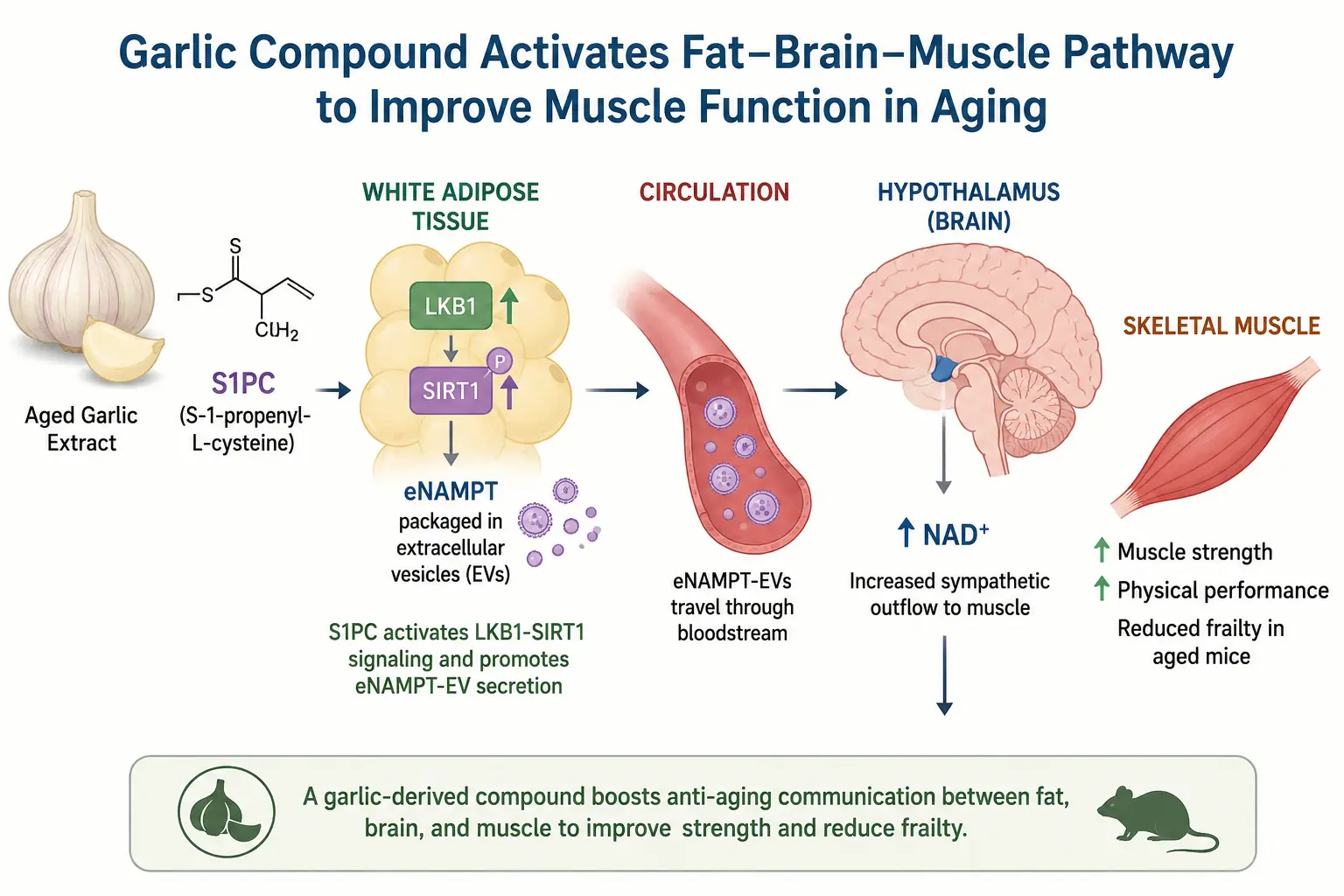
The compound, known as S-1-propenyl-L-cysteine (S1PC), was found to stimulate the release of an anti-aging protein from white adipose tissue and improve physical performance in older animals. The findings also provide early evidence that the same molecule may influence this pathway in humans.
Unlocking a New Role for Garlic
Garlic (Allium sativum) has long been associated with a range of health benefits, including cardiovascular protection, anti-inflammatory effects, and improved metabolic health. Among the many bioactive compounds present in garlic and aged garlic extract, S1PC has recently attracted attention for its potential role in mitochondrial function and vascular health.
However, exactly how S1PC exerts its biological effects has remained largely unknown.
In the new study, researchers discovered that S1PC activates a key metabolic regulator called liver kinase B1 (LKB1). LKB1 is known to influence multiple cellular processes, including energy metabolism and aging-related pathways.
The team found that S1PC promotes the assembly of a three-protein complex involving LKB1, STRAD, and MO25, leading to activation of the enzyme and subsequent stimulation of SIRT1, a protein often linked to healthy aging and longevity.
Fat Tissue as an Anti-Aging Organ
One of the most surprising findings of the study was the central role played by white adipose tissue.
Rather than simply storing excess calories, fat tissue is increasingly recognized as an active endocrine organ that releases signaling molecules influencing the function of distant organs.
Researchers showed that activation of the LKB1-SIRT1 pathway in adipose tissue increased the secretion of extracellular nicotinamide phosphoribosyltransferase (eNAMPT), a key enzyme involved in NAD⁺ metabolism.
Importantly, eNAMPT was packaged into extracellular vesicles and released into the bloodstream, allowing it to act as a long-distance messenger.
A Fat-to-Brain-to-Muscle Communication Network
The study revealed an unexpected communication pathway between fat tissue, the hypothalamus, and skeletal muscle.
Rather than acting directly on muscle, eNAMPT released from adipose tissue traveled to the hypothalamus, a brain region responsible for regulating metabolism and physiological homeostasis.
This increased NAD⁺ production within the hypothalamus and enhanced sympathetic nervous system signaling to skeletal muscle.
As a result, aged mice receiving S1PC showed significantly improved muscle strength and reduced frailty scores compared with untreated animals.
“Our findings suggest that adipose tissue can communicate with the brain to influence muscle aging,” the researchers noted.
Evidence in Humans
To explore whether the pathway may also exist in humans, investigators conducted a small human study.
They found that a single dose of S1PC increased circulating levels of eNAMPT in middle-aged individuals who maintained healthy adipose tissue mass.
Although muscle performance was not assessed in the human participants, the results suggest that the biological pathway identified in mice may also be active in people.
Not a Fountain of Youth
While the findings are exciting, the researchers caution that several important questions remain unanswered.
The study was conducted primarily in mice, and it remains unclear which specific hypothalamic neurons respond to eNAMPT signaling. Long-term human studies will also be needed to determine whether S1PC supplementation can meaningfully improve muscle strength, frailty, or healthy aging.
The authors also note that sex-specific responses and additional biological mechanisms require further investigation.
Implications for Healthy Aging
Age-related loss of muscle strength, often referred to as sarcopenia, is one of the major contributors to frailty and loss of independence in older adults.
The discovery that a naturally occurring garlic-derived molecule can influence an adipose-brain-muscle communication network opens new possibilities for developing nutritional interventions targeting healthy aging.
The researchers also suggest that combining S1PC with NAD⁺-boosting compounds such as NMN may further enhance the activity of the LKB1-SIRT1 pathway, although this remains to be tested in clinical studies.
While it is too early to recommend S1PC as an anti-aging therapy, the study provides compelling evidence that compounds found in everyday foods may influence complex biological networks involved in aging.
As scientists continue to unravel the molecular language through which organs communicate, garlic may once again prove that ancient remedies can inspire modern biomedical discoveries.
Reference
Garlic-derived metabolite activates LKB1, promotes adipose eNAMPT secretion, and improves age-related muscle function via hypothalamic signaling. Cell Metabolism (2026).
Book Launch: Molecules, Mentors & Mindsets: Building Indian Biopharma | Biocon Focus