


BioWave 2026: As science, capital and policy converge, India’s biotech ecosystem enters a new era
At BioWave 2026, entrepreneurs, investors and policymakers argued that the country’s next biotechnology milestone will depend not on scientific capability alone, but on building an innovation ecosystem where breakthrough research, patient capital and enabling regulation evolve together.
7 Key Highlights from BioWave 2026
- Science, capital and policy must converge to accelerate biotech innovation.
The conference emphasized that India’s next phase of biotechnology growth will depend on stronger collaboration between academia, startups, investors, industry and government to translate breakthrough science into globally competitive companies. - The ecosystem is shifting from scientific capability to commercialization.
Speakers agreed that India has established strong research capabilities and entrepreneurial talent. The focus has now moved toward scaling innovation through translational research, manufacturing infrastructure, supportive regulation and patient capital. - Human Health startups showcased globally relevant innovation.
Founders from Bugworks Research, Eyestem Research, Peptris Technologies and InnAccel Technologies demonstrated how Indian startups are developing first-in-class antibiotics, regenerative medicine, AI-enabled drug discovery platforms and affordable medical technologies designed for global markets. - Artificial intelligence is becoming an accelerator—not a replacement—for biology.
Across both healthcare and industrial biotechnology discussions, panelists emphasized that AI should enhance biological research, improve drug discovery and optimize biomanufacturing while remaining grounded in strong scientific understanding. - Planetary Health emerged as a major biotechnology opportunity.
Discussions highlighted the role of synthetic biology, microbial engineering and biomanufacturing in reducing fossil fuel dependence, advancing sustainable manufacturing and creating new bio-based industries for future economic growth. - Investment has improved, but growth-stage funding remains a bottleneck.
Venture capitalists noted that while early-stage biotech funding has expanded significantly, companies advancing into clinical development and commercialization still face a shortage of patient, long-term capital to bridge the “valley of death.” - BioWave 2026 reflected a maturing biotechnology ecosystem with global ambitions.
The conference concluded that India’s biotechnology sector has moved beyond low-cost innovation and is increasingly focused on developing globally competitive products and companies through original science, strategic partnerships and ecosystem-wide collaboration.
Bengaluru | July 9, 2026
Around the world, biotechnology is increasingly being recognized as a strategic technology alongside artificial intelligence, semiconductors and quantum computing. Governments are investing heavily in domestic biomanufacturing, precision medicine and synthetic biology to strengthen economic competitiveness, healthcare resilience and national security. The United States has expanded support for biomanufacturing through federal initiatives, Europe continues to accelerate industrial biotechnology, while China has elevated biotechnology to a strategic national priority with sustained investments across research, manufacturing and commercialization.
Against this backdrop, BioWave 2026 offered a timely snapshot of how India’s biotechnology ecosystem is positioning itself within this rapidly evolving global landscape.
Held in Bengaluru, the second edition of the annual conference—organized by C-CAMP, Omnivore, SOSV, Nucleate, and supported by the Wadhwani Foundation—brought together startup founders, venture investors, researchers, industry leaders and policymakers for a day-long discussion that extended well beyond startup success stories. Instead, conversations focused on a more fundamental question: how can one of the world’s fastest-growing biotechnology ecosystems transform scientific excellence into globally competitive companies capable of delivering breakthrough medicines, medical technologies and sustainable biological manufacturing platforms?
Unlike many startup conferences that celebrate fundraising milestones or product launches, BioWave emphasized the broader architecture required to sustain innovation. Throughout keynote addresses and panel discussions, a consistent message emerged. The scientific foundations already exist. Entrepreneurial talent is stronger than ever. Venture capital is becoming increasingly sophisticated. The remaining challenge lies in connecting these strengths through supportive regulation, translational infrastructure and long-term collaboration.
In many ways, the conference reflected an ecosystem moving from adolescence to maturity.
A decade ago, conversations about biotechnology entrepreneurship often centered on whether cutting-edge innovation could emerge from India at all. Today, founders are advancing first-in-class antibiotics, regenerative therapies, AI-enabled drug discovery platforms and globally relevant medical devices. The discussion has shifted from proving scientific capability to building companies capable of competing internationally.
Beyond a $300 billion bioeconomy
Opening the conference, Dr. Taslimarif Saiyed, Director and CEO of C-CAMP, framed BioWave as far more than an annual gathering of entrepreneurs and investors. Instead, he described it as a platform designed to connect scientific discovery with commercial execution.
“BioWave has established itself as a flagship platform to ignite a convergence of validated, nurtured and impactful science stories on the one hand, and the VC investment community on the other, so that scientific conviction meets sound business legs.”
His keynote reflected the remarkable transformation of the country’s biotechnology landscape over the past decade.
The bioeconomy has expanded far more rapidly than many earlier projections anticipated, surpassing previous milestones ahead of schedule. While reaching a US$300 billion bioeconomy remains an important national objective, Saiyed argued that numerical targets alone will not define long-term success. The more pressing challenge is building stronger connections between scientific institutions, entrepreneurs, investors, manufacturers and policymakers.
Across the country, islands of excellence have emerged independently. Research institutions continue to produce globally competitive science. Government initiatives, particularly through BIRAC and allied organizations, have strengthened translational research. Venture investors are increasingly willing to support deep-technology startups. Entrepreneurs are tackling problems once considered too ambitious for young biotechnology companies.
Yet these strengths often operate in parallel rather than as an integrated innovation ecosystem.
“The need now,” Saiyed emphasized, “is convergence.”
For him, BioWave represents an attempt to create precisely that convergence—bringing academia, industry, investors, government agencies and startup founders into sustained dialogue capable of accelerating scientific translation.
His message established a theme that resurfaced repeatedly throughout the day: scientific capability is no longer the principal constraint. Building effective connections between ecosystem stakeholders has become the next competitive advantage.
A second generation of biotechnology entrepreneurs
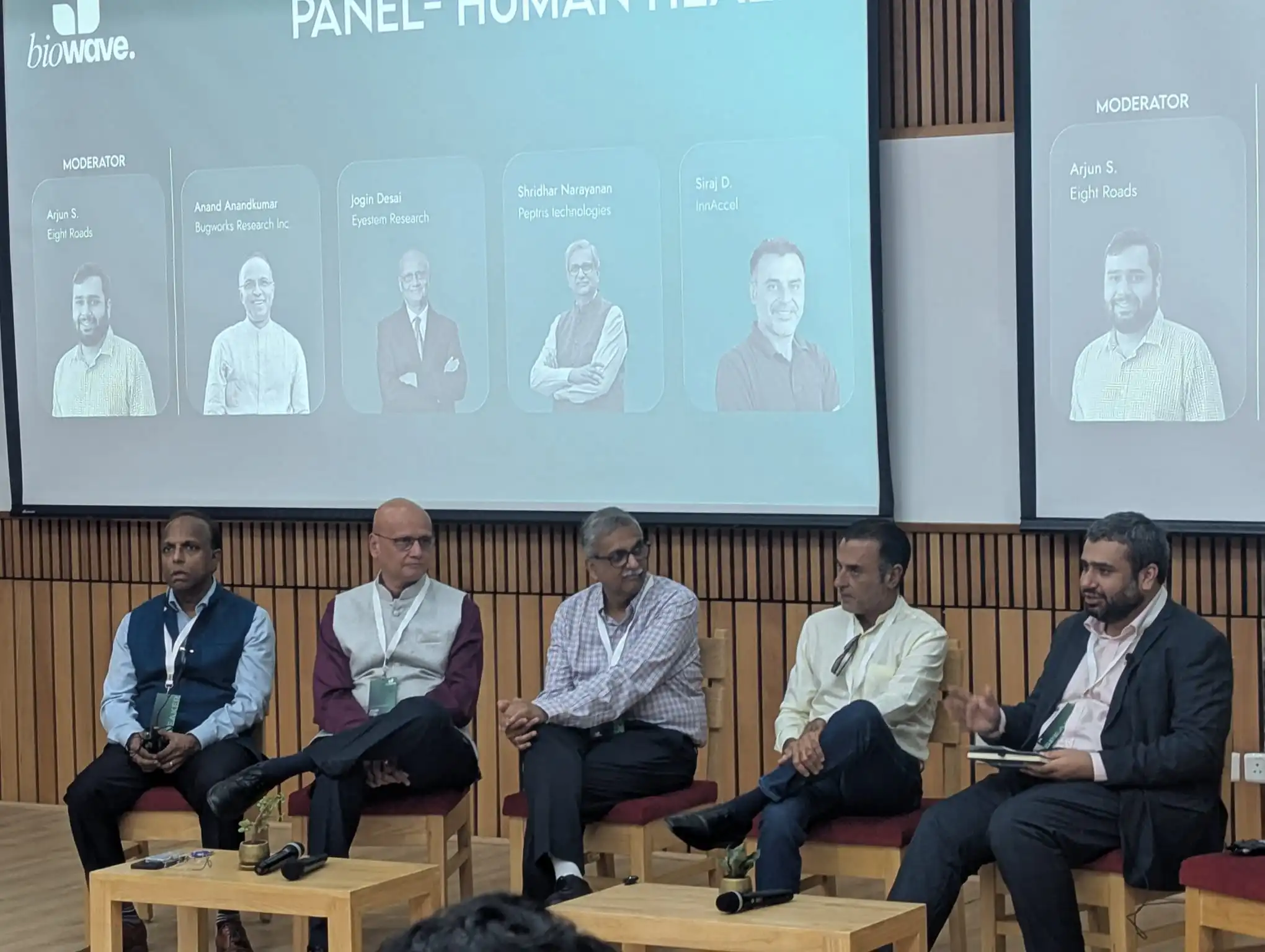
The conference’s opening Human Health discussion illustrated just how far the ecosystem has evolved.
Moderated by Arjun Singh, Vice President at Eight Roads Ventures, the panel assembled founders working across some of biotechnology’s most technically demanding fields—novel antibiotics, regenerative medicine, AI-driven drug discovery and advanced medical devices.
Together, their companies represented a marked departure from the earlier generation of biotechnology startups that often concentrated on contract research, biosimilars or incremental innovation.
Today’s founders are increasingly pursuing globally differentiated products.
Introducing the session, Singh reflected on how quickly the landscape has changed.
“Over the last five years, life sciences innovation has actually moved from a trickle to a brisk pace. We are seeing founders creating cutting-edge solutions both in therapeutics and biotechnology.”
That acceleration, he argued, reflects the cumulative impact of entrepreneurs who took difficult scientific and financial risks during the previous decade. Those companies demonstrated that sophisticated biotechnology ventures could be built locally, attracting experienced investors, skilled scientists and global partnerships that are now supporting a much broader wave of startups.
Another transformative force has emerged alongside this maturation.
Artificial intelligence is beginning to reshape virtually every stage of biotechnology—from target identification and molecular design to clinical trial optimization, manufacturing and diagnostics. Yet unlike discussions that portray AI as a universal solution, the panel consistently emphasized that computational advances must remain grounded in biological understanding.
Throughout the day, AI was described less as a replacement for biology than as a powerful amplifier of scientific insight.
Building companies around problems—not technologies
Perhaps the most striking commonality among the founders was that none began with a technology searching for an application.
Instead, each company originated from a clearly defined unmet need.
For Jogin Desai, Founder and CEO of Eyestem Research, the journey began not in a laboratory but in conversations with ophthalmologists frustrated by their inability to offer meaningful treatment to patients facing irreversible blindness.
“We have to tell patients they are going to go blind,” Desai recalled hearing repeatedly. “But we can’t tell them when, and we can’t do anything about it.”
Those conversations eventually evolved into Eyestem’s mission of developing stem-cell therapies for complex diseases affecting large patient populations.
The company deliberately selected age-related macular degeneration as its first indication. Beyond representing a significant unmet clinical need, the eye offered practical advantages for regenerative medicine because relatively small numbers of therapeutic cells are required compared with other organs.
The decision illustrates a broader philosophy increasingly evident among emerging biotechnology companies: begin with a clinically meaningful problem, then identify the most appropriate technology to solve it.
A similar story emerged at Peptris Technologies, although its origins were considerably less conventional.
Co-founder Shridhar Narayanan described how conversations with AI specialists outside their children’s school events gradually evolved into discussions about whether artificial intelligence could fundamentally reshape pharmaceutical discovery.
At the time, AI was beginning to transform industries ranging from finance to autonomous driving.
The founders began asking whether similar computational approaches could identify novel therapeutics, rescue compounds abandoned during development or uncover new uses for existing drugs.
Founded in 2019, Peptris has since developed an AI-enabled drug discovery platform spanning multiple therapeutic areas. The company recently licensed an AI-discovered therapy for Duchenne muscular dystrophy and, following a ₹70 crore Series A financing completed in late 2025, is advancing additional programmes targeting kidney disease, women’s health and alopecia.
Although the technological platforms differ considerably, both companies illustrate a broader shift occurring across the ecosystem.
Rather than adapting imported technologies to local markets, founders are increasingly identifying globally relevant biological problems and building original technological solutions around them.
Fighting antimicrobial resistance from the epicenter
Among the founders, Anand Anandkumar, Co-founder and CEO of Bugworks Research, perhaps best illustrated how globally relevant biotechnology companies can emerge by addressing problems that are particularly acute in low- and middle-income countries.
Unlike many biotechnology entrepreneurs, Anandkumar did not come from a traditional life sciences background. Trained as a semiconductor engineer, he described his entry into drug discovery as an exercise in curiosity rather than careful career planning. His previous venture, Cellworks, initially applied computational modelling to cancer biology before expanding into infectious diseases through a tuberculosis research collaboration. That experience coincided with an alarming global trend: major pharmaceutical companies were steadily withdrawing from antibiotic discovery even as antimicrobial resistance (AMR) was becoming one of the world’s fastest-growing public health threats.
Rather than viewing this as a shrinking market, Bugworks saw an opportunity to tackle one of medicine’s most pressing unmet needs.
Its ambition remains unusually bold—to develop the first novel broad-spectrum antibiotic since the fluoroquinolone class was introduced nearly five decades ago. Today, the company has multiple antimicrobial programmes in development, with its lead candidate progressing through Phase I clinical studies in Australia before planned evaluation in India.
For Anandkumar, however, Bugworks’ greatest competitive advantage is not lower development costs but geographical proximity to the clinical problem itself.
“We innovate next to where the problem is largest.”
Hospitals across India routinely encounter multidrug-resistant pathogens that remain comparatively uncommon in many high-income healthcare systems. Developing antibiotics within that clinical environment provides access to some of the world’s most challenging bacterial isolates while generating evidence directly relevant to regions carrying the highest disease burden.
The traditional model has often involved discovering drugs in Western research hubs before adapting them to emerging markets. Anandkumar argued that the opposite approach may increasingly make scientific and commercial sense.
“If it works here,” he suggested, “there is a very good chance it will work elsewhere.”
He also challenged the long-standing assumption that global launches must begin in the United States or Europe. Given the scale of antimicrobial resistance across Asia and other low- and middle-income regions, launching first in countries where unmet clinical need is greatest could generate valuable real-world evidence while expanding access to innovative therapies.
Yet Anandkumar was equally candid about the challenges that remain. While early-stage funding has improved considerably over the past decade, he argued that growth-stage financing continues to lag behind global competitors. Companies preparing for Phase II and Phase III clinical trials often require tens of millions of dollars in additional capital—investment that remains difficult to secure domestically. Regulatory modernization, he added, has progressed but must continue evolving if biotechnology companies are to compete internationally.
Redesigning medtech for healthcare systems—not hospitals
If Bugworks illustrated how biotechnology can address global infectious diseases, InnAccel Technologies demonstrated how medical technology innovation often begins by rethinking healthcare delivery itself.
Founder and CEO Siraj Dhanani argued that Indian medtech has historically concentrated on producing lower-cost versions of devices already available in developed markets. While affordability is important, he suggested that this approach overlooks a more fundamental question.
Rather than asking what product should be manufactured?, entrepreneurs should begin by asking what clinical problem remains unsolved?
That philosophy has shaped InnAccel since its inception.
Working closely with clinicians through Stanford University’s Biodesign methodology, the company embedded multidisciplinary teams inside hospitals to observe healthcare delivery rather than simply design new devices. The result was a portfolio focused on practical care gaps instead of incremental product improvements.
Its flagship innovation addresses neonatal respiratory distress.
Continuous positive airway pressure (CPAP) therapy has existed for decades, but most systems were designed for tertiary hospitals equipped with neonatal intensive care units. In many parts of the world—including much of India—that assumption does not reflect clinical reality.
“There are around 50,000 birthing centres but fewer than 2,000 NICUs,” Dhanani noted during the discussion. The consequence is that hundreds of thousands of newborns requiring respiratory support never receive timely treatment simply because existing technologies were designed for different healthcare systems.
By redesigning CPAP specifically for frontline care settings, InnAccel has deployed thousands of devices across public and private health systems, supporting approximately 300,000 newborns.
The broader implication extends beyond neonatal care.
As healthcare systems across Africa, Asia and Latin America confront similar infrastructure constraints, technologies developed for resource-limited settings may ultimately prove more globally relevant than devices designed exclusively for high-resource hospitals.
Frugality: competitive advantage or long-term constraint?
Few concepts are discussed more frequently in conversations about biotechnology than frugal innovation. Yet BioWave’s founders offered a far more nuanced perspective than the term often implies.
For Eyestem, cost efficiency was never simply a financial necessity; it was embedded within the company’s scientific strategy.
By initially selecting diseases requiring relatively small numbers of therapeutic cells, the company reduced manufacturing complexity while maintaining rigorous preclinical standards. That approach enabled Eyestem to complete Phase I clinical development at a fraction of typical international costs without compromising scientific quality.
However, Desai cautioned that the culture of extreme efficiency can eventually become a limitation.
As companies progress into later-stage development, commercial manufacturing and multinational clinical trials require fundamentally different thinking.
“Once you reach Series A,” he observed, “your culture is attuned to saving pennies.”
At that stage, founders must transition from conserving resources to deploying capital strategically in pursuit of long-term value creation.
Anandkumar echoed that sentiment.
Scientific ambition alone cannot compensate indefinitely for limited access to growth capital. Building globally competitive biotechnology companies ultimately requires sustained investment in clinical development, manufacturing and commercialization—areas where financial requirements increase dramatically.
The panel therefore reframed frugal innovation not as an end in itself but as an early-stage advantage that must eventually evolve into scalable innovation.
Artificial intelligence as augmented intelligence
Artificial intelligence inevitably featured throughout the conference, but the Human Health discussion resisted many of the sweeping claims currently surrounding AI in biotechnology.
Instead, founders consistently emphasized that biology—not algorithms—must remain the starting point.
Desai argued that many AI initiatives continue to approach biological questions primarily from computational rather than biological perspectives. Meaningful advances, he suggested, will come from integrating AI into existing scientific workflows instead of expecting algorithms to replace biological understanding.
Narayanan offered perhaps the day’s most memorable formulation.
“At Peptris, we define AI a little differently. It is not artificial intelligence; it is augmented intelligence.”
He continued:
“AI is the heart of everything we do. Biology is the soul.”
That philosophy underpins Peptris’ drug discovery platform.
Rather than relying on enormous proprietary datasets, the company combines publicly available biological information with machine learning models capable of extracting insights from comparatively small datasets. The objective is not to automate biology but to accelerate hypothesis generation, identify promising therapeutic candidates and shorten early-stage discovery timelines.
Throughout the discussion, AI emerged less as a disruptive force replacing scientists than as a sophisticated research tool capable of enhancing biological decision-making.
The distinction may prove important.
While computational capabilities continue advancing rapidly, founders repeatedly emphasized that successful biotechnology companies will still depend on deep biological expertise, careful experimental validation and a thorough understanding of disease mechanisms.
A biotechnology ecosystem gaining confidence
Although the panel covered diverse therapeutic areas—from regenerative medicine and antibiotics to medical devices and AI-driven drug discovery—it consistently returned to a common theme.
The country’s biotechnology ecosystem is no longer attempting merely to demonstrate that world-class innovation can emerge locally.
Instead, founders are beginning to build companies designed from the outset for global markets, while remaining closely connected to local healthcare challenges.
That shift reflects a broader change in ambition.
Rather than viewing resource constraints solely as obstacles, entrepreneurs increasingly see them as opportunities to develop technologies that are simultaneously more affordable, more scalable and more relevant to healthcare systems beyond traditional high-income markets.
The afternoon sessions expanded this perspective even further.
Moving beyond therapeutics and medical devices, discussions on Planetary Health and venture capital explored how biology is reshaping manufacturing, agriculture, energy and industrial sustainability—and whether the investment ecosystem is prepared to support the next generation of globally competitive biotechnology companies.
From healthcare to planetary health
If the Human Health session explored how biotechnology is reshaping medicine, BioWave’s second major discussion broadened the lens considerably. Moderated by Priya Shah, Founder and General Partner at Theia Ventures, the Planetary Health panel examined biology as a platform technology capable of transforming manufacturing, agriculture, materials science and energy production.
Featuring Tanay Lohia (Mandrake Bio), Taraka Ramji (Peelon), Ezhil Subbian (String Bio) and Sourav P. (IUVA Labs), the discussion reflected one of the most significant shifts occurring across global biotechnology today: biology is increasingly viewed not merely as a healthcare discipline, but as an industrial technology with the potential to redefine entire manufacturing value chains.
Across North America, Europe and East Asia, governments are investing heavily in industrial biotechnology to reduce dependence on fossil resources while strengthening supply-chain resilience. Similar themes surfaced repeatedly throughout BioWave.
For the panelists, biology represents an opportunity to simultaneously address sustainability, economic competitiveness and strategic self-reliance.
Reducing dependence on imported fossil fuels through indigenous bio-based manufacturing, they argued, would strengthen both the economy and planetary health. Biomanufacturing, biomaterials and microbial engineering therefore represent not simply climate technologies, but emerging industrial capabilities that could reshape multiple sectors.
Biology still begins with biology
Despite the growing enthusiasm surrounding artificial intelligence, the Planetary Health panel offered an important reminder: successful industrial biotechnology still depends fundamentally on understanding biology.
One of the earliest—and often overlooked—decisions in building a biomanufacturing company is selecting the appropriate feedstock. That choice influences manufacturing economics, scalability, regulatory strategy and ultimately commercial success.
Unlike software development, biological manufacturing remains inherently iterative.
Microbial strains evolve.
Fermentation conditions require optimization.
Supply chains influence process design.
Consumer acceptance shapes commercial viability.
Only after these biological and engineering foundations are established can computational tools begin to accelerate development.
The discussion therefore presented AI as an accelerator rather than a substitute for scientific understanding—a theme remarkably consistent with the earlier Human Health session.
AI expands biology rather than replacing it
Panelists nevertheless acknowledged that artificial intelligence is beginning to transform industrial biotechnology in profound ways.
Machine learning can rapidly screen millions of naturally occurring microbial variants, identify promising CRISPR systems and optimize microbial engineering far more efficiently than conventional experimental approaches.
Instead of attempting to design entirely synthetic biological systems from scratch, AI increasingly enables researchers to identify naturally evolved organisms possessing desirable characteristics and optimize them for industrial applications.
This dramatically shortens development timelines while reducing technical risk.
Yet speakers cautioned that enthusiasm for AI should not distract from the importance of building robust platform technologies.
Decades of publicly funded research have generated extensive knowledge of microbial diversity, fermentation systems and biological resources. Much of that knowledge remains underutilized.
Commercial success, they argued, will depend on translating these existing scientific assets into scalable industrial platforms before layering increasingly sophisticated computational capabilities on top.
Scaling biology requires infrastructure
Throughout the conference, one message repeatedly emerged from both founders and investors.
Biology does not scale like software.
Building globally competitive biotechnology companies requires fermentation facilities, pilot plants, downstream processing infrastructure and manufacturing capabilities that demand substantial capital investment long before commercial revenues appear.
Scientific discovery alone is therefore insufficient.
Successful commercialization requires infrastructure capable of translating laboratory breakthroughs into industrial-scale production.
While the country’s startup ecosystem has expanded rapidly over the past decade, panelists noted that manufacturing infrastructure has not always kept pace.
Bridging that gap will require long-term investment from both public and private sectors.
Unlocking academic innovation
Another recurring theme was the untapped commercial potential within universities and publicly funded research institutions.
Across the country, thousands of patents remain largely disconnected from industry despite addressing commercially relevant scientific problems.
Rather than beginning every company from first principles, startups could increasingly accelerate development by licensing existing academic intellectual property and integrating it into scalable business models.
Whether developing ethanol-based microbial expression systems, sustainable biomaterials or industrial fermentation technologies, entrepreneurs have access to an expanding scientific foundation that remains significantly underutilized.
For the panelists, improving technology transfer may prove as important as generating entirely new discoveries.
Regulation must evolve alongside innovation
As biotechnology becomes increasingly programmable, regulatory systems face growing complexity.
Panelists broadly agreed that future regulatory frameworks must balance scientific rigor with sufficient flexibility to accommodate rapidly evolving technologies.
India’s relatively new biostimulant regulatory framework illustrated both the challenges and opportunities associated with adaptive regulation. The category has evolved considerably since its introduction, moving from thousands of unverified products toward a smaller portfolio of scientifically validated biologicals.
Rather than slowing innovation, speakers argued that rigorous yet responsive regulation can strengthen confidence in emerging biotechnology sectors while improving overall product quality.
That perspective echoed comments made earlier in the Human Health session, where founders similarly emphasized that predictable and science-based regulation represents a competitive advantage rather than merely an administrative requirement.
Investors see a maturing biotechnology investment landscape
If founders described the scientific opportunities ahead, the afternoon venture capital dialogue examined whether the investment ecosystem is prepared to support companies through increasingly expensive stages of development.
Moderated by Abhilash, Partner at Omnivore, the panel featured investors from Prosperity7, Speciale Invest, Bloom Ventures, Ventureast and Rainmatter—organizations collectively responsible for backing many of the country’s leading deep-technology startups.
Rather than debating whether biotechnology deserves investment, the discussion reflected a notable shift.
The question has become how biotechnology companies should be financed—not whether they should exist.
Better founders, stronger companies
According to several investors, today’s biotechnology ecosystem differs fundamentally from that of even a decade ago.
Institutional support from organizations such as BIRAC and C-CAMP has helped create a much deeper pipeline of investable companies.
Equally important, founders themselves have evolved.
As Prosperity7 observed, biotechnology entrepreneurs today are not only accomplished scientists but increasingly experienced business builders capable of navigating regulation, fundraising, product development and international partnerships simultaneously.
This maturation substantially changes the investment equation.
Earlier investors often funded scientific promise.
Today’s investors increasingly back teams capable of translating science into sustainable businesses.
Artificial intelligence changes investment economics
Several panelists highlighted AI as one of the most important factors reshaping biotechnology investing.
Historically, drug discovery demanded enormous capital, lengthy development timelines and exceptionally high technical risk.
Machine learning is beginning to compress each of those variables.
Improved computational models enable companies to prioritize experiments more efficiently, optimize biological systems and identify promising drug candidates earlier in development.
For investors, this translates into faster technical validation and improved capital efficiency.
Yet panelists consistently resisted portraying AI as an investment thesis in itself.
The strongest companies remain those combining sophisticated computational approaches with rigorous biological science.
Technology alone does not replace deep domain expertise.
The funding gap has moved—not disappeared
Perhaps the most insightful observation from the investor panel concerned how financing challenges have evolved.
Ten years ago, early-stage biotechnology capital was scarce.
Today, seed and pre-Series A funding have improved dramatically.
The bottleneck has shifted.
Companies entering expensive translational stages continue to encounter what investors described as the “valley of death”—the period between promising scientific validation and commercially meaningful revenues.
Growth-stage financing, particularly for companies preparing Phase II or Phase III clinical programmes, remains comparatively limited.
As Vishesh Rajaram of Speciale Invest noted, relatively few investors are currently positioned to write multi-million-dollar cheques for companies that remain pre-revenue despite possessing strong scientific validation.
Collectively, the panel suggested that the ecosystem’s next challenge is therefore less about increasing the number of investors than expanding the availability of patient growth capital capable of supporting companies through commercialization.
Venture capital beyond financing
The discussion also reflected how biotechnology investing differs fundamentally from software investing.
Scientific due diligence frequently extends over weeks or months.
Investment teams work closely with technical advisors to evaluate biological mechanisms, regulatory pathways and commercialization strategies.
That engagement often continues well beyond the investment itself.
Investors increasingly assist founders with recruitment, strategic partnerships, governance, regulatory planning and future fundraising.
In biotechnology, venture capital has become as much about ecosystem building as financial investment.
Regulation remains the final competitive variable
Despite differing investment philosophies, founders and investors expressed remarkable consensus on regulation.
Significant progress has been made over recent years, particularly through initiatives supporting biotechnology innovation and translational research.
Nevertheless, regulatory modernization remains essential if the ecosystem hopes to compete with global biotechnology hubs.
Importantly, panelists argued that regulation should not simply become faster.
It must become more predictable, scientifically informed and responsive to emerging technologies ranging from gene editing and cell therapy to industrial biotechnology and programmable biology.
Viewed together, the discussions throughout BioWave suggested that regulation, capital and scientific capability should not be considered independent variables.
Each depends upon the others.
BioWave 2026 signals a new chapter
The most significant outcome of BioWave 2026 was not a funding announcement, product launch or policy declaration.
It was a noticeable change in confidence.
Only a decade ago, discussions about biotechnology entrepreneurship frequently revolved around whether globally competitive innovation could emerge from India. Throughout this conference, that question appeared largely settled.
Instead, conversations focused on how quickly companies could move discoveries from laboratory benches to patients, farms, factories and global markets.
That shift is important.
It reflects an ecosystem no longer defining itself through cost advantages or service capabilities, but through original science, platform technologies and globally relevant innovation.
Equally striking was the convergence of stakeholders.
Researchers, entrepreneurs, investors, incubators, industry leaders and policymakers were no longer speaking in parallel conversations. Across every session—from antibiotics and regenerative medicine to synthetic biology and venture capital—the same themes repeatedly surfaced: translational science, patient capital, regulatory modernization and collaboration.
In many respects, BioWave itself has become a reflection of that convergence.
Rather than serving as another biotechnology conference, it increasingly functions as a meeting point where scientific ambition intersects with commercial execution.
The road ahead remains demanding. Clinical development continues to require substantial investment. Manufacturing infrastructure must expand. Growth-stage financing remains limited. Regulatory systems will need to evolve alongside increasingly sophisticated technologies.
Yet unlike earlier years, these challenges were discussed not as barriers but as solvable ecosystem problems.
If there was a defining message from BioWave 2026, it was this: the country’s biotechnology sector has moved beyond proving that world-class science can emerge from its laboratories. The next phase will be defined by how effectively that science is translated into globally competitive companies, transformative products and sustainable industries.
The conversations in Bengaluru suggested that this transition is already underway. Whether developing first-in-class therapeutics, AI-enabled drug discovery platforms, life-saving medical technologies or next-generation biomanufacturing systems, a new generation of founders is building with global ambition from the outset. If that momentum continues—and if science, capital and policy continue to converge—the coming decade may be remembered not simply as a period of growth for Indian biotechnology, but as the point at which it became an influential contributor to the global innovation economy.