


Actinomycete-Derived Compounds Show Promise as New Drug Leads Against Visceral Leishmaniasis
Research Summary: Computational screening and experimental validation of actinomycete-derived secondary metabolites identified promising antileishmanial lead and established LdMetRS as one of its potential molecular targets.
Researcher Spotlight
Satyendra Singh, Ph.D. Scholar working on infectious diseases with research interests in drug discovery, immunology, vaccine development, and immunotherapeutics, aiming to translate scientific discoveries into meaningful solutions for neglected and emerging infectious diseases.
Linkedin: https://www.linkedin.com/in/satyendra-singh-51b1a5191/
Twitter: https://x.com/sat96cu
Google Scholar: https://scholar.google.com/citations?user=oipBDeAAAAAJ&hl=en
Research Gate: https://www.researchgate.net/profile/Satyendra-Singh-27
Lab: Prof. Vijay Kumar Prajapati, University of Delhi South Campus, New Delhi
Lab website: https://biochem.du.ac.in/Academic/Faculty-Profiles/Dr.-Vijay-Kumar-Prajapati
What was the core problem you aimed to solve with this research?
Visceral leishmaniasis remains a serious health problem, particularly in resource-limited regions, while existing treatments face challenges such as toxicity, drug resistance, high cost, and prolonged treatment. The core aim of this research was to explore the largely untapped chemical diversity of actinomycete secondary metabolites and identify compounds with antileishmanial potential. The study also aimed to go beyond computational prediction by experimentally testing promising compounds and investigating their possible molecular targets in Leishmania donovani.
How did you go about solving this problem?
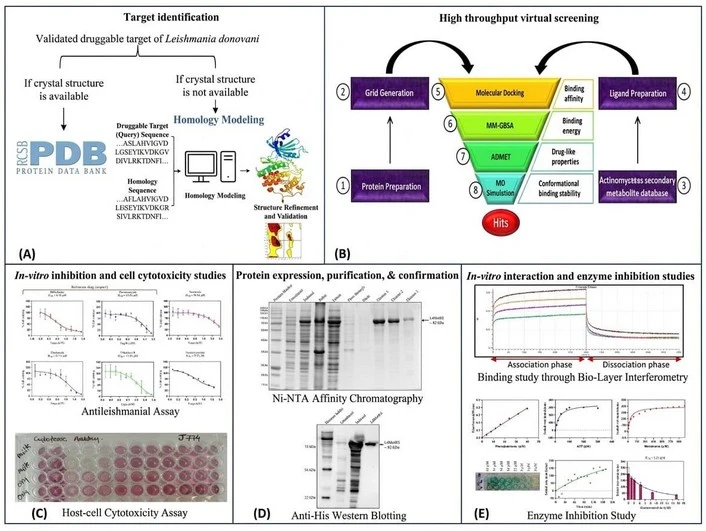
The study followed a stepwise approach that connected computational predictions with laboratory experiments. First, 6,524 actinomycete-derived secondary metabolites were screened against 17 validated drug targets of Leishmania donovani. The most promising compounds were then studied using molecular docking, binding energy calculations, in silico ADME analysis, and molecular dynamics simulations before being tested directly against the Leishmania parasite. Oxytetracycline emerged as the most active hit and was further evaluated for host-cell cytotoxicity. Finally, its interaction with LdMetRS was examined using Bio-Layer Interferometry, followed by an enzyme inhibition assay to determine whether this interaction could also inhibit the enzyme’s function. This integrated workflow allowed the study to move from large-scale virtual screening to experimental activity and biochemical target validation.
“Untapped potential of actinomycete secondary metabolites provide a systematic path from computational prediction to experimental validation in the discovery of antileishmanial leads” – Prof. Vijay Kumar Prajapati
How would you explain your research outcomes (Key findings) to the non-scientific community?
In simple terms, the research explored thousands of natural molecules produced by actinomycetes to find potential treatments for visceral leishmaniasis. Actinomycetes are microorganisms already known as a rich source of bioactive compounds (antibiotics/medicines). From 6,524 molecules screened, oxytetracycline showed promising activity against Leishmania donovani in laboratory experiments with no side effects and less harmful to the host cells at the tested concentrations. The study also showed that oxytetracycline can bind and inhibit LdMetRS, an enzyme important for parasite protein synthesis and survival. These findings do not mean that oxytetracycline is ready to be used as a treatment for leishmaniasis, but they provide a promising foundation for further studies in clinically relevant parasite models and animals.
What are the potential implications of your findings for the field and society?
Our research highlights the potential of actinomycete-derived metabolites as a valuable source of antileishmanial leads and demonstrates how computational screening can be effectively connected with experimental and biochemical validation. The findings also open possibilities for exploring new therapeutic uses of existing molecules, which could help shorten some stages of early drug discovery. In the long term, such approaches may contribute to the development of safer and more effective treatment options for visceral leishmaniasis, a neglected disease that mainly affects vulnerable populations with limited access to healthcare. However, further studies in intracellular amastigotes and animal models are essential before any therapeutic application can be considered.
What was the exciting moment during your research?
The most exciting part of the research was the scientific curiosity that developed as the results unfolded. Oxytetracycline initially emerged as a promising hit from screening 6,524 metabolites, raising the question of whether a computational prediction could translate into real biological activity. Observing its strong antileishmanial activity was exciting, but it also raised another question: how was the compound acting on the parasite? This curiosity led to LdMetRS binding and enzyme inhibition studies. Seeing the research progress from a computational prediction to antiparasitic activity, direct target interaction, and finally functional enzyme inhibition was the most exciting and scientifically rewarding part of the journey.
Paper reference: Singh S, Baghel K, Bhalerao P, Bhatt TK, Prusty D, Prajapati VK. Systems-Driven Identification and Experimental Validation of Actinomycetes-Derived Secondary Metabolites as Promising Antileishmanial Agents Targeting Leishmania donovani Methionyl-tRNA Synthetase. ACS Medicinal Chemistry Letters. June 2026. https://doi.org/10.1021/acsmedchemlett.6c00201.