



Ani2: A dual chaperone from Schizosaccharomyces pombe, unveiling its structural and functional roles
Research Summary: Nucleosomes are the fundamental units of chromatin, and their organization is very important in chromatin compaction. Histone chaperones play significant roles in nucleosome assembly. Ani2 is a member of the nucleoplasmin family of histone chaperones from the fission yeast Schizosaccharomyces pombe. The N-terminal nucleoplasmin domain of the protein acts as a histone chaperone, while the C-terminal FK506-binding protein (FKBP) domain functions as a peptidyl-prolyl cis trans isomerase (PPIase) that catalyzes peptidyl-prolyl bond isomerization. The N-terminal domain binds histone oligomers (H2A/H2B and H3/H4) and facilitates nucleosome assembly on DNA, while the C-terminal domain aids protein folding. The study also suggests a potential role for Ani2 in centromeric positioning and in maintaining genomic stability in yeast.
Researcher Spotlight
Archana Samal is a PhD student at the BRIC-Institute of Life Sciences, Bhubaneswar. She specializes in structural biology and biophysics research, investigating fundamental chromatin thematic projects.
LinkedIn: https://www.linkedin.com/in/archana-samal-9882b422a/
Twitter: x.com/ArchanaSamal10
Instagram: https://www.instagram.com/archie_thereal/
Lab PI name: Dr. Dileep Vasudevan
University: BRIC-RGCB, Thiruvananthapuram (Previously with BRIC-ILS, Bhubaneswar)
Lab social media: x.com/lab_vasu
What was the core problem you aimed to solve with this research?
Understanding the structural and functional intricacies of Ani2 was the problem we wanted to address in this research.
How did you go about solving this problem?
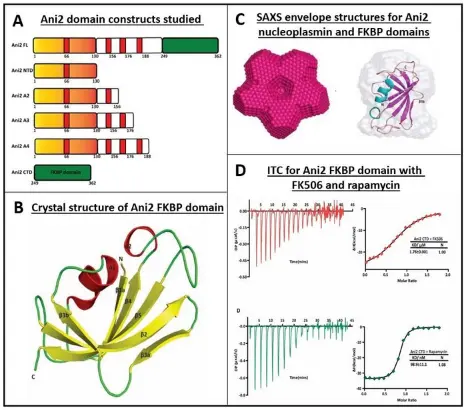
Multiple biophysical approaches, such as analytical SEC, analytical ultracentrifugation (AUC), and small-angle X-ray scattering (SAXS), were used to characterize the N-terminal nucleoplasmin domain as a stable pentamer. Histone interaction studies, in vitro nucleosome assembly, and plasmid supercoiling assays confirmed that Ani2 functions as a histone chaperone. The C-terminal domain (CTD) crystal structure revealed a characteristic monomeric FKBP fold that binds stably to immunosuppressive drugs such as FK506 and rapamycin. The activity assay confirmed Ani2 as an active PPIase, demonstrating its dual chaperone activity as both a histone chaperone and a PPIase.
“Our study characterizes Schizosaccharomyces pombe Ani2 as a dual chaperone, functioning both as a histone chaperone and a prolyl isomerase.” – Dr. Dileep Vasudevan
How would you explain your research outcomes (Key findings) to the non-scientific community?
This work presents the first detailed characterization of a fission yeast FKBP nucleoplasmin protein called Ani2. Various biophysical, structural, and functional studies were conducted to better understand the protein. Our study showed that the N-terminus of the protein forms a pentamer, and that the long disordered arms terminate in well-folded, functional FKBP domains. We could also show that the nucleoplasmin domain of the protein, with its disordered acidic tracts, can bind histones and perform nucleosome assembly.
What are the potential implications of your findings for the field and society?
The FKBP domain of Ani2 has been reported to modify the genomic stability-regulating site within the GRANT region of CENP-A, the centromeric variant of histone H3. This function, mediated by the protein through prolyl isomerization, has been reported to be crucial for centromeric positioning in S. pombe. Therefore, future studies looking at the centromeric functions of histone chaperones and PPIases will get a fresh direction.
What was the exciting moment during your research?
Every moment of this study was exciting. The most exciting part of the project was perhaps solving the crystal structure of the PPIase domain and understanding the SAXS envelope structure of the N-terminal nucleoplasmin domain.
Paper reference: Archana Samal, Purushottam Patnaik, Dileep Vasudevan. 2026. Unravelling the structure-function features of Ani2, a dual chaperone from Schizosaccharomyces pombe. International Journal of Biological Macromolecules, 383(Pt 1): 154525. https://doi.org/10.1016/j.ijbiomac.2026.154525