



AXL Signaling Controls Golgi Organization and Function in Cancer Cells
Research Summary: We discovered that the receptor tyrosine kinase receptor AXL regulates Golgi organization and function through an adhesion-dependent Arf1 signaling pathway, revealing a new mechanism linking extracellular signals to intracellular organization.
Researcher Spotlight
First authors: Prachi Joshi, Arnav Saha, Radhika Malaviya
Prachi Joshi completed her PhD from IISER Pune (India) and is currently a Postdoctoral associate at the Yale University (USA). Her research focuses on how extracellular mechanical and biochemical signals regulate organelle organization, membrane dynamics, and cellular function in health and disease.
LinkedIn | Twitter | Instagram
Arnav Saha recently completed his PhD from IISER Pune, where he investigated how cell-extracellular matrix (ECM) adhesion, signal transduction, and organelle mechanobiology integrate to regulate cancer cell behavior and mechanobiology.
LinkedIn | Twitter | Instagram
Radhika Malaviya is a PhD student at IISER, Pune, working on the relationship between cell-matrix adhesion, mechanosensing, and organelle organization and function in cancers.
Lab: Prof. Nagaraj Balasubramanian, Indian Institute of Science Education and Research (IISER) Pune, India
Twitter: @AdhesionLab
What was the core problem you aimed to solve with this research?
Changes in Golgi organization are frequently observed in cancer cells and are often associated with disease progression. However, the signaling mechanisms that regulate Golgi architecture remain poorly understood. Since our lab had previously shown that cell-matrix adhesion influences Golgi organization, we wanted to understand how signals from the cell surface are transmitted to the Golgi and identify the molecular players involved in this process.
How did you go about solving this problem?
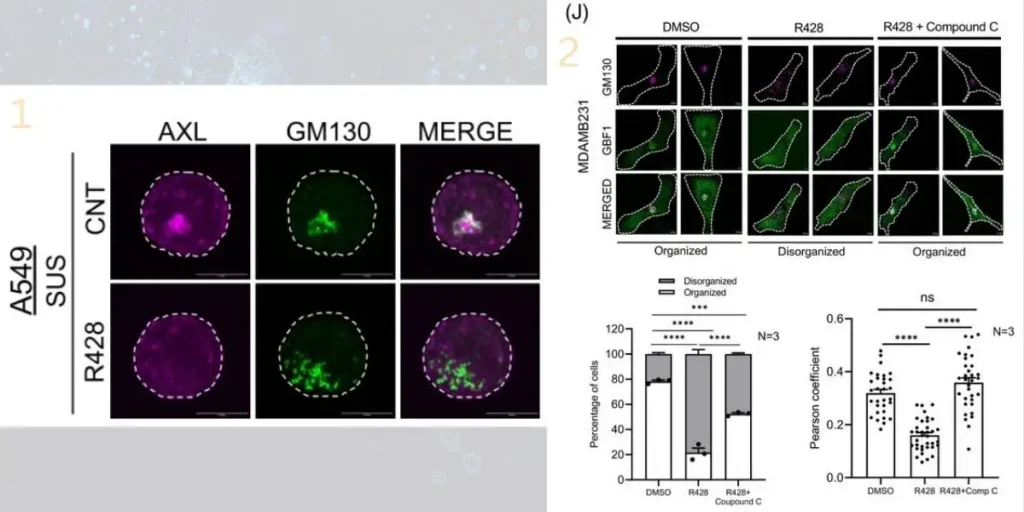
We began with a large in silico screen to identify candidate regulators of Golgi organization in cancer cells. Among several potential candidates, AXL emerged as particularly interesting because of its well-established role in cancer progression but unknown role at the Golgi. Using a combination of microscopy, molecular biology, biochemical assays, and functional experiments in breast and lung cancer cell lines, we investigated how AXL influences Golgi organization. This ultimately led us to uncover an adhesion-dependent signaling axis involving AXL, AMPK, GBF1, and Arf1 that controls Golgi structure and function.
“This study reveals how a simple screen comparing cancer cell lines could allow us to identify novel regulators of Golgi organisation and function. In doing so, it not only revealed a new localisation and role for AXL at the Golgi but also established how it could be differentially regulated by adhesion in different cancers. The implications for AXL in other regulators’ pathways, like cellular mechanosensing, make this discovery that much more exciting” – Dr Nagaraj Balasubramanian
How would you explain your research outcomes (Key findings) to the non-scientific community?
PJ – Every cell communicates with its environment through physical and chemical cues. Our study discovered a previously unknown communication pathway that helps cells translate these external signals into changes inside the cell. We found that AXL, an integral membrane protein, can relay these external signals to regulate Golgi apparatus, which is the cell’s packaging and distribution center. When AXL activity is disrupted, the Golgi loses its architecture and becomes less efficient at performing its functions. We also identified other key players – Arf1-GTPase, AMPK and GBF1 which could be working alongside AXL to maintain the Golgi organization and function.
AS– Our study shows that the way cancer cells attach to their surroundings influences the structure and function of the Golgi, a key compartment that processes and distributes molecules inside the cell. We identified a signalling pathway involving two key proteins, AXL and Arf1, that links these external attachment cues to the cell’s internal organization. When this AXL–Arf1 axis is disrupted, the Golgi becomes disorganized and functions poorly, leading to changes in how cells function. This highlights how signals from a cell’s environment can directly control its internal machinery and behaviour.
RM– The Golgi apparatus is responsible for modifying newly synthesized proteins so that they function correctly. The correct organization of the Golgi is important for this. We have found a new mechanism that regulates the Golgi organization that connects a novel Golgi regulator, AXL, with Arf1, a well-known regulator of Golgi organization.
What are the potential implications of your findings for the field and society?
PJ– AXL is already an important therapeutic target in several cancers, yet many aspects of its cellular functions remain unknown. Our work identifies a previously unrecognized role for AXL in controlling Golgi organization and Golgi-dependent processes. Furthermore, it highlights the Golgi as a dynamic organelle that actively responds to mechanical cues from the surroundings. Perturbations in AXL or Golgi dysfunction are commonly reported in various pathologies including cancer. Our findings can potentially contribute to better understanding pathological conditions and improve current therapeutic strategies.
AS – From a scientific perspective, identifying the AXL-Arf1 pathway reveals a previously unrecognized mechanism by which cells translate signals from their external mechanical environment into changes in the organization of an intracellular organelle. This not only advances our understanding of Golgi biology but also provides a framework for discovering similar regulatory pathways controlling other organelles. More broadly, because abnormalities in cell adhesion, mechanosensing, and Golgi organization are common features of diseases such as cancer, understanding these mechanisms could help explain how disease develops and progresses. In the long term, components of this pathway may also serve as potential therapeutic targets or biomarkers, opening new avenues for developing more effective treatments.
RM– We have studied the AXL-Arf1 axis and its regulation of Golgi organization in both Breast and Lung cancer cells. The breast cancer cell line has an adhesion-dependent Golgi, while the lung cancer cell line has an adhesion-independent Golgi. The subtle difference in how the AXL-Arf1 axis operates in these two cells may contribute to the differences in adhesion-dependent Golgi organization. The Golgi phenotype is known to be heterogeneous in cancers, and our study highlights a new pathway that may contribute to this heterogeneity.
What was the exciting moment during your research?
PJ – One of the most exciting moments came when AXL emerged from a large computational screen as a potential Golgi regulator. At the time, there was no established connection between AXL and the Golgi organization. Seeing that targeting AXL consistently disrupted Golgi architecture across cell lines was striking. Even more exciting was discovering that restoring active Arf1 could rescue these effects, providing a mechanistic link that helped connect all the pieces of the story. That was the point when an interesting observation became a compelling biological mechanism.
AS– One of the most rewarding moments in this project was uncovering how AXL communicates with Arf1. At first, this connection wasn’t obvious, so we spent a lot of time investigating potential intermediate regulators. Based on existing literature and our own observations, we focused on AMPK and its regulation of GBF1, the key activator of Arf1. It was incredibly satisfying when our experiments showed that changes in AMPK activity altered GBF1 localization and Golgi organization, and that inhibiting AMPK could rescue these defects. That was the point where all the pieces of the puzzle came together, giving us a coherent mechanism linking extracellular mechanical cues to Golgi organization.
RM– AXL is a well-known RTK and is largely reported to be present in the plasma membrane. Our study reports, for the first time, that AXL may also play a role at the Golgi. The prominent pool of AXL localized to the organized Golgi was quite striking. This has raised many questions about the role AXL may play at the Golgi and how this pool may differ from the one at the plasma membrane. The connection between AXL phosphorylation. activity and its localization are very interesting and something I want to study further.
Paper reference: Joshi P*, Saha A*, Malaviya R, Panda D, Mehta G, Pattanayak M, Singh V, Balasubramanian N. AXL receptor tyrosine kinase regulates Golgi organization and function via an adhesion-Arf1 signalling axis in breast and lung cancer cell lines. Biol Open. 2026 May 15;15(5):bio062581. doi: 10.1242/bio.062581. Epub 2026 May 19. PMID: 42152811; PMCID: PMC13225716 (* Equal contributors)