



Research Summary: In this study we identified a protein that acts like a switch, helping plants adjust and thrive in warmer temperatures by controlling two key opposing signals within the plant.
Researcher Spotlight
Dr. Shubhi Dwivedi
Linkedin: https://www.linkedin.com/in/shubhi-dwivedi-a18375180
Twitter: @shubhiD26
Instagram: @dwivedi.shubhi26
Lab PI name: Prof. Sourav Datta; Plant Cell and Developmental Biology Lab
University: Indian Institute of Science Education and Research, Bhopal
Lab social media: Twitter: @pcdb_lab_iiserb
LinkedIn: https://www.linkedin.com/company/pcdb_iiserb/
Instagram: @pcdb_lab_iiserb
What was the core problem you aimed to solve with this research?
Global warming represents one of the most pressing threats of the 21st century. According to the European Copernicus Climate Change Service, the global average temperature in 2024 reached 1.6°C above the pre-industrial average, marking the hottest year since records began in 1850. Without aggressive intervention, current trajectories place the world on track for a global average temperature rise of 2.5–2.9°C above pre-industrial levels — a scenario with catastrophic implications for global food production.
Plants are exquisitely sensitive to temperature fluctuations, and even modest increases in ambient temperature. A 1°C rise in global temperature leads to an average yield reduction of approximately 6.0% in wheat (Triticum aestivum), 3.2% in rice (Oryza sativa), and 7.4% in maize (Zea mays). Global food security is one of the many challenges the world is facing in this increasing population. Food production will need to rise by 60% by 2050 just to keep pace with expected global population growth and changing demand. Therefore, understanding how plants perceive and respond to elevated temperatures is essential.
At the heart of these challenges lies a fundamental biological question: how do plants perceive, integrate, and respond to elevated temperatures at the molecular level? Understanding the mechanisms of plant thermosensing and thermomorphogenesis and the group of developmental responses plants utilize to cope with warming is essential for designing the next generation of heat-resilient crops. Deciphering these pathways not only advances our basic understanding of plant developmental biology but also provides molecular targets for breeding and biotechnology strategies urgently needed to safeguard global food security in a warming world.
How did you go about solving this problem?
At the heart of these challenges lies a fundamental biological question: how do plants perceive, integrate, and respond to elevated temperatures at the molecular level? Understanding the mechanisms of plant thermosensing and thermomorphogenesis and the group of developmental responses plants utilize to cope with warming is essential for designing the next generation of heat-resilient crops. Deciphering these pathways not only advances our basic understanding of plant developmental biology but also provides molecular targets for breeding and biotechnology strategies urgently needed to safeguard global food security in a warming world. To address this question, we took a combined genetic, molecular, and biochemical approach using Arabidopsis thaliana as our model system to dissect the molecular players governing thermomorphogenesis.
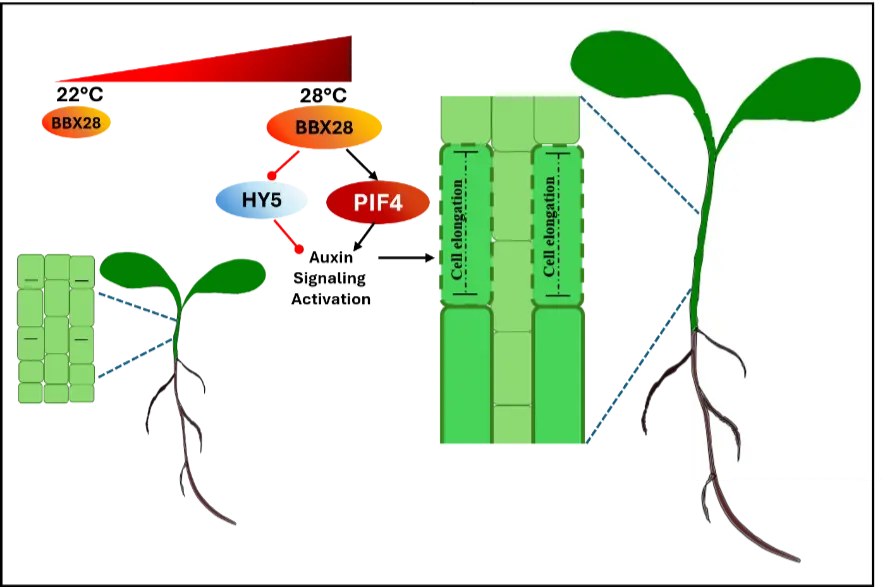
Plant thermomorphogenesis is orchestrated by a delicate balance between growth-promoting and growth-suppressing transcription factors, most notably PIF4 and HY5, whose opposing activities are tightly tuned by the prevailing light and temperature environment. Further these transcription factors oppositely regulate plant growth hormone auxin, which promote cellular elongation in different tissues of the plants
Our study identifies BBX28, a B-box zinc finger protein, as a previously unrecognized regulator sitting at the intersection of these two competing pathways. We demonstrate that BBX28 simultaneously promotes PIF4 transcriptional activity and relieves HY5-mediated repression of auxin signaling genes — effectively acting as a molecular rheostat that amplifies the thermoresponsive growth program. This dual antagonism positions BBX28 as a key fine-tuner of the PIF4–HY5 regulatory axis in a temperature-dependent context.
These findings reveal a new regulatory node within the light–temperature signaling network. Our findings have particular relevance for understanding how plants establish heat resilience at the most vulnerable phase of their life cycle — a critical window for crop establishment and productivity under a warming climate.
How would you explain your research outcomes (Key findings) to the non-scientific community?
Imagine your body on a hot summer day — you sweat, seek shade, and slow down to cope with the heat. Plants cannot do any of that. Instead, they stretch themselves — growing taller, lifting their leaves, and reaching for cooler air. Like us, plants also contain proteins regulating several physiological processes.
In our study, we discovered a new protein called BBX28 — that acts like a traffic controller at a busy junction. When temperatures rise, BBX28 steps in and simultaneously gives a green signal to the proteins that drive growth, while stopping the ones that would hold it back. As a result, plants adapt efficiently to cope with the heat. Finally, the more we understand about these mechanisms, the better equipped scientists and farmers will be to crops like wheat, rice, and maize improving our food supply worldwide.
What are the potential implications of your findings for the field and society?
Our findings carry meaningful implications that extend well beyond the laboratory, to one of the most pressing challenges of our time — feeding a growing global population in a rapidly warming world. Given that heat stress during early seedling establishment is among the most damaging and least understood phases of crop vulnerability, insights gained from this study are particularly timely and translatable.
Ultimately, our findings contribute to a growing toolkit of knowledge that plant breeders and agricultural scientists can draw upon to safeguard food security for the estimated 9.7 billion people who will need to be fed by 2050 — a goal that will be impossible to achieve without a fundamental understanding of how plants cope with heat at the molecular level.
What was the exciting moment during your research
Throughout this long journey, I have experienced several ups and downs, along with many exciting and memorable moments. From getting my first perfect Western blot in the early days of my PhD to finally obtaining positive results after months of troubleshooting and eventually seeing my research published in a prestigious journal, it is difficult to choose just one moment as the most exciting. I still remember how I felt when I learned that my manuscript had gone under review. I had never imagined that my work would reach that stage, and I found myself feeling incredibly anxious and happy at the same time. Looking back, this journey has taught me so much—not only about science and research, but also about patience, resilience, and believing in the process. I am truly grateful for all these experiences, as each of them has contributed to my growth as a researcher and as a person.
Paper reference https://www.science.org/doi/10.1126/sciadv.aeh5725