



BLM regulates MALT1-driven NF-κB signalling and is targetable in B-cell malignancies
Research Summary: BLM helicase regulates B-cell development and proliferation by modulating MALT1-dependent NF-κB signalling, highlighting the BLM–MALT1–NF-κB axis as a potential therapeutic target for B-cell malignancies.
Researcher Spotlight
Ritu Agrawal is a Postdoctoral Fellow at NIH, USA, studying cell cycle regulation at the single-cell level. She worked as a Research Associate at NIBMG, Kalyani, and earned her PhD at NII, New Delhi, under Dr. Sagar Sengupta, specializing in molecular and cellular biology with a focus on DNA damage and repair.
Linkedin | Twitter @AgrawalRitu | Instagram @ruagrawal
Lab PI name: Dr. Sagar Sengupta
University: BRIC-National Institute of Biomedical Genomics, Kalyani, India
BRIC-National Institute of Immunology, New Delhi, India
Lab social media: @DrSagarSengupta
What was the core problem you aimed to solve with this research?
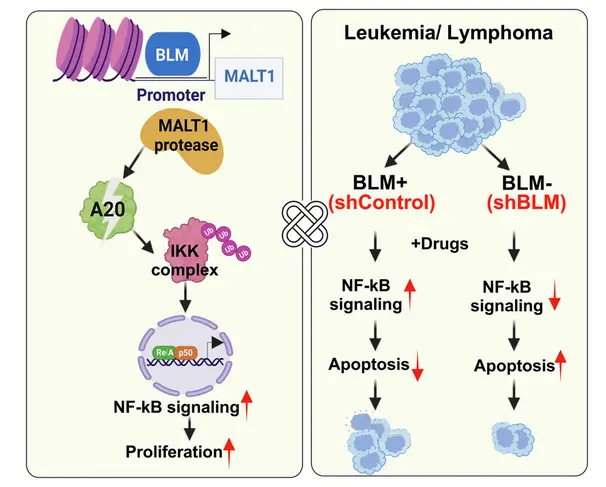
The central question of our study was why B-cell-specific loss of BLM causes defective B-cell development. Although BLM deficiency was already known to reduce mature B-cell populations, the underlying molecular mechanism was unclear. We therefore investigated how BLM regulates B-cell development and found that BLM maintains MALT1 expression and thereby sustains NF-κB signaling. Loss of BLM disrupts this BLM–MALT1–NF-κB axis, leading to impaired B-cell proliferation and development.
How did you go about solving this problem?
To address this question, we isolated B cells from BLM wildtype and B-cell-specific BLM kncokout mice and performed single-cell RNA sequencing to identify molecular pathways altered by BLM loss. Our analysis revealed that NF-κB signaling was significantly reduced in BLM-deficient B cells. Based on this finding, we hypothesized that impaired NF-κB signaling was responsible for the B-cell developmental defect. We then restored NF-κB signaling in BLM kncokout mice and found that this rescued B-cell development, providing functional evidence that defective NF-κB signaling is a key mechanism underlying the phenotype.
“A rare study which shows how fundamental research findings can contribute to understanding of how hematological cancers can be potentially treated. Has good clinical potential in future.” – Dr. Sagar Sengupta
How would you explain your research outcomes (Key findings) to the non-scientific community?
Our study discovered an unknown role for Bloom helicase (BLM), a protein mainly known for repairing damaged DNA. We found that BLM also helps B cells grow and survive by regulating the MALT1 gene, which in turn activates an important cell-survival pathway called NF-κB. When BLM was absent, this survival pathway was disrupted, and normal B-cell development was impaired.
Interestingly, we found that this same mechanism can be exploited in B-cell cancers. Reducing or inhibiting BLM suppressed the progression of lymphoma and leukaemia and made the cancer cells more sensitive to chemotherapy. Therefore, our study identifies a new BLM–MALT1–NF-κB pathway that is important for normal B-cell development but can also be targeted therapeutically in B-cell malignancies.
What are the potential implications of your findings for the field and society?
Our findings have important implications for the development of novel therapeutic strategies for lymphoma and leukaemia. While BLM is well established as a DNA repair protein, our study identifies an additional role for BLM in regulating MALT1 expression and, consequently, NF-κB signalling. Importantly, targeting BLM in our study resulted in the suppression of lymphoma and leukaemia, highlighting its potential as a therapeutic target. Thus, inhibition of BLM may provide a dual anti-cancer benefit by simultaneously attenuating MALT1-driven NF-κB pro-survival signalling and impairing DNA damage repair, thereby limiting tumour cell survival and disease progression.
What was the exciting moment during your research?
One of the most exciting moments during my research was when we first observed a striking difference in NF-κB signalling proteins between BLM wild-type and BLM-knockout mice. This was particularly exciting because it provided the first indication that BLM, beyond its well-established role in DNA repair, might also play an important role in regulating NF-κB signalling. Another key moment was when we were able to rescue the phenotype in vivo through retroviral transduction of MALT1 and constitutively active IKKβ, a key component of the NF-κB signalling pathway. Observing this rescue experimentally provided strong functional evidence for the link between BLM, MALT1, and NF-κB signalling and was one of the most rewarding moments of the study.
Paper reference: Agrawal, R., Ghosh, S., Kumar, N. et al. BLM regulates MALT1-driven NF-κB signalling and is targetable in B-cell malignancies. Cell Death Dis 17, 636 (2026). https://www.nature.com/articles/s41419-026-08846-3