



From Buffalo DNA to Biotechnology: A Robust Promoter for Gene Expression
Research Summary: We developed and characterized a buffalo EF1α1 promoter that provides strong and stable gene expression across mammalian cells and tissues, with promising applications in biotechnology and biomedical research.
Researcher Spotlight
Satarupa Dutta is a PhD researcher working in molecular biotechnology and genetic engineering, with research interests in gene expression, cellular engineering, and therapeutic protein delivery.
Linkedin https://www.linkedin.com/in/satarupa-dutta-44344a130/
Twitter https://x.com/SATARUP61031427
Instagram https://www.instagram.com/itz_me_satarupa?stkn=MWZicmRxd2cwcXBqag==
Lab PI name: Dr. Nirmalya Ganguli
Institute: BRIC-National Institute of Animal Biotechnology, Hyderabad
Lab social media: www.gpel.online | https://www.niab.res.in/peoplenirmalya/
Linkedin https://www.linkedin.com/in/nirmalya-ganguli-0b1791204/ | https://www.linkedin.com/in/gpe-lab/
What was the core problem you aimed to solve with this research?
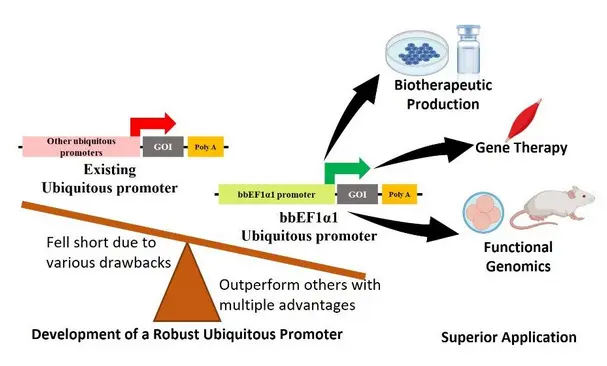
Most commonly used promoters, derived from human or viral sources, may not always provide strong and stable gene expression across different systems. We aimed to identify and characterize a buffalo-derived promoter that could efficiently drive gene expression in mammalian cells and animals.
How did you go about solving this problem?
We isolated the buffalo EF1α1 promoter from the Indian Murrah buffalo genome and compared its activity with commonly used CMV and human EF1α promoters. We tested its strength and stability in different mammalian cells and further evaluated its activity in mice.
“This study transforms an insight from the buffalo genome into a practical genetic tool with exciting potential for biotechnology, genomics, and biomedical research.” – Dr. Nirmalya Ganguli
How would you explain your research outcomes (Key findings) to the non-scientific community?
Think of a promoter as an ON switch for a gene. We identified an ON switch from the buffalo genome that can efficiently turn genes on and keep them active in different cells and tissues. This could be useful for future genetic and biotechnology applications.
What are the potential implications of your findings for the field and society?
The buffalo EF1α1 promoter could serve as a useful tool for gene expression studies, transgenic animal generation, functional genomics, gene delivery research, and production of recombinant therapeutic proteins.
What was the exciting moment during your research?
The most exciting moment was seeing that the promoter was not only strong in cultured cells but also worked in vivo. Detecting its activity in multiple tissues and successfully generating transgenic mice made the findings particularly exciting.
Paper reference: Dutta, S. et al. A stable and potent buffalo EF1α1 promoter for robust gene expression in mammalian systems. Transgenic Research (2026), 35:32. DOI: 10.1007/s11248-026-00507-7