



Chemical editing rewires peptide assembly
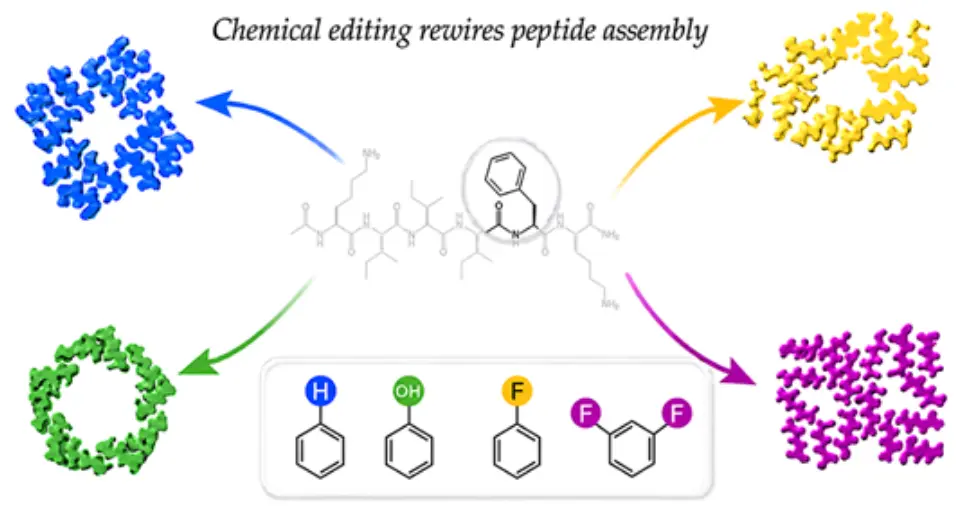
Research Summary: Using cryo-EM helical reconstruction, we found that in near-identical sequences assembled under identical conditions, a single-atom substitution can fundamentally change the resulting filament structure.
Researcher Spotlight
Abhinaba Das is a PhD candidate in Professor Vincent Conticello’s group in chemistry at Emory University. Abhinaba uses cryo-electron microscopy to study self-assembled helical macromolecules.
Lab PI name: Professor Vincent P Conticello, Emory University
Lab social media: https://conticello.emorychem.science/ ; https://x.com/conticellolab
What was the core problem you aimed to solve with this research?
A central goal in materials science is to understand how a molecule’s sequence determines the structure it assembles into. If we could predict that reliably, we could design functional materials deliberately rather than discovering them by trial and error.
Peptides make this especially hard. They assemble hierarchically, so a tiny change in one molecule can be amplified as thousands of molecules pack into layers and filaments. Our lab had already seen that assembly conditions alone can change the final structure dramatically. So we asked the opposite question: what happens if we keep the peptide molecule essentially the same and change only one or two atoms?
How did you go about solving this problem?
We started from a short peptide that forms thin filaments and edited a single phenylalanine, either adding a hydroxyl group to make tyrosine or replacing hydrogen atoms with fluorine. These edits sit at the far end of the side chain, pointing away from the backbone, so we expected them to barely matter. Instead, cryo-EM structures of five filaments showed that every variant built something different, with different helical symmetries, different protofilament arrangements and different ways of packing peptides together, even though all of them shared the same basic amyloid-like cross-β scaffold.
“Abhi and I were interested in the significance of circumspect chemical substitutions on peptide supramolecular structure.” – Professor Vincent P Conticello
How would you explain your research outcomes (Key findings) to the non-scientific community?
Peptides are short chains of amino acids, the building blocks of proteins, and many of them spontaneously stack into long, thread-like fibers that could become useful materials for medicine and technology. To design such materials, we need to predict what shape a peptide will build. We took one peptide and changed just one or two atoms, a change so small we expected nothing to happen. Using cryo-electron microscopy, which lets us see these fibers almost atom by atom, we found that each version built a different fiber. It is like swapping a single tiny piece in a construction set and watching the whole tower come out a different shape. The lesson is that tiny chemical changes can have outsized effects, which makes designing these materials harder, and more interesting, than we assumed.
What are the potential implications of your findings for the field and society?
For the field, our findings show that peptide materials cannot be designed simply by assuming that small, local edits will leave the overall structure intact. Adding a single functional group to give a material a new property, a routine step in materials design, can reshape the entire assembly. At the same time, this sensitivity is an opportunity: chemical editing gives researchers a precise tool for probing and potentially tuning how peptides assemble.
For society, peptide materials are being developed for tissue engineering, drug delivery, vaccines and catalysis, and their performance depends on their structure. Understanding how tiny chemical changes redirect assembly will help make these materials more predictable and reliable. Because these fibers share their core architecture with amyloids, some of the most stable protein structures in nature, insights from amyloid research can be leveraged to build stronger, more robust peptide materials by design.
What was the exciting moment during your research?
Beyond what we learned about this peptide system, what moved me most was a realization about the team itself. The authors come from India, China, Pakistan and the United States, yet whatever our backgrounds, we were united by the science, which cuts across the differences that so often divide us. And the science itself is universal: a researcher anywhere in the world, say in the Netherlands, who repeats these experiments would arrive at the same structures. I find that deeply beautiful and gratifying.
Paper reference: Abhinaba Das, Ayisha Zia, Gunnar N. Eastep, Fengbin Wang, Vincent P. Conticello; Chemical Editing Reveals Atomic-Level Control of Supramolecular Structure in Self-Assembling Peptides. Journal American Chemical Society 2026; https://doi.org/10.1021/jacs.6c11510