



How do plants warn distant leaves upon insect attack?
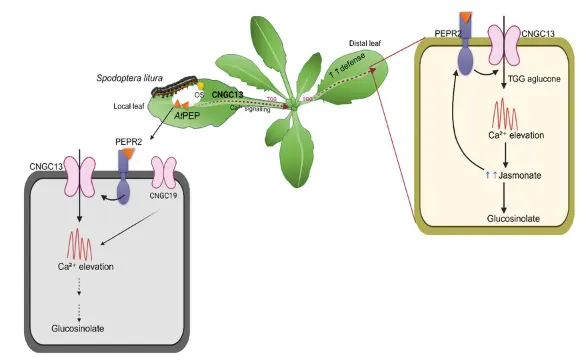
Research Summary: We discovered that the calcium channel CNGC13 helps plants transmit long distance danger signals after insect attack, activating jasmonate and glucosinolate based defense response in distant leaves.
Researcher Spotlight
Misha Kumari is a plant molecular biologist at NIPGR, New Delhi, whose research focuses on calcium signaling, plant-insect interactions and molecular mechanism underlying plant defense
Linkedin: https://www.linkedin.com/in/mishakumari5
Twitter: https://x.com/MishaKu16647918
Instagram: https://www.instagram.com/231.misha
Lab PI name: Dr. Jyothilakshmi Vadassery
University: National Institute of Plant Genome Research, New Delhi, India
What was the core problem you aimed to solve with this research?
Plants cannot escape when insects attack them, so they need to rapidly communicate the danger from the damaged leaf to undamaged distant parts of the plants. Calcium signals are known to participate in this communication, but the molecular components responsible for long distance calcium signaling during herbivory were not fully understood. We identified the calcium channel involved in long distant calcium signal propagation in plants ultimately providing immunity to the whole plant.
How did you go about solving this problem?
We investigated the expression and function of different cyclic nucleotide gated calcium channels in model plant, Arabidopsis thaliana following simulated and actual herbivory treatment. We identified CNGC13 as strongly induced by the damage and studied its role using mutant plants, calcium imaging, defense hormone and secondary metabolite accumulation. We also identified CNGC13 as a vascular localized channel and are involved in long distance signal propagation.
“The CNGC13 is involved in systemic calcium propagation and activations of defense responses in the vascular-connected distant leaf of Arabidopsis plant upon herbivore perception.” – Dr. Jyothilakshmi Vadassery
How would you explain your research outcomes (Key findings) to the non-scientific community?
The plant has its own internal alarm system. When an insect starts feeding on one leaf, the plant needs to warn other leaves before the insect reaches them. We found that CNGC13 acts as an important component of this alarm system, helping calcium signals travel through the plant’s vascular tissues. These calcium signals help activate defense hormones such as jasmonates and toxic defense metabolite accumulation in distant leaves. When CNGC13 gene is knocked out, the calcium signaling is weaker, defense responses reduces and plants become more susceptible to insect feeding
What are the potential implications of your findings for the field and society?
Our findings expand the current understanding of how plants communicate damage over long distances. They show that systemic calcium signaling is not dependent on a single type of calcium channel; rather plants appear to use multiple interconnected signaling pathways to respond to different damage cues. In the longer term, understanding these natural defense mechanisms could contribute to strategies for developing crops with stronger endogenous resistance to insect pests. Such knowledge may eventually support crop improvement, dense priming and more sustainable approaches to pest management
What was the exciting moment during your research?
One of the most exciting moments was when our calcium-imaging experiments revealed a clear difference between the wild-type and cngc13 mutant plants. Seeing that the systemic calcium signal was significantly reduced and delayed in the mutant was a particularly rewarding moment, because it provided strong evidence that CNGC13 plays an important role in transmitting damage signals between distant leaves. What made it even more exciting was that this observation was supported by our other experiments, including defense-related hormone and metabolite analyses. Together, these results helped us connect a calcium signal to the plant’s actual defense response.
Paper reference: Kumari, M., Prajapati, R., Pawar, M., Sharma, B., Orlando Marchesano, B. M., Yang, Y., … & Vadassery, J. (2026). The Ca2+ channel CYCLIC NUCLEOTIDE GATED CHANNEL13 regulates vasculature-mediated systemic Ca2+ and jasmonate signaling on herbivory. Proceedings of the National Academy of Sciences, 123(40), e2612869123. https://www.pnas.org/doi/abs/10.1073/pnas.2612869123