



Making CRISPR/Cas Genome Editing Work Efficiently in Pea
Research Summary: We developed an efficient regeneration and transformation system that makes CRISPR/Cas9 genome editing more practical in pea, opening new possibilities for functional genomics and crop improvement.
Researcher Spotlight
Hardeep Singh is a PhD scholar at BRIC-NABI, Mohali, working in plant tissue culture, genetic transformation, and CRISPR/Cas9-mediated genome editing, with a focus on functional genomics and crop improvement.
LinkedIn: https://www.linkedin.com/in/hardeep-singh-a0a058b5/
Twitter: https://x.com/hardeep9416
Instagram: https://www.instagram.com/hardeep.singh16/
Lab PI name: Dr. Siddharth Tiwari
University/Institute: BRIC-National Agri-Food and Biomanufacturing Institute (BRIC-NABI), Mohali
What was the core problem you aimed to solve with this research?
Pea is an important pulse crop, but genetic improvement through genome editing poses a major challenge because it is relatively difficult to regenerate in-vitro and its transformation efficiency varies considerably among genotypes. CRISPR/Cas enables researchers to make precise changes to a plant’s DNA, but the technology is only as useful as the transformation and regeneration system that supports it. In pea, these steps have remained relatively difficult and genotype dependent.
So, our central question was simple: Can we develop a reliable and efficient pipeline to enable CRISPR/Cas9 genome editing in pea more effectively?
That question motivated us to optimize the regeneration and transformation process step by step, and then to test the system by targeting the phytoene desaturase (PsPDS) gene.
How did you go about solving this problem?
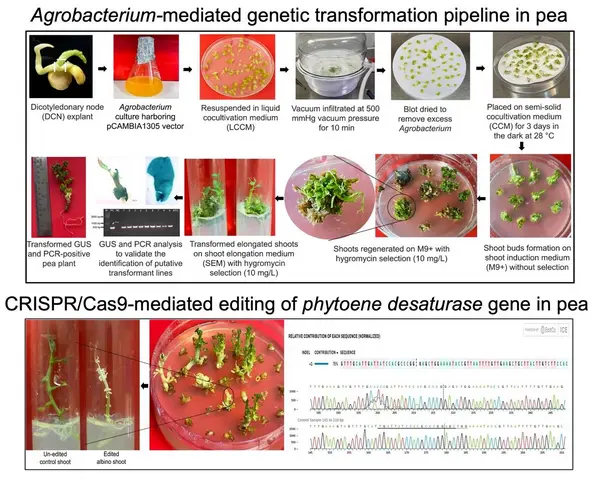
We systematically optimized the major steps of genome editing from in-vitro regeneration to Agrobacterium-mediated transformation.
First, we evaluated different explant types and regeneration conditions to determine which combination would most efficiently produce shoots. We found that the dicotyledonary node (DCN) was particularly effective, achieving 100% shoot-bud induction under optimized conditions and producing up to 39.70 shoots per explant.
We then optimized the Agrobacterium-mediated transformation process. Several parameters, including Agrobacterium density, vacuum infiltration, acetosyringone concentration, infection period, and co-cultivation duration, were evaluated.
Once we had an optimized regeneration and transformation pipeline, we put it to the real test: CRISPR/Cas9-mediated editing of the phytoene desaturase (PsPDS) gene.
This allowed us to move beyond simply developing a tissue culture protocol and demonstrate that the system could support genome editing in pea.
“This work establishes an efficient platform that can accelerate functional genomics and genome-editing-based improvement of pea.” – Dr. Siddharth Tiwari
How would you explain your research outcomes (Key findings) to the non-scientific community?
I would describe it as developing a better route for scientists to edit the DNA of pea plants.
Imagine having a powerful editing tool but lacking an efficient way to deliver it to plant cells and regenerate them into complete plants. That is essentially the bottleneck we were trying to address.
Our study developed an efficient workflow for these steps. Under optimized conditions, we obtained very strong regeneration responses and high transient transformation efficiencies. Most importantly, we successfully generated pea lines in which the phytoene desaturase (PsPDS) gene had been edited using CRISPR/Cas.
So, the broader message is that we have established a platform that researchers can use to study pea genes and, potentially, work toward improving important traits in the future.
What are the potential implications of your findings for the field and society?
The contribution of our work is to provide researchers with a more efficient platform for functional genomics and genome editing in pea.
With a reliable transformation and regeneration system, scientists can investigate what individual genes do and how they influence traits such as plant development, stress responses, nutritional characteristics, and other agronomically important features.
In the longer term, such technologies could contribute to the development of improved pea varieties. But I think it is important to distinguish between establishing the technology and developing a new crop variety. Our study establishes an important foundation; applying this platform to specific agricultural traits will require further research.
What was the exciting moment during your research?
The most exciting moment was when we saw the optimized system successfully achieve genome editing.
There is a big difference between optimizing individual steps in the laboratory and seeing the complete pipeline work, from regeneration and transformation all the way to confirmed CRISPR/Cas9-mediated editing.
When we obtained the edited lines and molecular analysis confirmed changes in the phytoene desaturase (PsPDS) gene, it was a very rewarding moment. It meant that all the optimization work had come together and that the system could do what we had designed it to do.
As a researcher, I find those moments particularly satisfying because they turn a long series of experiments into something tangible.
Figure Caption: An optimized regeneration and transformation pipeline enables CRISPR/Cas9-mediated editing of the phytoene desaturase (PsPDS) gene in pea. The study integrates efficient in-vitro regeneration, Agrobacterium-mediated transformation, and genome editing to establish a platform for functional genomics in pea.
Paper reference: Singh H, Kumar P, Sharma V, et al. (2026). Efficient in-vitro regeneration and transformation for CRISPR/Cas9-mediated genome editing of phytoene desaturase (PsPDS) gene in pea (Pisum sativum L.). Plant Cell Reports, 45, 261. DOI:10.1007/s00299-026-03945-z