



TKL3: A Key Regulator of blood-stage fitness, male gamete fertility, and transmission-stage development in Plasmodium berghei
Research Summary: Despite declining mortality rates, malaria remains a major infectious disease in the developing world. To effectively control and eliminate malaria, interventions must target multiple stages of the parasite’s life cycle. Male gamete fertility, ookinete maturation, and establishment of infection in the midgut are critical for malaria transmission to the mosquito vector. In this study, we demonstrate that P. berghei TKL3 is critical for male gamete fertility, ookinete differentiation, and establishment of infection in the mosquito midgut. Our study identifies TKL3 as a potential target for developing malaria transmission-blocking strategies.
Researcher Spotlight
Dr. Himadri Shukla is a malaria parasitologist investigating molecular mechanisms underlying Plasmodium fitness, sexual development, and transmission, with research focused on identifying targets for malaria intervention.
Linkedin: https://www.linkedin.com/in/himadri-shukla-b44227215/overlay/contact-info/
Lab PI name: Dr. Satish Mishra, Senior Principal Scientist, CSIR-Central Drug Research Institute, Lucknow, India.
University: Academy of Scientific and Innovative Research, Ghaziabad. CSIR-Central Drug Research Institute, Lucknow, India.
Lab social media: phd_resource (Instagram)
What was the core problem you aimed to solve with this research?
The core problem we aimed to solve was to understand the functional role of TKL3 in Plasmodium berghei and how this kinase contributes to parasite survival and development across different stages of its life cycle. Although protein kinases are important regulators of malaria parasite biology, the role of TKL3 was not well understood. Our research therefore aimed to determine how TKL3 regulates these stage-specific processes and whether it could represent a potential target for interfering with malaria transmission.
How did you go about solving this problem?
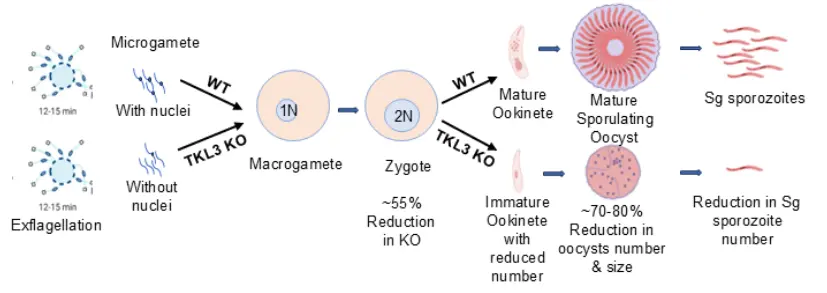
To address this problem, I first asked whether TKL3 has an essential role in the Plasmodium berghei life cycle and, if so, whether its function is restricted to a particular developmental stage. I used a combination of genetic, molecular, cellular, and in vivo approaches to investigate this systematically. “We tackled the problem by taking a stage-specific genetic approach. We generated a TKL3 knockout parasite line in Plasmodium berghei and systematically followed the parasite through the blood, sexual, and transmission stages. We first assessed blood-stage growth and fitness, then examined gametocyte development and male gamete fertility, and finally followed parasite development through the transmission stages. By combining these phenotypic analyses, we demonstrated that TKL3 has distinct but interconnected roles in blood-stage fitness, male gamete fertility, and transmission-stage development.”
“This study establishes TKL3 as a key regulator of Plasmodium berghei development, male gamete fertility, transmission, and blood-stage fitness, revealing new therapeutic opportunities.” – Dr. Satish Mishra (Shukla et al., 2026)
How would you explain your research outcomes (Key findings) to the non-scientific community?
Malaria is caused by a parasite that must survive in humans and then enter mosquitoes to spread to the next person. My research focused on understanding how one particular protein, called TKL3, helps the malaria parasite complete this complex life cycle.
We found that TKL3 is important at several stages of the parasite’s development. It helps the parasite maintain its ability to survive and grow in the blood, supports the fertility of the parasite’s male reproductive cells, and is also required for successful development of the stages that allow the parasite to be transmitted to mosquitoes.
In simple terms, TKL3 acts like an important control point that helps the malaria parasite survive, reproduce, and prepare for transmission. When TKL3 function is disrupted, the parasite becomes less fit in the blood and has difficulty reproducing and progressing through the transmission stages.
These findings improve our understanding of how malaria parasites survive and spread. Importantly, identifying proteins that are essential for both parasite survival and transmission could help researchers explore new strategies to interrupt the malaria life cycle and, in the long term, contribute to the development of better malaria-control approaches.
What are the potential implications of your findings for the field and society?
Our findings demonstrate that TKL3 is an important regulator of parasite fitness across multiple stages of the Plasmodium berghei life cycle, including blood-stage growth, male gamete fertility, and transmission-stage development. This highlights TKL3 as a multifunctional kinase that contributes not only to parasite survival and proliferation in the mammalian host but also to successful sexual development and transmission to the mosquito.
These findings expand our understanding of the molecular mechanisms governing malaria parasite development and identify TKL3 as a potential target for further investigation in antimalarial drug discovery. Because TKL3 affects both parasite fitness and transmission-related processes, targeting this pathway could potentially have dual benefits: reducing parasite burden in the host while also limiting transmission between humans and mosquitoes. Such transmission-blocking approaches are increasingly important for malaria elimination and eradication efforts.
Although further studies are required to determine the conservation and functional relevance of TKL3 in human malaria parasites, particularly Plasmodium falciparum and P. vivax, our work provides a foundation for investigating TKL3-related pathways as potential therapeutic or transmission-blocking targets. In the longer term, such knowledge could contribute to the development of novel antimalarial interventions and support global efforts to reduce malaria transmission and disease burden.
What was the exciting moment during your research?
The most exciting moment during our research was discovering that TKL3 plays a much broader role in Plasmodium berghei than we initially anticipated. We were particularly excited to find that TKL3 not only regulates blood-stage parasite fitness but also has important roles in male gamete fertility and transmission-stage development. Seeing these distinct phenotypes come together provided a strong indication that TKL3 is involved in multiple critical stages of the parasite life cycle. This was a rewarding moment because it transformed our initial hypothesis into a broader understanding of how a single kinase can influence parasite survival, reproduction, and transmission.
Paper reference: Shukla, H., Nirdosh, and Mishra, S. (2026) TKL3 regulates blood-stage fitness, male gamete fertility, and transmission-stage development in Plasmodium berghei. PLoS Pathog 22: e1014582.