



Copper Signaling Shapes Rice Domestication and Crop Yield, Study Finds
Research Summary: This study reveals the unexpected role of a metal ion in regulating crop yield. The study highlights the broader role of micronutrients in signaling rather than nutrition in plants.
Researcher Spotlight
Steffi Raju, is a graduate student at National Centre for Biological Sciences, Bangalore. She studies sRNAs and histones in plants using a crop model system, rice. Outside research, her favorite hobbies are swimming and painting.
BlueSky : @steffiraju.bsky.social
Linkedin: https://www.linkedin.com/in/steffi-raju-7035912b5/
Twitter: @rajusteffi1
Instagram: @ffiraste
Lab: Dr. Shivaprasad P.V, National Centre for Biological Sciences, Bangalore (@NCBS_Bangalore)
Lab social media: @shivaprasad_pv
What was the core problem you aimed to solve with this research?
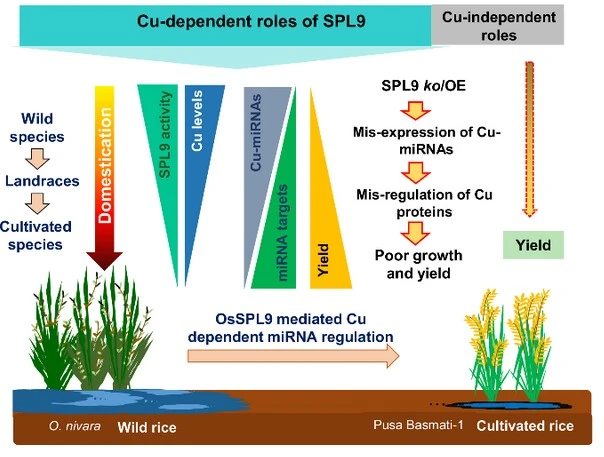
Rice domestication has led to major shifts in phenotypes and the epigenetic basis of these changes are unknown. When genetic changes lead to one gene – one trait sort of mechanisms, less is known about those regulatory layers that can override the genomic sequence but can change the expression of genes.
How did you go about solving this problem?
Our first approach was to look at the sequencing datasets between wild and cultivated rice to study the differentially expressed class of RNAs. Further, we made a series of mutants in cultivated rice backgrounds with the candidate genes to study what are the phenotypic and molecular outcomes of this kind of perturbation.
“How nutrient availability and habitat altered molecular wiring in rice during domestication was previously unknown. Several epigenetic changes characterized in our study are unique and help to improve rice as a high-yielding crop.” – Dr. Shivaprasad P.V
How would you explain your research outcomes (Key findings) to the non-scientific community?
During agriculture, macronutrients such as nitrogen, phosphorus and potassium were extensively used but lesser is known that nutrients required in smaller amounts also are important and they have bigger roles to play. One such micronutrient identified from our research is copper (Cu). This micronutrient apart from its role in nutrition or as a fertilizer, it acts as a cofactor for key enzymes and proteins essential for plant growth.
Some proteins not bound by Cu are inactive or non-functional in plant cells, making the Cu balance very important. In wild and cultivated rice, modulating the Cu levels changes a group of small RNAs, creating this imbalance. The cultivated rice that we use for our study is a high-yielding variety called Pusa basmati-1, which balances copper differently from its wild relatives. It increases the level of many copper-binding proteins by post-transcriptionally regulating the mRNAs that code for them. Therefore, the Cu is present in bound form for many essential, growth/yield promoting enzymes and proteins. This allows better photosynthesis, grain yield and plant architecture in modern rice varieties compared to ancient rice.
What are the potential implications of your findings for the field and society?
- Our study is the first to highlight the role of a micronutrient-mediated signal in rice domestication that can alter gene expression.
- This kind of a switch can allow us to regulate a broader set of agricultural traits by altering the doses of a single micronutrient – copper.
- Extending this micronutrient-mediated gene expression changes to other crops allow us to enhance yield by still making our favorite crops stress tolerant.
- This work shows that copper levels can change two different classes of RNAs – the mRNAs which code for copper-binding proteins and the miRNAs which target and degrade the above mRNAs.
- Modulating the copper level can help us in maintaining rice varieties with favorable yield and stress tolerance, thus maintaining the growth-defense trade-off that occurred during domestication.
What was the exciting moment during your research?
I had to detect the miRNA levels using northern blotting – one of my favorite experiments. I couldn’t detect any miRNAs in the homozygous mutant of the transcription factor. At first, it was hard for me to believe and I thought I was looking at a least expressed miRNA and that’s why it was not detected. But I observed the same for all the four miRNAs that we identified from our sRNA analysis. It was a moment of happiness for me, also because the homozygous CRISPR Cas9 knockout of the transcription factor came after multiple rounds of segregation and genotyping. Seeing the results come through after initial years of effort made me really happy. Until then, no one had shown that a single transcription factor knockout in cultivated indica rice could deplete all the miRNAs associated with domestication. This experiment was truly a gem.
Paper reference: Raju, S., Swetha, C., Harshith, C.Y. et al. Copper-sensitive OsSPL9 TF regulates expression of indica rice domestication-associated miRNAs and phenotypes. Commun Biol 9, 737 (2026). https://www.nature.com/articles/s42003-026-10325-6
Book Launch: Molecules, Mentors & Mindsets: Building Indian Biopharma | Biocon Focus