


One Molecule, Two Targets: Blocking EZH2 and EGFR in TNBC
Research Summary: We discovered and developed a first-in-class dual EZH2-EGFR inhibitor that simultaneously targets two therapeutic vulnerabilities in triple-negative breast cancer (TNBC) and demonstrated its antitumor potential in TNBC preclinical animal models.
Researcher Spotlight
Saumya Ranjan Satrusal is a PhD scholar working in cancer drug discovery, with a focus on understanding molecular vulnerabilities in triple-negative breast cancer and developing novel targeted therapeutic strategies.
Linkedin: www.linkedin.com/in/saumya-ranjan-satrusal-55b1931b4
Twitter: https://x.com/SRSaumya5
Instagram: https://instagram.com/sr5_saumya?cplk=MW91MmRrdjM0c3A5ZA%3D%3D
Lab PI name: Dr. Dipak Datta
University: CSIR-Central Drug Research Institute, Lucknow
Lab social media: https://sites.google.com/view/dipak-datta-cdri/
What was the core problem you aimed to solve with this research?
Triple-negative breast cancer (TNBC) remains a formidable medical challenge worldwide owing to limited targeted treatment options and a high risk of metastatic progression. Its molecular complexity also allows cancer cells to rely on multiple signaling pathways for their growth and survival, which can limit the effectiveness of targeting a single protein. Analysis of The Cancer Genome Atlas (TCGA) data revealed markedly higher expression of both EZH2 and EGFR in TNBC compared with other breast cancer subtypes. Our survival analysis further showed that TNBC patients with concurrently high expression of both genes had the poorest overall survival, providing a strong rationale to investigate their simultaneous inhibition. We therefore sought to develop a single molecule capable of targeting both vulnerabilities and investigate whether this approach could provide effective antitumor efficacy against TNBC.
How did you go about solving this problem?
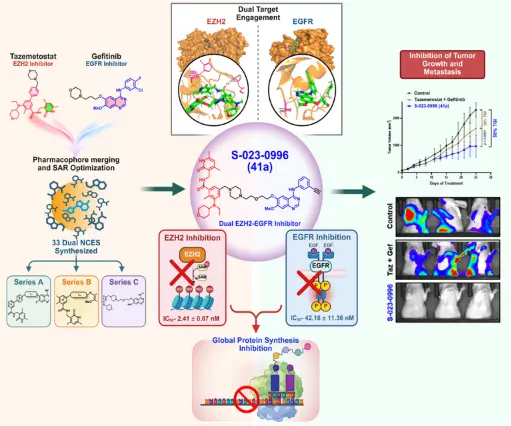
We followed a multidisciplinary approach amalgamating medicinal chemistry, computational studies, molecular and cell biology, pharmacokinetics, toxicology and preclinical animal studies. We designed and synthesized a series of compounds with the aim of simultaneously targeting EZH2 and EGFR and systematically evaluated their activity to identify a promising lead dual inhibitor. The lead compound, S-023-0996 was then studied in TNBC cells to understand its anti-cancer effects on TNBC cell growth and migration and then mechanistically validated its superior activity over the combination treatment, while demonstrating significant safety to non-cancerous cells. We further evaluated its antitumor efficacy in preclinical mice models of TNBC to determine whether the promising effects observed in the laboratory could also translate to more complex biological systems, so that we can provide a strong proof-of-concept for this novel therapeutic strategy.
“Our study results are encouraging from a therapeutic perspective, given the tough fight TNBCs put up against the current treatment regimens.” – Dr. Dipak Datta
How would you explain your research outcomes (Key findings) to the non-scientific community?
Cancer cells have several ways to keep growing, so blocking just one may not be enough. Our research explored whether a single molecule could block two of these routes at the same time.
We developed a first of its kind dual inhibitor, S-023-0996, that simultaneously targets two proteins, EZH2 and EGFR, against triple negative breast cancer, an aggressive form of breast cancer with limited targeted treatment options. In laboratory studies, it inhibited cancer cell growth while largely sparing the noncancerous cells tested, highlighting its selectivity for cancer cells. Proteomic analysis, a technique which examines changes in thousands of proteins, revealed that the molecule disrupted the cells’ protein production machinery more extensively than combining two separate inhibitors. Further experiments confirmed this stronger suppression of protein production, helping explain its greater anticancer activity. Encouragingly, these effects extended beyond cells grown in the laboratory. In mice, the molecule suppressed tumour growth and reduced the spread of cancer. It also controlled tumour growth more effectively than the combination of two separate inhibitors targeting the same proteins, under the conditions we tested. The key finding is that one carefully designed molecule can act against two cancer vulnerabilities and disrupt processes that cancer cells rely on. Although further research is needed before this approach can be tested in patients, our findings provide a foundation for developing novel treatment strategies for this challenging disease.
What are the potential implications of your findings for the field and society?
This study provides proof of concept for simultaneously targeting EZH2 and EGFR with a single chemical entity in TNBC. Our findings identify suppression of protein translation, the process by which cells make new proteins, as a novel mechanism underlying this dual inhibition. More pronounced suppression is linked to the lead molecule’s greater anticancer activity compared with the combination of separate inhibitors.
Beyond the specific compound, this work supports the development of rationally designed molecules that target multiple cancer vulnerabilities. Although substantial research is still required before clinical use can be considered, it provides a foundation for further optimization and preclinical development of dual EZH2 and EGFR inhibitors. For society, the longer-term promise lies in developing treatments that more effectively control aggressive cancers while limiting harm to noncancerous cells.
What was the exciting moment during your research?
One of the most exciting moments was seeing the activity we had repeatedly observed in cancer cells translate to an animal model. Drug discovery involves many stages, and promising laboratory findings do not always produce the same response in a living system. Seeing the compound suppress tumor growth, and particularly observing its effect on metastatic progression through bioluminescence imaging, was therefore especially rewarding. It felt like several years of designing molecules, optimizing experiments, troubleshooting, and repeating studies had finally come together into one coherent story.
Paper reference: https://authors.elsevier.com/c/1nogq_YhAs1HyB