



Covering the role of early-life aging on long-term gut health
Research Summary: We uncover that aging-related pathways in Drosophila larval gut progenitors impairs proliferation, differentiation and epithelial barrier integrity, with effects transitioning into adults, shedding light on developmentally programmed intestinal aging trajectories.
Researcher Spotlight
Dr. Shikha Malik, along with Atharva Anand Mahajan and Saraswathi J. Pillai are equal-contribution first authors on this study, investigating how developmental aging pathways shape long-term Drosophila intestinal homeostasis.”
Linkedin– linkedin.com/in/dr-shikha-malik-6a5358331
Twitter– https://x.com/malik_shikha
Lab PI name: Dr. Rohan Khadilkar
University: Advanced Centre for Treatment Research and Education in Cancer, Navi Mumbai
Lab social media: https://scthlab.wixstudio.com/scthlab
What was the core problem you aimed to solve with this research?
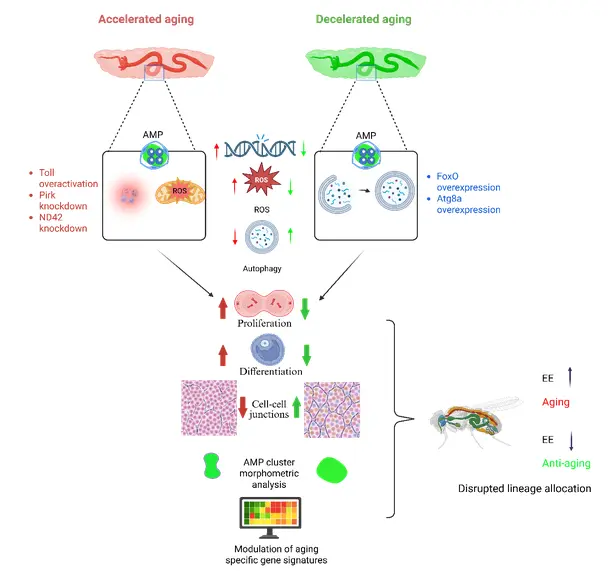
Aging research had extensively characterized how adult intestinal stem cells decline over time, but almost nothing was known about whether this decline is actually set much earlier during development. We wanted to ask whether genetically perturbing aging associated pathways (inflammation, oxidative stress, autophagy and foxo signalling) in larval gut progenitors, before the adult intestine even forms, could shape how that gut ages later in life. This question was significant because it challenged the preconceived notion that aging is entirely a time accumulated process in adult tissue, and instead asked whether vulnerability could be programmed early on. Our findings indicated that accelerating these aging pathways in larval progenitors caused lasting defects in proliferation, differentiation and gut barrier integrity that lasted well into adulthood, while reversing them was protective. This established adult midgut progenitors as a previously unknown developmental checkpoint for lifelong intestinal health. Ultimately our work suggests that early life interventions during this developmental window could offer a new strategy for preventing age-related decline later in life.
How did you go about solving this problem?
We used Drosophila melanogaster as a model system, taking advantage of its genetically tractable gut and well- characterized adult midgut progenitors (AMPs). Using the Gal4-UAS system, we induced or suppressed aging related pathways in larval AMPs by activating Toll and Imd signalling and knocking down ND42 to accelerate aging-like genotypes while overexpressing Atg8a and Foxo to decelerate them. We examined key aging hallmarks, including oxidative stress, autophagy, DNA damage, proliferation and differentiation using immunostaining, the smurf assay, and AMP cluster morphometrics, and validated these findings independently with chemical interventions (paraquat and rapamycin). Finally, bulk RNA transcriptomics revealed the underlying transcriptomic signatures, and we also tracked flies into adulthood (7- and 30-days post eclosion) to assess whether these early perturbations left a lasting effect on adult intestinal homeostasis.
Dr. Rohan Khadilkar says “This study is extremely exciting as it delves into the mechanisms underlying stem cell aging which can serve as a blueprint for the perturbations that can occur later in life and what is fascinating is that it is all developmentally determined”.
How would you explain your research outcomes (Key findings) to the non-scientific community?
We found that stress-like signals switched on early in a fruit fly’s gut development can permanently affect how well that gut ages later in life. Activating aging pathways in these early progenitors led to faster intestinal decline in adulthood, while enhancing the cells natural recycling system (autophagy) kept the gut health intact for longer. This suggest that the seeds of aging may be planted much earlier than we thought, opening the door to early interventions that could protect long-term gut health.
What are the potential implications of your findings for the field and society?
For the field, our findings redefine how aging is studied. Rather than viewing aging as something that merely builds up gradually in adult tissue, we demonstrate that its course can be determined much earlier, during development, in progenitor cells that are yet to form the final organ. This encourages researchers to examine early life windows, not just adult models, when studying age- related decline.
For our society, it has real translational value. If early life stressors, such as oxidative stress or inflammation during fetal development or childhood, can predispose tissues to age poorly later in life, it may help explain why and how some people have more age-related diseases even without obvious adult risk factors. It also suggests that protective interventions, such as boosting autophagy or curbing early inflammation, may prove most effective when introduced early rather than after symptoms emerge, ultimately shaping future approaches in preventive medicine and lifelong organ health.
What was the exciting moment during your research?
The most exciting moment during the research was uncovering that early-life aging interventions did not just influence the AMPs in the moment, they actually changed the physical architecture of AMP clusters, altering their shape, size and spatial organization within the larval gut. It was interesting to observe that aging-related stress could disrupt something as basic as how these progenitor cell cluster and arrange themselves, a phenotype that had not been documented before in this developmental context.
Another exhilarating part came when we tracked these flies into adulthood. Finding that the consequences of early life perturbations did not simply fade after metamorphosis, but instead persisted and surfaced as lasting effects in the adult gut, was a defining moment for us. It confirmed that this went beyond a transitional developmental anomaly, representing a genuine imprint of aging capable of shaping organ health well into adult life.
Paper reference: Malik, S., Mahajan, A.A., Pillai, S.J., Shinde, I., Shameem, M., Pande, S., Chandrani, P., Inamdar, M.M. and Khadilkar, R.J. (2026), Developmental regulation of progenitor aging shapes long-term intestinal homeostasis in Drosophila. FEBS Lett. https://doi.org/10.1002/1873-3468.70462