



RICTOR: The Molecular Link Between Microbes, Mitochondria and Longevity
Research Summary: Our study reveals how RICTOR-dependent sensing of microbial nutrients reshapes host metabolism and mitochondrial quality control, modulating stress resilience and longevity in C. elegans.
Researcher Spotlight
Dr Simran Motwani is a researcher at the National Institute of Immunology, studying how host-microbe interactions, metabolism, and mitochondrial quality control shape aging and disease.
Linkedin: https://www.linkedin.com/in/simran-motwani-phd-b33827150
Twitter: SimranM08
Instagram: simranmotwani24
Lab PI name: Dr Arnab Mukhopadhyay
University: National Institute of Immunology
Lab social media: https://www.linkedin.com/in/arnab-mukhopadhyay-40088342
Twitter: smartelegans
What was the core problem you aimed to solve with this research?
Our study began with a simple but intriguing question: Why does a genetic change of a host lead to different physiological outcomes depending on the microbial environment? It made us wonder whether microbes should be perceived as more than just a source of nutrients for the host – could they actually be sending molecular signals that influence how the host adapts, copes with stress, and ages?
To explore this, we focused on RICT-1, the C. elegans homolog of RICTOR and an essential component of the conserved mTORC2 complex. Because RICTOR is central to mTORC2 function, it provides an ideal entry point to understand how this important nutrient-sensing pathway connects the microbial environment to the host response. This question is particularly important because the microbial environment is increasingly recognized as a powerful determinant of host physiology, influencing metabolism, stress responses, aging, and disease. Yet, we still know little about how signals originating from microbes are sensed by the host and translated into specific cellular responses that ultimately shape health and longevity.
C. elegans offers us a remarkably simple but powerful genetic model system to investigate this relationship: the bacteria it consumes serve both as its food and as its microbial environment. This means we can change the bacteria through genetic manipulations or metabolite supplementation, and at the same time, genetically control the host, and directly observe how a microbial signal translates into changes in the physiology of the whole animal.
How did you go about solving this problem?
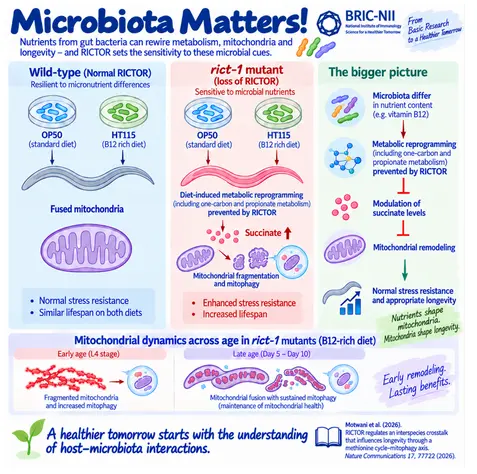
We started with a simple but intriguing clue: the bacterial diets differed in their vitamin B12 (B12) content. We first asked whether this difference could explain why RICT-1-deficient worms responded so differently to the two bacterial diets, E. coli OP50 (low B12 diet) and HT115 (high B12 diet). But the story turned out to be more complicated than that. We found that a B12-rich environment, together with optimal methionine availability, is required for enhanced stress resistance and longevity of the mutant. This led us to the bacterial one-carbon metabolism and two connected B12-dependent enzymes in the worm. METR-1, the methionine synthase, connects B12 to the methionine cycle, while MMCM-1 took us in a different but crucial direction, a mitochondrial enzyme that channels propionate metabolism towards succinyl-CoA. This was our first important clue that mitochondria might be at the center of the response.
We then followed this metabolic trail and found that the pathway ultimately increased succinate, a metabolite of the mitochondrial TCA cycle. When we visualized the mitochondria of the rict-1 mutant worms, we found that they became fragmented early in life and that this was accompanied by increased mitophagy, the process by which cells remove and recycle mitochondria. Importantly, disrupting the pathway, reducing succinate production, or blocking mitophagy abolished the stress-resistance and longevity benefits. Following the animals into later adulthood revealed another striking feature: despite early fragmentation, the mutants maintained more fused mitochondrial networks and sustained mitophagy. Step by step, the evidence revealed how RICT-1 prevents metabolic signals originating from the microbes from reprogramming host metabolism and mitochondrial dynamics, which ultimately influence mitochondrial quality control, stress resilience, and longevity.
“The microbial metabolites try to reshape host metabolism and mitochondrial quality control systems, influencing stress resilience and longevity. Host proteins like RICTOR/TORC2 have evolved to prevent that.” – Dr Arnab Mukhopadhyay
How would you explain your research outcomes (Key findings) to the non-scientific community?
In our study, we found that changing the bacterial environment changed the worm’s internal metabolism and, in turn, influenced how its mitochondria, the tiny structures that provide energy to cells, are maintained. The cells increased their natural clean-up and recycling process (mitophagy), helping them remove worn-out mitochondria and maintain healthier ones. This improved cellular maintenance helped the animals cope better with stress and live longer. Since microbes can influence host physiology to such an extent, the host has evolved genes like rict-1 to counter these effects and maintain normal life-history traits.
What makes the finding exciting is that it shows microbes are not simply a source of food; they can actively influence how their host maintains its life-history traits. It gives us a glimpse into how the conversation between microbes and their host can ultimately influence health and aging.
What are the potential implications of your findings for the field and society?
For the field, the study provides a mechanistic link between microbial inputs, RICTOR-dependent metabolic alterations, mitochondrial quality control, and aging, offering a framework for understanding how host-microbiota interactions influence stress resilience and longevity. More broadly, it raises the possibility that modulating microbial nutrients or the pathways through which the host responds to them could become a strategy for maintaining mitochondrial health and promoting healthy aging. While these implications will require validation in more complex organisms, the work provides a foundation for exploring how microbial environments may influence aging and age-associated diseases.
What was the exciting moment during your research?
The most exciting part was not when we first saw the fragmented mitochondria – it was when we realized that the story did not end there. We continued to follow the animals to understand what this early mitochondrial change would mean as they age. What we saw was quite striking: the animals that had undergone early mitochondrial fragmentation later maintained more fused mitochondrial networks, while still showing active mitophagy.
That changed the way we interpreted the early phenotype. The mitochondria seemed to be responding to an early challenge by preparing their quality-control machinery for the future. It was almost like a rehearsal: an early-life signal prompts cells to practice handling mitochondrial stress, and that preparation proves valuable later, as the animal ages. Realizing that a transient change in mitochondrial morphology could have consequences much later in life was one of the most exciting moments of the study.
Paper reference: Motwani, S., Bhandari, S., Chitkara, S. et al. RICTOR regulates an interspecies crosstalk that influences longevity through a methionine cycle-mitophagy axis. Nature Communications (2026). https://www.nature.com/articles/s41467-026-77722-7