



Matrix permissiveness regulates three-dimensional fibroblast confinement in biosynthetic hydrogel microenvironments.
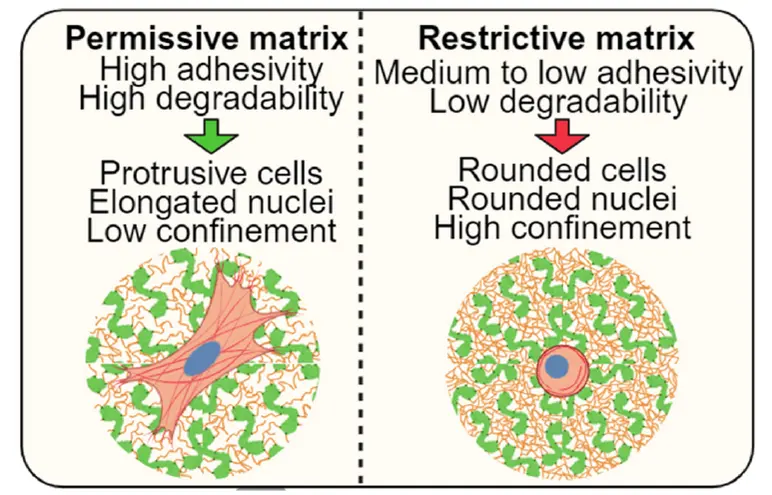
Research Summary: In this work, we engineered tunable PEG-fibrinogen biosynthetic hydrogels and established matrix permissiveness, integrating adhesivity and degradability, as the principal regulator of fibroblast viability, mechanotransduction, and cellular-nuclear confinement in three-dimensional microenvironments.
Researcher Spotlight
Indira Priyadarshani Patra is a biomaterials researcher developing engineered three-dimensional cellular microenvironments to uncover fundamental mechanisms of cell–matrix interactions.
LinkedIn: www.linkedin.com/in/indira-priyadarshani-patra-9505221b4
Instagram: indira_priyadarshani_patra
Twitter: @patra_indira
Lab PI name: Dr. Shantanu Pradhan
University: Indian Institute of Technology, Madras
Lab social media: @PradhanLab
What was the core problem you aimed to solve with this research?
The core challenge was identifying the matrix properties that collectively regulate fibroblast mechanotransduction, viability, and cellular-nuclear confinement, enabling rational engineering of biomimetic three-dimensional hydrogel microenvironments.
How did you go about solving this problem?
We addressed this challenge by engineering a series of tunable PEG-fibrinogen biosynthetic hydrogels with systematically varied adhesivity, degradability, porosity, and stiffness. Through comprehensive physicochemical characterization, three-dimensional fibroblast culture, quantitative morphometric analyses, and mechanotransduction profiling, we established matrix permissiveness as an integrated framework governing cellular viability, mechanobiology, and cellular-nuclear confinement.
“Matrix permissiveness regulates fibroblast spreading, viability, and nuclear confinement in engineered three-dimensional hydrogels.” – Dr. Shantanu Pradhan
How would you explain your research outcomes (Key findings) to the non-scientific community?
Our research asked a simple question: does the environment around a cell determine how the cell behaves? We found that it does. When cells were placed in a supportive environment where they could attach to and remodel their surroundings, they remained healthier, spread and moved more freely, and developed elongated nuclei. When the environment became restrictive, the cells became rounded and confined, and their nuclei also became smaller and more restricted. Most importantly, we found that the ability of cells to attach to and remodel their surroundings was more strongly associated with their behavior than stiffness alone. This work helps us understand how the physical environment can influence cells and provides principles for designing better 3D models of tissues and diseases
What are the potential implications of your findings for the field and society?
The findings establish matrix adhesivity and degradability as key regulators of 3D cellular and nuclear confinement, providing a mechanistic framework for understanding cell–ECM interactions. This framework can guide the rational design of tunable biomimetic matrices for tissue engineering and for modeling microenvironment-driven cellular behavior in diseases such as cancer and fibrosis.
What was the exciting moment during your research?
Realizing that adhesivity and degradability together could explain diverse cellular responses through the unified concept of matrix permissiveness was the most exciting breakthrough.
Paper reference: Patra IP et al. Matrix permissiveness regulates 3D confinement of fibroblasts in biosynthetic hydrogel microenvironments. Acta Biomaterialia (2026). https://doi.org/10.1016/j.actbio.2026.06.046