



Glial ceramide orchestrates lipid homeostasis and age-dependent motor function
Research Summary: Glial disruption of ceramide synthesis or transfer in the brain alters brain lipid levels, reduces lipid droplets and impairs age-dependent motor function, highlighting sphingolipids’ role in motor neuron disorders.
Researcher Spotlight
Lovleen Garg recently completed his doctorate in Ratnaparkhi Lab at IISER Pune. He aspires to become a research scientist and contribute to the understanding of lipid metabolism in disease progression.
Linkedin https://www.linkedin.com/in/dr-lovleen-garg-949494180/
Twitter https://x.com/lovi_garg
Lab PI name: Prof. Girish Ratnaparkhi
University: Indian Institute of Science Education and Research (IISER) Pune
Lab social media: https://sites.google.com/view/ratnaparkhilab/home
What was the core problem you aimed to solve with this research?
Sphingolipids constitute a class of lipids which play structural as well as signaling roles in the brain. The two major cell types in the brain, neurons and glia, have different needs for sphingolipids. Ceramide production is key to sphingolipid flux, and its imbalance has been implicated in several neurodegenerative disorders. Emerging evidence suggests that genetic mutations affecting sphingolipid metabolism can contribute to neurodegeneration, while defects in ceramide transfer (CERT) have been linked to childhood neurodegenerative disorder also known as CerTra syndrome. However, cell-specific roles in the brain remain unclear. To address this gap, we chose the adult brain of Drosophila melanogaster (fruit fly) to investigate neuronal or glial roles of both ceramide synthesis and transfer. Drosophila excels as a model system because metabolic pathways are conserved with humans, and the fly is amenable to genetic manipulation.
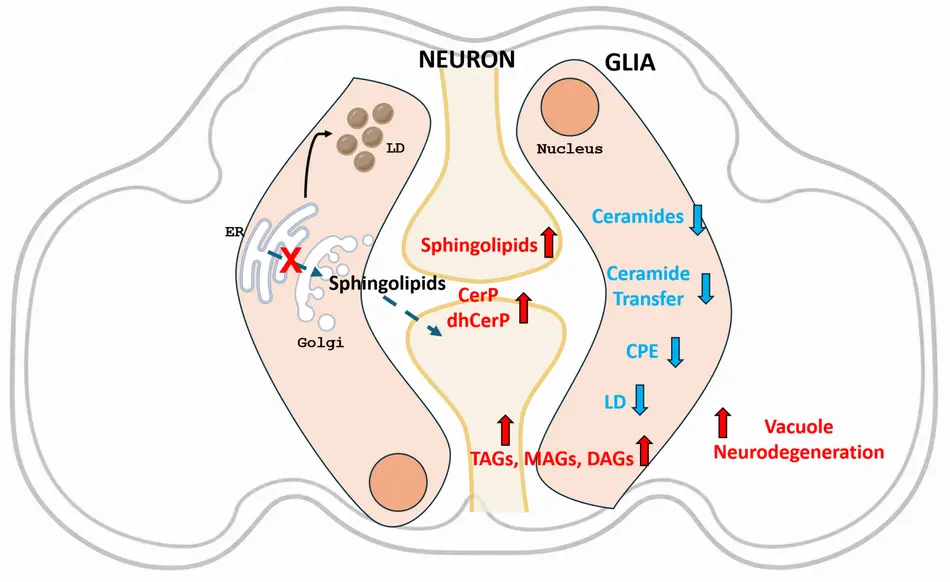
Surprisingly, we found that glial cells were highly sensitive to sphingolipid flux, and modulating enzymes involved in ceramide synthesis or transfer led to seizures as well as an age-dependent drop in motor function, specifically affecting appendages. Intriguingly, reduced ceramide levels, or cessation of transfer within glial cells, led to reduced lipid droplet production.
These findings highlight ceramide’s glial role as an important regulator of brain lipid homeostasis and establish a potential mechanistic link between sphingolipid dysfunction and neurological disorders.
How did you go about solving this problem?
Sphingolipids (complex ceramides) are diverse and branch into multiple pathways and cellular sub compartments. Initially, we focused on the Endoplasmic reticulum (ER), where ceramide is synthesized and is subsequently transferred to other organelles like Golgi, plasma membrane and mitochondria. We systematically investigated ceramide synthesis and transfer in both neuronal and glial cells using robust genetic and biochemical tools available for Drosophila. We targeted individual enzymes in the synthesis pathway by reducing RNA levels and observed the fly behavior in terms of locomotion, climbing or seizures. Then, we performed age dependent lipidomics of the flies’ head using LC-MS technique in collaboration with Prof. Siddhesh Kamat Lab at IISER Pune. Our findings suggest that proper ceramide/sphingolipid flux in glial cells in the brain is critical for motor function. We observed that perturbation of glial schlank (Ceramide synthase in humans) and Ceramide Transfer Protein (CERT) leads to age-dependent remodelling of brain lipid homeostasis, which can cause behavioural and physiological defects that mimic human motor neuron disease. Interestingly, these changes are not only restricted to lipids but lipid droplets as well. Our lab also studies Amyotrophic Lateral Sclerosis (ALS) disease known to cause neurodegeneration in humans. VAPB [VAMP (Vesicle Associated Membrane Protein) Associated Protein B] is the 8th genetic locus found to cause the disease (ALS8). Interestingly, CERT is a physical interactor of VAPB and we have found that VAPB also affects lipid droplet homeostasis which we have recently published as a separate story. This suggests the VAPB-CERT axis at ER-Golgi contact site may be playing a crucial role in brain lipid droplet regulation and in regulating motor neuronal function.
“This study highlights the importance of glial cells in regulating lipid homeostasis and sphingolipids role in age dependent motor function.” – Prof. Girish Ratnaparkhi
How would you explain your research outcomes (Key findings) to the non-scientific community?
Lipids are one of the important macromolecules that act as building blocks of the cell. Ceramides are one such species of lipids synthesized at the endoplasmic reticulum (ER) membrane using a specific set of enzymes in a conserved pathway. Then, ceramide is transferred from ER to other organelles using transfer proteins such as ceramide transfer (CERT) for the formation of sphingolipids. These enzymes are conserved across species. The human brain also contains different types of lipids, including ceramides. The brain tissue has two kinds of cells: neurons, which pass information and glial cells, which support neurons. We use a tiny organism, the fruit fly known as Drosophila melanogaster, for our research because it contains a similar set of enzymes and has specialized genetic tools. So, we reduced RNA transcripts of these enzymes/proteins using genetic tools either in neurons or glial cells. This leads to reduction in ceramide production or its transfer which ultimately leads to disruption of other lipid molecules of the brain. Prolonged disruption of ceramide synthesis or transport in the glial cells of the brain leads to climbing, locomotor defects as well as seizure symptoms. Interestingly, these brains also develop holes, called vacuoles, inside the brain, which is a marker of neurodegeneration. Our study shows the significance of ceramides in regulating brain functions and also contribute to the understanding of neurological disorders where genetic mutations cause defects in sphingolipid pathway thus affecting human physiology.
What are the potential implications of your findings for the field and society?
Several studies point toward lipid imbalance in a number of neurodegenerative disorders. Moreover, a number of genetic mutations have been identified in human patients linked to sphingolipid metabolism. Recently, ceramide transfer (CERT) have also been implicated in neurological disorders. Our study highlights the importance of ceramide pathway in glial cells and how imbalance in ceramide phosphoethanolamine (CPE, analog of sphingomyelin) can remodulate brain lipid homeostasis. Our study also focused towards ceramide roles in lipid droplet dynamics, which can act as a biomarker in neurodegenerative diseases. Furthermore, the role of glial cells in shaping animal physiology suggests their importance in brain function and opens potential treatment avenues for diseases linked to sphingolipid metabolism.
What was the exciting moment during your research?
When I first observed reduced lipid droplets in the brain after knocking down CERT in glial cells, it was quite puzzling. Very few studies link ceramide to lipid droplets in the brain. When I put back CERT in the brain, using genetic tools, not only were lipid droplets back to normal but motor dysfunction was rescued. That was a eureka moment for me. I had a lot of fun learning about fly genetics and taking a deep dive into lipids and their critical role in regulating brain function. My research (and many other studies) makes it increasingly clear that glia are more important for brain homeostasis than previously thought, and that the partnership between glia (10-15% of brain cells) and neurons (80-85% of brain cells) is one of equals.
Paper reference: Lovleen Garg, Karthik H, Aakash Chandramouli, Senthilkumar D, Siddhesh Kamat, Anuradha Ratnaparkhi, Girish Ratnaparkhi; Glial ceramide orchestrates lipid homeostasis and age-dependent motor function. Dis Model Mech 2026; dmm.052840. doi: https://doi.org/10.1242/dmm.052840