


The Bigger, The Better: A Hidden Link between Glycolysis and Titan Cell Formation
Research Summary: Our study reveals a glycolysis–calcium–calcineurin signaling axis that governs titan cell morphogenesis in Cryptococcus neoformans, establishing a direct mechanistic link between central carbon metabolism, calcium homeostasis, and fungal morphogenesis.
Researcher Spotlight
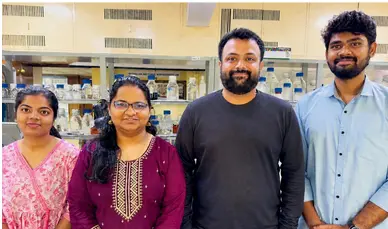
Pallavi S Phatak is a PhD student in Dr. Sriram Varahan’s laboratory at CSIR-CCMB, Hyderabad. Her research focuses on elucidating the metabolic drivers of titan cell formation in C. neoformans.
Twitter: @Phatak6Phatak/
Lab PI name: Dr. Sriram Varahan
University: CSIR-Centre for Cellular and Molecular Biology (CCMB)
LinkedIn – https://www.linkedin.com/in/sriram-varahan-01361a51/
Twitter: @sriram_varahan
What was the core problem you aimed to solve with this research?
Titan cell formation in C. neoformans has long been recognized as an important virulence factor, but the mechanistic details governing this morphological transition remain poorly understood. Our goal was to delineate this mechanism, with the hope of uncovering new ways to target this deadly fungal pathogen. Notably, one of the foundational studies establishing an in vitro assay to recapitulate titan cell formation under laboratory conditions reported upregulation of several glycolysis genes during titanization. Yet the field has lacked a clear answer to a fundamental question: does central carbon metabolism, particularly glycolysis, play a functional role in titan cell formation, and if so, through what mechanism does it regulate this morphological transition? Our study set out to address precisely these questions.
How did you go about solving this problem?
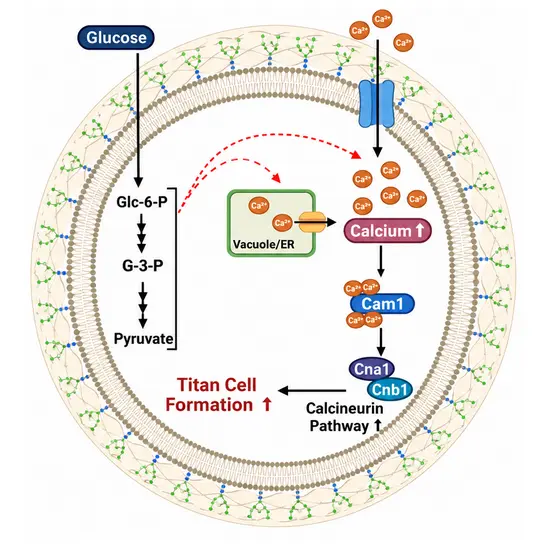
To address this question, we employed a multidisciplinary approach combining pharmacological, genetic, transcriptomic, and cell-biological methods to dissect the role of glycolysis in titan cell formation. We first tested whether glycolysis contributes to titanization using both glycolysis inhibitors and knockout strains of key glycolytic genes under titan cell-inducing conditions. Our results demonstrated that functional glycolysis is indeed required for titan cell formation. We next sought to uncover the underlying mechanism governing this glycolysis-dependent regulation. Transcriptomic analysis revealed an unexpected connection between glycolysis and the calcineurin signaling pathway, specifically under titan cell-inducing conditions, and the functional relevance of calcineurin signaling in titanization was subsequently validated through pharmacological inhibition of this pathway. However, how glycolysis regulates calcineurin signaling to control titan cell formation remains unclear. To resolve this, we measured intracellular calcium levels in glycolysis mutants, with and without calcium chloride supplementation, relative to wild-type cells under titan cell-inducing conditions. We observed significantly reduced intracellular calcium levels in the glycolysis mutants, which were fully restored upon calcium chloride supplementation. Further functional validation confirmed that glycolysis is essential for maintaining intracellular calcium homeostasis, thereby regulating calcineurin signaling. Together, these findings identify a previously unrecognized glycolysis–calcium–calcineurin axis governing titan cell formation in C. neoformans.
“Our study uncovers a previously unrecognized glycolysis–calcineurin axis that provides new insights into the metabolic regulation of titan cell formation.” – Dr. Sriram Varahan
How would you explain your research outcomes (Key findings) to the non-scientific community?
Cryptococcus neoformans is a dangerous fungus that can cause life-threatening infections, including meningitis. One of its important survival strategies is to transform into unusually large cells called “Titan cells,” which help the fungus withstand attacks from the host immune system. However, how this remarkable transformation is controlled has remained poorly understood.
Our study uncovered a previously unknown link between the fungus’s metabolism and titan cell formation. We found that glycolysis, the process by which cells break down sugar (glucose), does more than provide energy. It helps maintain the calcium balance required to activate an important signaling pathway called calcineurin. This metabolic–signaling connection enables the fungus to undergo titan cell formation. When glycolysis was disrupted, calcium levels and calcineurin signaling were reduced, resulting in impaired Titanization, while restoring calcium levels rescued this defect.
Together, our findings reveal a glycolysis–calcium–calcineurin axis that controls titan cell formation and provide new insight into how C. neoformans adapts to its host environment. This previously unrecognized connection also highlights a potential metabolic vulnerability that could be explored for developing new strategies against this deadly fungal pathogen.
What are the potential implications of your findings for the field and society?
Our study identifies a previously unrecognized glycolysis–calcium–calcineurin regulatory axis that controls titan cell formation in Cryptococcus neoformans, providing a new framework for understanding how fungal metabolism is coupled to morphogenesis. This finding expands the role of glycolysis beyond energy production and highlights how metabolic state can directly influence key signaling pathways that regulate fungal adaptation and virulence.
From a therapeutic perspective, this novel metabolic–signaling connection could provide new opportunities for antifungal development. Targeting components of this axis may offer a strategy to interfere with titan cell formation and thereby weaken an important fungal adaptation that contributes to persistence in the host. Moreover, the connection between glycolysis and calcineurin, both evolutionarily conserved pathways with broad roles across biological systems, raises the possibility of uncovering similar metabolic–signaling relationships in other fungal pathogens and related metazoan systems. Ultimately, our findings provide a foundation for exploring metabolism–signaling interactions as potential therapeutic targets for combating fungal infections.
What was the exciting moment during your research?
The most exciting moment of the study was discovering that perturbing glycolysis led to a significant downregulation of the calcineurin pathway. This connection was completely unexpected and gave us a new direction for understanding how metabolism could regulate titan cell formation. The subsequent finding that glycolysis mutants had reduced intracellular calcium levels provided an important mechanistic link between glycolysis and calcineurin signaling. The most exciting and affirmative moment came when calcium supplementation specifically rescued the titan cell formation defect in the glycolysis mutants. Together, these findings allowed us to move from an unexpected observation to a mechanistic model linking glycolysis, calcium homeostasis, and calcineurin signaling in titan cell formation.
Paper reference: Pallavi S Phatak, Sudharsan Mathivathanan, Dhrumi Shah, Ishvarya Suresh, Mary Shejo, Santosh Kumar Das, Sriram Varahan, A glycolysis–calcineurin regulatory axis orchestrates titan cell formation in Cryptococcus neoformans, Genetics, 2026; iyag211, https://doi.org/10.1093/genetics/iyag211