


Unraveling molecular intricacies of naturally encoded signaling bias at GPCRs
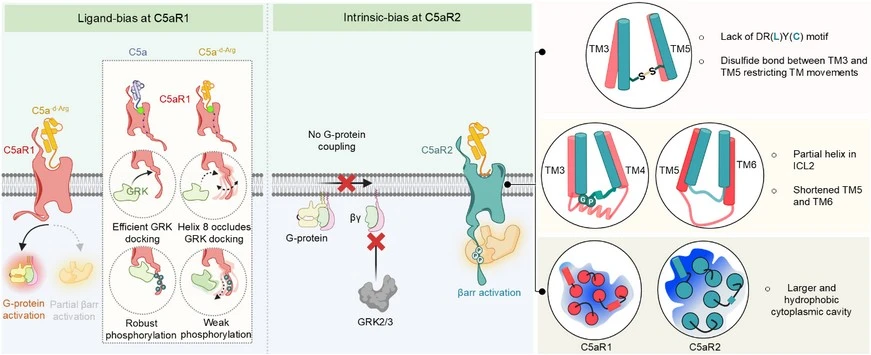
Research Summary: We discovered the ligand-mediated G-protein bias and receptor-mediated β-arrestin biased-signaling encoded within complement anaphylatoxin receptors, C5aR1 and C5aR2, using pharmacological, biochemical and biophysical techniques.
Researcher Spotlight
First authors: Divyanshu Tiwari, Kazuhiro Sawada, Annu Dalal, Sudha Mishra, Xaria X. Li, Joshua C. Dent, Kiae Kim, Manish K. Yadav
Divyanshu Tiwari is a Ph.D. researcher at the Indian Institute of Technology Kanpur, exploring the structural and molecular mechanisms driving naturally encoded signaling bias at G protein-coupled receptors, under the mentorship of Prof Arun K Shukla.
Linkedin | Twitter
Lab: Prof Arun K Shukla, IIT Kanpur
What was the core problem you aimed to solve with this research?
C5aR1 and C5aR2 are very closely related seven-transmembrane receptors, belonging to the GPCR superfamily, constituting an integral part of our immune system and playing a crucial role in driving inflammatory response under pathogen attacks. Although C5aR1 and C5aR2 recognize the same immune signaling molecule, they produce remarkably different cellular responses. For example, C5a, a complement anaphylatoxin, binds to and activates both C5aR1 and C5aR2. While C5aR1 activates both G-proteins and β-arrestins, C5aR2 exclusively signals through β-arrestins. The molecular basis for this difference had remained an open question for many years. Our goal was to understand how these two closely related receptors interpret the same signal so differently, and to uncover the structural features that allow C5aR2 to selectively recruit β-arrestins while lacking G-protein signaling
How did you go about solving this problem?
To address this, we combined cellular and pharmacological signaling assays with advanced biochemical, biophysical, and structural approaches. We first established that C5a-desArg, a naturally occurring form of C5a lacking only the terminal arginine residue, acts as a G-protein-biased ligand at C5aR1, revealing a naturally encoded mechanism of ligand bias. We then determined five cryo-electron microscopy (cryo-EM) structures of C5aR2 in complex with its endogenous ligand C5a and synthetic peptide agonists, uncovering the structural basis of its intrinsic β-arrestin bias. These structural studies also revealed an unexpected homodimeric assembly of mouse C5aR2 and yielded one of the smallest cryo-EM structures reported for a monomeric GPCR bound to its endogenous ligand. Finally, we designed and characterized a highly selective species-specific peptide agonist for human C5aR2 and determined its cryo-EM structure, providing a molecular blueprint for receptor-selective drug design.
How would you explain your research outcomes (Key findings) to the non-scientific community?
Imagine two identical-looking locks opened by the same key, yet each unlocks a different door. We discovered that this is exactly how these immune receptors work. Although both recognize the same signaling molecule, they interpret its message differently. One receptor activates multiple cellular communication pathways, whereas the other selectively engages only one. We also found that a naturally occurring version of the signaling molecule subtly shifts this balance without changing the message itself. Together, these discoveries reveal how nature fine-tunes immune signaling with remarkable precision, allowing the body to mount an effective defense while avoiding unnecessary or excessive inflammation.
What are the potential implications of your findings for the field and society?
Our immune system constantly walks a fine line; it must respond strongly enough to eliminate infections yet know when to stop to prevent damage to healthy tissues. When this balance is lost, it can lead to chronic inflammation and autoimmune diseases such as rheumatoid arthritis, multiple sclerosis, and sepsis. Our work uncovers one of the molecular mechanisms that nature uses to maintain this balance. By learning how these receptors selectively control different signaling pathways, we can envision designing next-generation medicines that harness the beneficial aspects of immune signaling while minimizing unwanted side effects. Since G-protein-coupled receptors (GPCRs) represent the largest family of drug targets, the insights from this study may also extend far beyond the complement system and contribute to better treatments for many human diseases.
What was the exciting moment during your research?
One of the most memorable moments was when we finally solved the first structure of C5aR2. Looking back, the turning point came much earlier when my mentor, Dr. Arun K. Shukla, was exploring strategies to overcome one of the biggest challenges in determining C5aR2 structure. This led us to test whether an antibody against C5aR2 could serve as a cryo-EM fiducial marker. We obtained the hybridoma clones, expressing C5aR2-specific antibody, purified and generated its Fab fragment, and reconstituted the C5aR2-Fab complex. Seeing that complex for the first time was an unforgettable moment. It gave us the first real confidence that solving the elusive C5aR2 structure was within reach. When the structure finally emerged, it answered a long-standing question in the GPCR field that why does C5aR2, despite binding the same ligand as C5aR1, lacks G-protein coupling. It was one of those rare moments in research where years of experiments, and hypotheses suddenly came together into a coherent picture, and this also reminds me how subtle changes in molecular architecture can profoundly influence the way our immune system functions.
Paper reference: Molecular mechanisms of naturally encoded signaling bias at the complement anaphylatoxin receptors. Molecular Cell