



Human hnRNPA1 protein acts as a host restriction factor against SARS-CoV-2
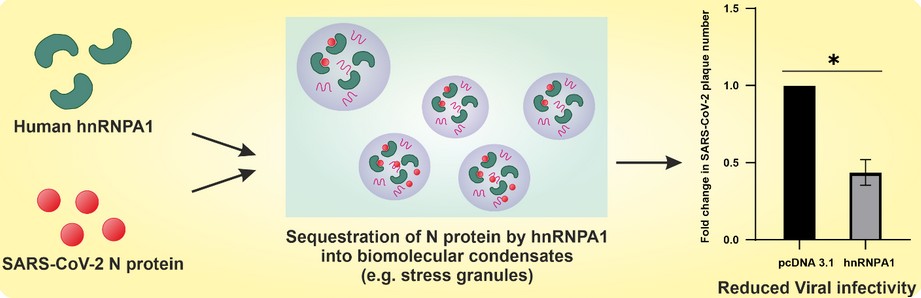
Research Summary: We found that human hnRNPA1 protein directly binds to the SARS-CoV-2 nucleocapsid protein, sequesters it into stress granules, and suppresses viral replication, thereby acting as a natural host defence factor.
Researcher Spotlight
Parul Gupta is a PhD scholar in the Molecular Biophysics Unit at the Indian Institute of Science, Bengaluru, studying protein–protein interactions, protein-RNA interactions, intrinsically disordered proteins, and liquid–liquid phase separation governing virus-host interaction.
Linkedin https://www.linkedin.com/in/parul-gupta-50b24a195/
Lab: Prof Mahavir Singh, Indian Institute of Science
Lab social media: https://singhmlab.weebly.com/
What was the core problem you aimed to solve with this research?
The primary role of the SARS-CoV-2 nucleocapsid (N) protein is to package the viral RNA genome into long, flexible, helical ribonucleoprotein (RNP) complexes, which is essential for viral replication. Together with the envelope protein, it participates in genome condensation and packaging. The N protein is abundantly expressed during viral infection, and it is capable of inducing protective immune responses against SARS-CoV-2. We set out to test whether one of the most abundant human RNA-binding proteins, hnRNPA1, physically interacts with the N protein, and what such an interaction would mean for the viral life cycle. Mapping this host-virus interaction is an important step towards identifying new therapeutic targets against future coronavirus outbreaks.
How did you go about solving this problem?
We used a combination of biochemistry, biophysics and cell biology approaches to address this question. First, we purified recombinant hnRNPA1 and N protein in vitro. We then used an affinity pull-down assay to confirm their interaction and measured the binding affinity by microscale thermophoresis (MST)These results suggested that the interaction is specific and strong between the two proteins. To identify the interacting regions, we generated a series of truncated protein constructs and mapped the interaction to the intrinsically disordered containing regions of both proteins. Using confocal microscopy, we showed that the two proteins co-phase separate into biomolecular condensates through their intrinsically disordered regions, and in cells, we found that they colocalise within stress granules. Finally, to test the functional relevance of this interaction, we modulated hnRNPA1 expression by overexpression and shRNA-mediated knockdown in SARS-CoV-2-infected cells and measured viral RNA levels and infectious virus production.
“Our results show that hnRNPA1 interacts with the SARS-CoV-2 nucleocapsid protein, sequestering it into stress granules and restricting viral replication.” – Prof Mahavir Singh
How would you explain your research outcomes (Key findings) to the non-scientific community?
Viruses rely on host cells to replicate and spread. We found that hnRNPA1, a highly abundant human RNA-binding protein, directly interacts with a key SARS-CoV-2 protein called Nucleocapsid (N) protein. This interaction drives the formation of liquid-like droplets, and both proteins colocalise in cells to stress granules (protective cellular compartments that cells form in response to stress). Importantly, when we increased the amount of this human protein hnRNPA1 in the cell, the virus made fewer copies of itself while when we depleted it, the virus multiplied more. In short, this human protein behaves like a natural restriction factor on the virus.
What are the potential implications of your findings for the field and society?
Our work identifies hnRNPA1 as a host restriction factor against SARS-CoV-2, a naturally occurring cellular defender that limits viral RNA assembly, and replication. This deepens our understanding of how phase separation and stress granules shape the battle between host and virus. Because the interaction depends on intrinsically disordered regions of these proteins and condensate formation, it points toward a new class of potential antiviral strategies: stabilizing or mimicking this host defense could help contain not only SARS-CoV-2 but also future coronaviruses. More broadly, it adds foundational knowledge that could inform next-generation broad-spectrum antiviral therapeutics.
What was the exciting moment during your research?
The most exciting moment was seeing both proteins colocalise and light up together inside the very same liquid-like droplets under the microscope for the first time. It was exciting to watch a human protein and a viral protein, originating from two different worlds, physically come together to form shared biomolecular condensates. The excitement grew even further when we demonstrated that increasing hnRNPA1 levels significantly reduced viral replication. That result made all the long hours and challenges in the lab feel truly worthwhile.
Paper reference: Gupta, Parul, et al. “Interaction and co‐phase separation of SARS‐CoV‐2 nucleocapsid protein and human hnRNPA1 and its implications for viral life cycle.” FEBS letters (2025). https://doi.org/10.1002/1873-3468.70375