



Why Co-Foraging Honeybee Species Keep Separate Gut Microbiomes
Research Summary: We compared gut bacteria and fungi across four Indian honeybee species sharing the same mustard fields, and found host identity — not shared foraging — shapes each species’ microbiome and its stability.
Researcher Spotlight
Dipendra Nath Basu is a Simons-Ashoka Early Career Fellow at Ashoka University, mentored by Imroze Khan and Jens Rolff, studying insect microbiomes, immunity and evolutionary ecology.
Linkedin: https://www.linkedin.com/in/dipendra-nath-basu-023707211/
Twitter: https://x.com/Deepnb
Lab PI name: Imroze Khan
University: Ashoka University
Lab social media: Evolutionary Immunology Lab — https://myevoecoimmunol.com/
What was the core problem you aimed to solve with this research?
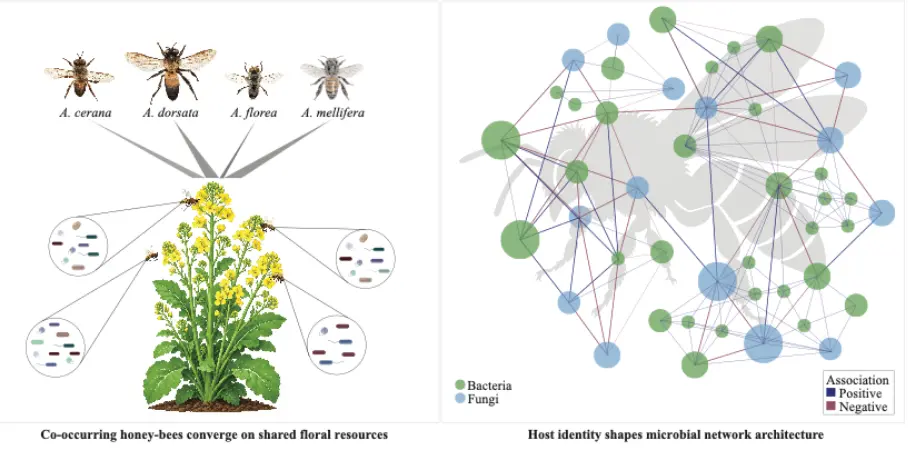
Honeybees are essential pollinators, but we know surprisingly little about how their internal microbial communities — which help with digestion, immunity and overall health — are assembled, especially in wild, non-European species. We wanted to know whether four co-occurring Indian honeybee species foraging on the very same mustard flowers end up sharing similar gut microbiomes simply because they visit the same flowers, or whether each species maintains its own distinct microbial community regardless of shared foraging. This matters because pollinator declines are increasingly linked to disruptions in the microbiome, and we didn’t yet know whether protecting one bee species’ microbiome also protects its neighbours’, or whether each species needs to be understood on its own terms.
How did you go about solving this problem?
We sampled four Apis species — A. cerana, A. dorsata, A. florea, and the managed A. mellifera — foraging together across seven mustard fields in Haryana during peak bloom, a natural setting where all four species are forced to rely on a single, homogeneous floral resource. Alongside behavioural observations of how each species foraged (abundance, time spent per flower), we used bacterial (16S) and fungal (ITS) amplicon sequencing to characterise the microbial communities each species carried, built microbial co-occurrence networks for each species, and used Bayesian network modelling together with simulated ‘extinction’ of network hubs to test how stable or fragile each species’ microbial community was under disturbance.
“Even sharing the same flowers doesn’t erase a honeybee’s microbial identity — host biology still calls the shots.” – Prof Imroze Khan
How would you explain your research outcomes (Key findings) to the non-scientific community?
Even though all four bee species were feeding on exactly the same mustard flowers, each carried its own distinct set of gut bacteria — species identity mattered far more than shared foraging. Fungal communities, by contrast, were much more similar across species, likely because fungi hitch a ride more easily via flowers. We also found that the native Indian hive bee, Apis cerana, has a more diverse and compartmentalised microbiome that appears better able to withstand disturbance, whereas the managed, non-native Apis mellifera has a more tightly-knit, vulnerable microbial network. In short, neighbouring bee species sharing the same flowers don’t necessarily share microbial health, and some species may be more at risk than others when their microbiomes are disrupted.
What are the potential implications of your findings for the field and society?
Our results suggest that microbiome-focused conservation or disease-management strategies can’t be one-size-fits-all across pollinator species, even when those species share the same habitat and floral resources — each host’s own biology filters and shapes its microbial community. Identifying the ‘hub’ microbes that stabilise each species’ network could offer a more targeted, tractable way to protect pollinator health than trying to preserve overall microbial diversity alone. The finding that managed honeybees may carry more fragile microbial networks than their wild, native relatives also has implications for how we manage apiaries and think about disease spillover risk between managed and wild bee populations.
What was the exciting moment during your research?
One exciting moment was watching the co-occurrence networks come together and realising that Apis cerana — the species with the lowest visitation dominance in our fields — turned out to carry by far the richest and most modular microbiome of the four species. It was a nice reminder that ecological ‘success’ in a shared landscape doesn’t always look like numerical dominance.
Paper reference: Basu, D.N., Khangar, P., Joshi, K., Krishna, S. & Khan, I. (2026). Tracking Microbiome Composition and Stability Across Indian Social Honeybees Foraging in a Homogeneous Mustard Crop Landscape. Microbial Ecology. https://doi.org/10.1007/s00248-026-02828-w (Preprint: https://doi.org/10.64898/2026.04.19.719467)