



5-Iodotubercidin targets NFκB signaling to inhibit Epithelial to Mesenchymal Transition
Research Summary: Epithelial to mesenchymal transition (EMT) is a trans-differentiation process, crucial for development, inflammation and cancer. 5-Iodotubercidin-a nucleoside analog acts as a direct inhibitor of IKKβ kinase and downstream EMT
Researcher Spotlight
Sayari Bhattacharya is a doctoral student from Kusuma School of Biological Sciences, IIT Delhi, and the work was done jointly with RNA Biology lab at the South Asian University.
Linkedin : https://www.linkedin.com/in/sayari-bhattacharya-83b36b104/
Lab PI name: Dr. Sonam Dhamija, Dr. Manoj B. Menon (joint project between two labs, one focused on kinase signaling and the other one on RNA Biology and EMT)
University: South Asian University (SD) and Indian Institute of Technology Delhi (MBM)
What was the core problem you aimed to solve with this research?
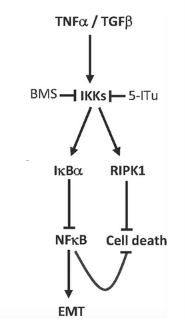
5-Iodotubercidin (5-ITu) was initially identified as a nucleoside analog and adenosine kinase inhibitor. Later studies have shown 5-ITu to target various protein kinases like CK1, CK2, ERK2, Haspin and more recently DYRK1A. 5-ITu also inhibits RNA synthesis and SARS CoV2. In our previous study, we had identified 5-ITu in a screen for compounds sensitizing MK2-deficient cells to TNFα-induced necroptosis. The study revealed that 5-ITu induced RIPK1 dependent cell death in MK2 deficient conditions by abrogating the IKK-dependent phosphorylation of RIPK1 and facilitating RIPK1 activation. While 5-ITu has been tested as a chemotherapeutic molecule in in vivo studies, its synergy with p38/MK2 inhibitors open additional opportunities for anticancer interventions. Hence, we decided to probe the effect of 5-ITu on other pathologically relevant processes other than necroptosis. EMT was chosen for the same. In addition, we also were curious to identify the kinase target of 5-ITu responsible for its effect on TNF-induced cell death.
How did you go about solving this problem?
We employed cell culture models to investigate the effect of 5-ITu on TGFβ induced EMT in lung and pancreatic cancer cell lines. Microscopic analyses, real time qPCR, immunoblotting and confocal microscopy was used to show that 5-ITu indeed inhibits TGFβ induced EMT in A549 (lung adenocarcinoma) and PANC1 (pancreatic cancer) cell lines. There was upregulation of epithelial marker like CDH1 and downregulation of mesenchymal markers like CDH2, ZEB1, SNAI1 and VIM. Interestingly this inhibition was independent of 5-ITu’s function as an adenosine kinase inhibitor. The effect of 5-ITu on TGFβ-mediated EMT was not dependent on RIPK1 activation. However, immunoblotting showed reduced levels of phospho p65, indicating a blockade of NFκB signaling. Pharmacological and siRNA-mediated knockdown experiments revealed that IKKα/β could be a potential target of the drug and NFκB pathway inhibition phenocopy the effects of 5-ITu on EMT.
In vitro kinase assays using recombinant IKKβ and its substrate IκBα showed that 5-ITu directly binds to and inhibits IKKβ. Dose-response experiments established 5-ITu was a potent IKK inhibitor with comparable IC50 values to commercial IKKβ inhibitor-BMS345541.
To further investigate the effect of 5-ITu on NFκB pathway, we compared the gene expression signatures unique to TGFβ signaling and that of TNF-NFκB pathway. Employing gene sets from MsigDB database genes common to TGFβ and TNFα/NFκB pathways were obtained. Ten genes common between the two datasets indicated these genes were NFκB-dependent transcripts downstream to TGFβ and TNFα signaling and these 10 genes were essential for predicting overall survival for both lung and pancreatic cancer. qPCR of 5-ITu treated A549 cells narrowed down the signature to 4 genes- SMAD3, SERPINE1, TGIF1, and PMEPA1. This four gene signature was associated with poorer disease-free survival and could be used as potential prognostic markers for lung and pancreatic cancer, thus establishing the significance of the 5-ITu–sensitive gene signature.
“Systematic analyses of signaling pathways will lead to translationally relevant leads. This study is a perfect example for this.” – Dr. Sonam Dhamija & Dr. Manoj B. Menon
How would you explain your research outcomes (Key findings) to the non-scientific community?
Epithelial to mesenchymal transition is an essential cellular process wherein epithelial cells lose cell to cell connections and from the basement membrane, transforming into invasive fibroblast like morphology. This process is mediated by various environmental conditions like hypoxia, inflammation, metabolic stress and multiple secreted factors including TGFβ. EMT is often a key step in tumor progression and metastasis. We found out that 5-ITu- a multi target kinase inhibitor inhibits TGFβ induced EMT. This inhibition is mediated through abrogation of the IKK- NFκB pathway-one of the crucial pathways for inflammation, cell survival and death, cancer progression and metastasis. Further, we showed that 5-ITu directly targets IKKβ with high sensitivity. Based on TGFβ/TNFα- NFκB pathway dependence and sensitivity to 5-ITu, we identified a gene expression signature consisting of 4 genes that can be used for prognosis for lung and pancreatic cancer.
What are the potential implications of your findings for the field and society?
The study identified 5-ITu as a potent inhibitor of TGFβ induced EMT, while its role in inducing RIPK1 dependent necroptotic cell death was also reported by our group earlier. EMT is crucial for wound healing, cancer progression and metastasis. We reported here that 5-ITu blocks morphological changes, migration, and EMT-marker expression in A549 lung and PANC1 pancreatic cancer cells—independent of adenosine kinase inhibition and also independent of RIPK1 activity.
The identification of a 5-ITu sensitive NFκB dependent 4-gene signature-SMAD3, SERPINE1, TGIF1, PMEPA1 predicts overall and disease-free survival in TCGA lung and pancreatic cancer cohorts serve as prognostic marker that can be tested more broadly for patient stratification.
5-ITu is a well-established nucleoside analogue with inhibitory functions ranging from acting as a genotoxic drug to inhibition of SARS-CoV-2 RNA replication. Our findings report its role as an inhibitor of EMT and expand its potential clinical implications as a chemotherapeutic agent and may accelerate repurposing efforts. Realization of these benefits, would however require rigorous in-vivo efficacy, toxicity, and combination studies.
What was the exciting moment during your research?
Quoting Prof. Peter Hegemann, “Look to nature, find something that fascinates you, and take the risk of pursuing it.”. We, as a lab, like to pursue the unknown with an open mind, rather than testing what we already expect for. This project indeed fascinated us with every new finding. It was exciting to see the effect of EMT by confocal microscopy. Revalidation of our initial finding by qPCRs and immunoblotting strengthened our hypothesis and intrigued us to probe into the mechanism behind our observation that 5-ITu inhibits TGFβ induced EMT. The day we found out that 5-ITu inhibits EMT by directly inhibiting IKKβ was a moment of Eureka for us. This finding fortified the base of our study. Establishment of the 4 gene signature was also exciting. Interestingly, this 4-gene signature stratified overall and disease-free survival in TCGA lung and pancreatic cancer cohorts . Realising that our in vitro study holds potential implications in lung and pancreatic cancer, and was highly significant, still leaves us with lingering questions that opens doors to more interesting questions for the future.
Paper reference: Bhattacharya, S., Manjari, M., Ganesh, V., Menon, M. B., & Dhamija, S. (2026). 5-Iodotubercidin inhibits epithelial to mesenchymal transition by inhibiting IKK/NFκB-dependent gene expression. The Journal of biological chemistry, 302(11), 113548. https://doi.org/10.1016/j.jbc.2026.113548