



Light-Controlled Chloride Transport Through Synthetic Anion Channels
Research Summary: We have designed and prepared molecules in the lab that mimic the anion transport proteins in selectively moving anions across biological membranes. Furthermore, our design allows control over the anion transporting activity through shining blue light.
Researcher Spotlight
Dr. Nyaya Prakash Pradhan completed his PhD in Chemistry under Prof. Aasheesh Srivastava at IISER Bhopal and joined the same group as Project Research Scientist – I. His research focuses on small molecule transporters and supramolecular systems for sensing and transporting anions and protons, with an emphasis on understanding and mimicking ion transport across biological membranes.
Linkedin – www.linkedin.com/in/dr-nyaya-prakash-pradhan-phd-505538258
Twitter – https://x.com/NP_Chem01
Instagram – https://www.instagram.com/nayan.23_8/
Lab PI name: Prof. Aasheesh Srivastava
University: Indian Institute of Science Education and Research (IISER), Bhopal
Lab social media: ASLab, Twitter: https://x.com/ASLab_iiserb
What was the core problem you aimed to solve with this research?
Biological ion channels are essential to how our cells work. Essentially, they are proteins that control the movement of ions across cell membranes and help regulate many important biological processes. When these proteins malfunction, they can lead to a range of diseases collectively known as “channelopathies”. Yet these natural protein channels are large and structurally complex, making them difficult to study or to control ion transport from outside. To address this challenge, we wanted to build much simpler, synthetic molecules that could mimic this channel-forming behaviour, while also being responsive to light so that we could potentially turn the ion transport ON and OFF by shining light.
Most reported light-responsive ion transporters either work as carriers that shuttle ions one at a time, or are already assembled into channels. What had not really been explored was a system where the molecules come together (self-assemble) to form a channel when they interact with anions, where that whole self-assembly process can then be modulated with light − that combination is what we set out to achieve with this work. In this way, we created a simple system in which ions help bring the molecules together, while light provides a way to control ion transport.
How did you go about solving this problem?
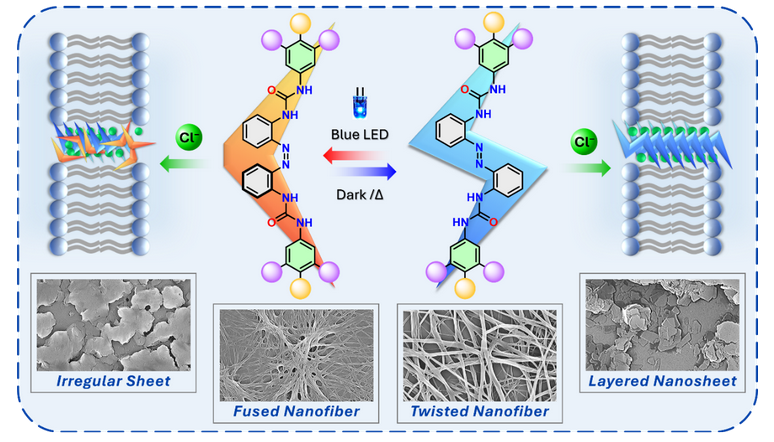
We built a series of molecules by combining together light-responsive azobenzene residues with anion binding urea residues within a single construct. We altered the electronics in the molecules to modulate their anion binding abilities along with their lipophilicity to control their partitioning into synthetic lipid membranes. Using NMR and UV-Vis spectroscopy, we confirmed that shining 450 nm blue light switched the molecules from a flat shape to a bent shape, and that the process was thermally reversible.
The next challenge was to understand whether chloride could actually induce these molecules to assemble into channels. The most promising molecule showed the strongest chloride binding and nanomolar transport activity, so we investigated it in greater detail. The real breakthrough came from growing single crystals, in which chloride binding changes the molecule from a planar to a bent conformation and drives their self-assembly into channel-like architectures. We backed this up with electron microscopy, which converted from long nanofibres to thin nanosheets upon chloride addition, and with electrophysiology experiments in artificial membranes, which picked up the flickering electrical signature of ions moving through genuine channel-like pores. Finally, blue light irradiation weakened the assembled channels and lowered chloride transport, while thermal relaxation restored their activity, allowing the system to be switched reversibly.
“This gratifying study demonstrates how molecular design profoundly influences the functional outcome – in this case, the transport of chloride ions across lipid bilayers.” – Prof. Aasheesh Srivastava
How would you explain your research outcomes (Key findings) to the non-scientific community?
Every cell in our body is wrapped in a fatty membrane, and charged ions such as chloride need dedicated ‘gates’ to cross it − gates that are usually large, complicated proteins. When this process is disrupted, cells can no longer control chloride ion movement properly, which can disrupt essential cellular processes and potentially cause disease such as cystic fibrosis (CF), epilepsy, and cancer. We built a much simpler artificial gate out of small, custom-made molecules. What is neat is that these molecules do not form a gate on their own − it is the chloride ion itself that assists in bridging several molecules together into a channel shape. Once that channel forms, chloride ions can pass through the membrane. On top of that, we had attached a light-sensitive switch to the molecule. So, shining a particular colour of light alters its shape and partially breaks up the channel, slowing down the chloride flow. Removing the light source, or gently heating the system lets the channel reassemble and restores the ion flow. In short, we have made a tiny, “Light-operated Gate” for salt ions that only assembles itself when it is needed.
What are the potential implications of your findings for the field and society?
For the research community, our findings provide a new strategy for designing artificial ion channels using synthetic molecules that can recognize ions, assemble themselves, and be controlled by light. Because the chloride transport could be modulated using light, they could allow ion movement to be controlled when and where it is needed. Such light-responsive ion transport systems could be valuable for developing new approaches in photopharmacology, where light is used to control biological activity. More broadly, these systems could help us better understand and control ion movement across cell membranes, with potential relevance to membrane biophysics and, in the longer term, targeted therapeutic strategies. Further studies will be needed to establish their practical biomedical applications.
What was the exciting moment during your research?
One of the most exciting moments was when the x-ray diffraction studies on the crystals revealed that chloride ions were actually driving the molecules to come together and form channel-like architectures. Seeing that transformation directly, atom by atom, rather than only inferring it from transport measurements, was the point where the whole story clicked together. It clearly showed that the very ion we were trying to transport was also the ion instructing the molecules how to organize themselves − essentially saying, “Stand in a queue, I’m coming!”
What made it even more exciting was that this structural observation was supported by our other experiments. We saw the morphology change from nanofibre-to-nanosheet upon chloride addition, while electrophysiology measurements showed channel-like ion conduction. Bringing these observations together, from the molecular structure to the larger-scale assembly and finally to membrane transport, was a particularly rewarding moment in the project.
Paper reference/citation: Pradhan, N. P.; Dhasmana, Y.; Pal, M.; Kumar, R.; Chopra, D.;* Manna, D.;* Srivastava, A.* Photoresponsive supramolecular chloride channels formed through anion-induced self-assembly of azo-urea molecular photoswitches. Nanoscale 2026, 18, 18008–18019. https://doi.org/10.1039/d6nr01488g