


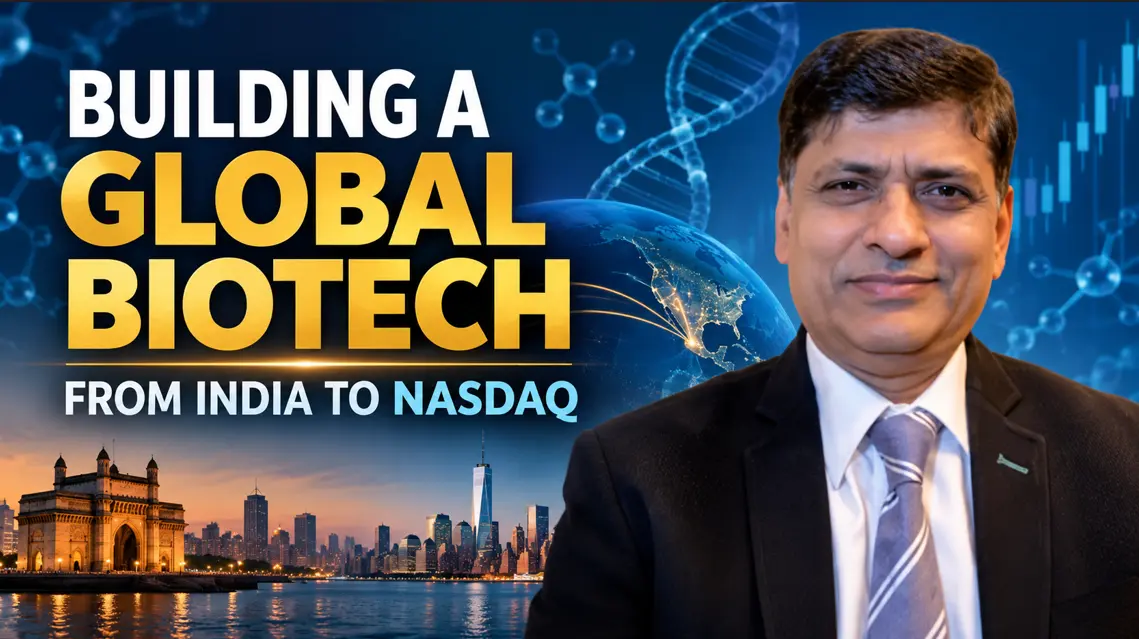
Building a Global Biotech Company
From India to NASDAQ: Venkat Nelabhotla on Building a Global Biotech Company, Raising Capital, and Why India Must Own the Next Biopharma Revolution
Founder Interview | BioPatrika
India has earned global recognition as the “pharmacy of the world,” supplying affordable medicines and vaccines to millions. Yet when it comes to discovering and developing novel therapies, the country still has a long way to go. Building an innovation-driven biopharmaceutical company requires far more than great science—it demands visionary leadership, patient capital, regulatory expertise, and the ability to execute across global markets.
Few Indian entrepreneurs have experienced this journey as comprehensively as Venkat Nelabhotla.
Over a career spanning more than three decades, Venkat has helped build and transform businesses across pharmaceuticals, biotechnology, and consumer healthcare. Before becoming an entrepreneur, he held leadership positions at CavinKare, Shantha Biotechnics, Aurobindo Pharma, and Emami, contributing to business expansion, product innovation, and significant value creation. Rather than continuing along a successful corporate path, he chose to take a far riskier route: building a biotechnology company from the ground up.
That vision became Vyome Holdings (NASDAQ: HIND), a Cambridge, Massachusetts-based clinical-stage biotechnology company developing therapies for immuno-inflammatory diseases while leveraging a unique India–US innovation model. Today, Vyome has multiple late-stage clinical programs, a growing pipeline, and the distinction of being listed on NASDAQ—a milestone achieved by only a handful of biotech companies with Indian roots.
In this conversation with Virender Singh, Founder of BioPatrika, Venkat reflects on the realities of biotechnology entrepreneurship—from raising capital and navigating regulatory pathways to building global teams and preparing for a public listing. More importantly, he shares his vision for India’s innovation ecosystem and explains why the country’s next biotechnology revolution will require bold thinking, global collaboration, and a renewed focus on owning intellectual property.
Whether you are a scientist, entrepreneur, investor, policymaker, or student aspiring to build a career in life sciences, this interview offers valuable lessons from someone who has experienced nearly every stage of the biotechnology journey.
About the Guest
Venkat Nelabhotla is the Co-Founder, President and Chief Executive Officer of Vyome Holdings (NASDAQ: HIND). An alumnus of IIM Ahmedabad and NIT Allahabad, he brings over 35 years of leadership experience across biotechnology, pharmaceuticals, and consumer healthcare. Prior to founding Vyome, he held senior leadership roles at CavinKare, Shantha Biotechnics, Aurobindo Pharma, and Emami, where he led business transformation, commercialization, and global growth initiatives. Today, he leads Vyome’s strategy across innovation, fundraising, clinical development, regulatory execution, and international expansion.
The Leap from Corporate Leadership to Entrepreneurship
Leaving behind a successful corporate career to build a biotechnology startup is never an easy decision. It means trading stability for uncertainty, established systems for uncharted territory, and predictable growth for the possibility of creating something entirely new. Before founding Vyome, Venkat Nelabhotla had already built an impressive career leading businesses across pharmaceuticals, biotechnology, and consumer healthcare. We began by asking what inspired him to make that leap.
BioPatrika: You held leadership positions at companies like CavinKare, Shantha Biotechnics, Aurobindo Pharma, and Emami. What motivated you to step away from a successful corporate career and become an entrepreneur?
Venkat Nelabhotla: Looking back, every stage of my corporate journey taught me something different about building businesses and creating value.
At CavinKare, I witnessed how a clear vision combined with disciplined execution could transform a company. During my six years there, we expanded distribution across India, launched multiple brands, and significantly increased the company’s scale. Shantha Biotechnics introduced me to the exciting world of biotechnology, where I worked on vaccine strategy and the commercialization of innovative products. Later, at Aurobindo Pharma, I was part of building the antiretroviral formulations and API business, helping it grow rapidly within a short period. My experience at Emami as CEO further reinforced how leadership, innovation, and strategic execution can dramatically enhance an organization’s value.
These experiences were immensely rewarding, but they also made me realize something important.
While corporate leadership allows you to grow businesses and create shareholder value, entrepreneurship offers a different kind of fulfilment. It gives you the opportunity to build something from the ground up—to create intellectual property, assemble exceptional teams, solve meaningful healthcare problems, and ultimately bring innovative medicines to patients.
“Entrepreneurship is not just about earning a salary; it’s about creating lasting value through innovation.”
Another factor was timing. By then, I was financially secure enough to take calculated risks. Coming from a family with no business background, entrepreneurship was not the obvious path for me, but it was a challenge I genuinely wanted to embrace.
The turning point came when I met my co-founder, Dr. Shiladitya Sengupta of Harvard Medical School. We shared a common belief that India had the scientific talent to build globally competitive biotechnology companies. Our conversations gradually evolved into a shared vision—not just to create another startup, but to demonstrate that an innovation-driven biotechnology company with Indian roots could compete on the global stage.
That vision eventually became Vyome.
When I look back today, I don’t see the decision as leaving corporate leadership behind. Instead, I see it as applying everything I had learned over three decades to build something that could create long-term value for patients, scientists, employees, investors, and the broader biotechnology ecosystem.
Building More Than a Startup: Creating an Innovation-Led Biotech Company
Every successful biotechnology company begins with a scientific question. But behind every successful founder lies an even bigger question: Why does this company need to exist? For Venkat Nelabhotla, the answer extended far beyond developing individual drug candidates. It was about proving that India could build globally competitive innovation-driven biotechnology companies.
BioPatrika: Every startup is born from an unmet need or a compelling opportunity. What inspired the creation of Vyome, and what were some of the biggest challenges during the company’s early years?
Venkat Nelabhotla: When we founded Vyome, our ambition was much larger than developing a few innovative products. We wanted to demonstrate that a biotechnology company originating from India could discover novel therapies, develop them through global regulatory pathways, and ultimately compete with the best biotechnology companies in the world.
There was a strong sense of purpose behind that vision. At the time, India had already established itself as a global leader in generic medicines and vaccines, but very few companies were investing in discovering and developing truly innovative, intellectual property-driven therapeutics. We wanted to challenge that perception.
Of course, vision alone is not enough. Every biotechnology startup must also survive its early years, and that requires making pragmatic decisions.
Instead of pursuing highly ambitious programs that would require enormous capital from day one, we deliberately focused on opportunities that could generate early validation. We chose inflammatory and infectious dermatological conditions—areas where development timelines were relatively shorter and where we could demonstrate our scientific and clinical capabilities.
That strategy proved valuable. We successfully advanced multiple programs through clinical development in India and licensed some of them to Sun Pharma. Those achievements gave both our existing investors and prospective investors confidence that our team could execute.
With that credibility, we were able to expand our ambitions.
Around 2014, we initiated our first US-focused clinical development program targeting inflammatory acne. As the pipeline evolved, so did the company. We began building capabilities in regulatory science, clinical development, chemistry, manufacturing, and quality systems that met US FDA standards. Our teams in India and the United States worked closely together, learning how to navigate the complexities of global drug development.
A major turning point came in 2018–19, when we attracted US investors and decided to restructure the organization. We moved our headquarters to Cambridge, Massachusetts, while continuing to leverage India’s scientific strengths. That decision allowed us to build what has since become a highly efficient India–US innovation model.
Like every biotechnology company, our journey was far from smooth. The COVID-19 pandemic disrupted clinical trials, fundraising became increasingly difficult as the global biotech market weakened between 2022 and 2024, and preparing for a NASDAQ listing brought an entirely new level of complexity. Each phase demanded resilience, adaptability, and disciplined execution.
Today, when I look at Vyome’s progress—with multiple late-stage clinical programs, a growing pipeline, and a publicly listed company—I see the outcome of a vision that has remained remarkably consistent from the beginning.
We never wanted to build just another startup.
We wanted to build a globally respected biotechnology company originating from India.
“Our goal was never simply to discover new medicines. It was to prove that an innovation-driven biotechnology company with Indian roots could compete on the global stage.”
Building Across Two Continents: The India–US Innovation Model
For decades, biotechnology innovation has been concentrated in a handful of global hubs such as Boston, San Diego, and Cambridge in the UK. Vyome chose a different path—combining the scientific strengths of India with the regulatory, clinical, and investment ecosystem of the United States. We asked Venkat how this cross-border model evolved and why he believes it has become one of the company’s greatest strengths.
BioPatrika: Vyome began its journey in India before establishing its headquarters in the United States. How have you leveraged the India–US innovation corridor to build the company, and what advantages does each ecosystem offer?
Venkat Nelabhotla: Our primary commercial market has always been the United States, but from the very beginning we believed that India could play a much larger role than simply providing outsourced research services.
India possesses exceptional scientific talent, particularly in early-stage drug discovery. The quality of research in medicinal chemistry, biology, formulation development, and analytical sciences is outstanding. At the same time, conducting this work in India offers a significant cost advantage without compromising scientific rigor.
That combination allows us to build innovation in a highly capital-efficient manner.
As the company matured, we expanded this philosophy beyond discovery research. Today, our teams in India and the United States work as one integrated organization. Strategic leadership, regulatory planning, and global clinical development are coordinated across both geographies, enabling us to combine deep scientific expertise with proximity to regulators, investors, and the world’s largest pharmaceutical market.
Another major advantage is India’s growing ecosystem of globally compliant contract development and manufacturing organizations (CDMOs), toxicology laboratories, and research partners. Many of these facilities have extensive experience working under US FDA standards, allowing us to maintain the quality required for global drug development while benefiting from India’s operational strengths.
Clinical development also benefits from this collaborative approach. We work with global contract research organizations (CROs) that operate across both countries, allowing us to recruit patients efficiently while maintaining internationally accepted regulatory and clinical standards.
This is an advantage that many smaller biotechnology companies have not yet fully recognized.
Large pharmaceutical companies have leveraged India for years—not only for research but also for manufacturing, development, and technical operations. Our objective has been to bring that same strategic thinking to an innovation-driven biotechnology company.
Rather than viewing India and the United States as separate ecosystems, we see them as complementary strengths within a single innovation engine.
“India offers extraordinary scientific talent and execution capabilities. The United States provides access to capital, regulatory expertise, and global markets. When these strengths are integrated thoughtfully, they create a powerful model for biotechnology innovation.”
Looking back, relocating Vyome’s headquarters to Cambridge in 2019 was not about moving away from India. It was about positioning the company closer to global investors and the world’s leading biotechnology ecosystem while continuing to build on the scientific foundation we had established in India.
That balance remains central to Vyome’s strategy today.
Winning Investor Confidence: From Early Funding to NASDAQ
For biotechnology startups, scientific discovery is only part of the journey. Transforming promising research into approved therapies requires years of sustained investment, patient capital, and the confidence of investors who are willing to support a long and uncertain path. We asked Venkat how Vyome navigated fundraising, survived one of the toughest periods for the biotech sector, and ultimately reached the milestone of becoming a publicly listed company.
BioPatrika: Fundraising is often one of the biggest challenges for biotechnology startups. How did Vyome build investor confidence over the years, and what lessons did you learn from taking the company to NASDAQ?
Venkat Nelabhotla: Biotechnology is fundamentally a long-term business. Unlike many other startups, success cannot be measured in months or even a few years. Drug discovery, clinical development, regulatory approvals, and commercialization all require significant time, capital, and patience. As founders, you have to accept that reality from the very beginning.
For us, investor confidence was never built through presentations alone. It was earned by consistently delivering meaningful milestones.
In the early years, we deliberately focused on programs that could generate clinical validation within a reasonable timeframe. Successfully advancing those programs and licensing products to Sun Pharma demonstrated that our scientific strategy and execution capabilities were credible. That validation became the foundation for attracting larger investors and expanding into more ambitious clinical programs in the United States.
As the company matured, every milestone created the opportunity for the next one. Regulatory progress strengthened investor confidence. Clinical data opened new fundraising opportunities. International expansion broadened our strategic options. Rather than chasing capital first, we concentrated on building a company that investors could believe in.
Of course, the journey was not without setbacks.
The biotechnology sector experienced a difficult period between 2022 and 2024. Capital became scarce, valuations declined across the industry, and many companies struggled to raise funds. Like many others, we had to navigate those market conditions while continuing to advance our clinical programs.
That experience reinforced an important lesson: founders cannot control market cycles, but they can control execution. During difficult times, disciplined decision-making, efficient use of capital, and continued scientific progress become even more important.
Eventually, as our pipeline advanced into late-stage clinical development, listing on NASDAQ became the logical next step.
For us, going public was never simply about prestige. It was a strategic decision.
A public listing provides two major advantages. First, it creates multiple pathways to access growth capital, which is essential for advancing clinical-stage biotechnology programs. Second, it offers liquidity to long-term investors who have supported the company through years of development.
Preparing for a NASDAQ listing, however, is an enormous undertaking. Beyond science and clinical development, it demands rigorous legal, financial, governance, and operational preparedness. The process requires complete organizational discipline and close coordination across leadership, particularly between the CEO, CFO, legal advisors, auditors, and investment partners.
Looking back, I don’t see fundraising as a series of financing rounds or the NASDAQ listing as a finish line. Both are outcomes of building credibility over many years.
When investors see a company that consistently delivers on its commitments, capital naturally becomes easier to attract.
“In biotechnology, trust is built milestone by milestone. Investors don’t just invest in ideas—they invest in a team’s ability to execute.”
Beyond Generics: Why India Must Build the Next Generation of Global Biopharma Companies
India is widely recognised as the “pharmacy of the world,” supplying affordable generic medicines and vaccines to millions of patients across the globe. Yet when it comes to discovering first-in-class medicines and building globally competitive innovation-led biotechnology companies, the country still trails established ecosystems such as the United States and, increasingly, China. We asked Venkat what India must do differently if it hopes to lead the next wave of biopharmaceutical innovation.
BioPatrika: India has become a global leader in generics and vaccines. What needs to change for the country to emerge as a leader in innovative biopharmaceutical research and drug discovery?
Venkat Nelabhotla: This is a subject that is very close to my heart because I believe India is at an important crossroads.
We have demonstrated our capabilities in manufacturing, vaccines, and high-quality generic medicines. Those achievements have earned India enormous global respect. But innovation-driven biotechnology requires a fundamentally different ecosystem—one built around intellectual property, long-term capital, global talent, and scientific risk-taking.
If we compare ourselves with leading innovation economies, the gap is evident.
India’s investment in pharmaceutical research remains only a small fraction of global R&D spending. The number of novel drug applications originating from India is also relatively modest, while countries like China have dramatically accelerated innovation over the past two decades through sustained investment and policy support.
The encouraging news is that India already possesses one of the most important ingredients for success: exceptional scientific talent.
The challenge is not talent.
The challenge is creating an ecosystem where that talent can build globally competitive companies.
In my view, this requires bold policy decisions rather than incremental reforms.
Instead of treating biotechnology like any other industry, we should recognise it as a strategic national capability. Drug discovery is a long-term endeavour that demands patient capital, specialised infrastructure, regulatory expertise, and the ability to attract the world’s best scientists and entrepreneurs.
I often suggest that India should consider establishing dedicated biotechnology innovation zones—similar in spirit to successful global innovation hubs—where international capital can move freely, highly skilled professionals from around the world can work with minimal barriers, and companies developing intellectual property receive policy support designed specifically for innovation-led businesses.
Such ecosystems would naturally attract scientists, entrepreneurs, investors, regulatory experts, analysts, and experienced business leaders. Once that critical mass develops, innovation begins to accelerate on its own.
Another important distinction is that we should avoid viewing innovation solely through the lens of India’s domestic healthcare market.
If Indian companies aspire to develop globally competitive medicines, they must think globally from the beginning. That means designing products for international regulatory standards, global clinical development, and worldwide commercialization—not just for one geography.
This is exactly how successful biotechnology ecosystems have evolved in places such as Boston, Switzerland, Singapore, and, more recently, China.
China offers an especially interesting example. Over the past two decades, it has invested heavily in attracting scientists, entrepreneurs, investors, and members of its global diaspora back into the country. Combined with sustained government support and long-term investment, this has transformed China’s biotechnology landscape.
India has the opportunity to create a similar success story—but only if we are willing to think differently.
The next revolution in Indian biotechnology will not be driven solely by lower manufacturing costs or contract research services. It will be driven by companies that own their intellectual property, develop globally relevant medicines, and compete alongside the world’s leading biotechnology innovators.
Ultimately, I believe India’s greatest opportunity is not simply to manufacture the world’s medicines.
It is to invent them.
“For decades, India has been known as the pharmacy of the world. The next chapter should be about becoming one of the world’s leading creators of new medicines.”
Building the Next Generation: Advice for Entrepreneurs, Scientists, and Future Biotech Leaders
As our conversation drew to a close, we asked Venkat what advice he would offer to young scientists, entrepreneurs, and professionals aspiring to build the next generation of biotechnology companies. His response reflected the lessons of more than three decades spent leading businesses, raising capital, navigating global drug development, and building an innovation-driven biotechnology company.
BioPatrika: Having built Vyome from a startup into a publicly listed biotechnology company, what advice would you give to young entrepreneurs, scientists, and professionals who aspire to build globally successful biotech companies?
Venkat Nelabhotla: Biotechnology is unlike most other industries.
Developing an innovative medicine requires bringing together multiple disciplines—science, clinical development, regulatory affairs, manufacturing, intellectual property, finance, business development, and commercialization. No single individual can master all of these areas alone.
One of the biggest mistakes young founders make is believing they have to do everything themselves.
From the very beginning, entrepreneurs should focus on building strong multidisciplinary teams. That often means bringing in people who know more than you in specific domains and being willing to share ownership to attract exceptional talent.
Many first-time founders worry too much about dilution.
In my experience, creating a stronger company is far more important than protecting a larger percentage of a smaller company. The right people create far greater long-term value than a few additional percentage points of equity ever will.
Another lesson I learned during my own entrepreneurial journey is the importance of storytelling.
Scientists are trained to present data, but entrepreneurs must also inspire confidence. Investors are certainly interested in the science, but they are equally interested in understanding the vision, the strategy, the execution plan, and, most importantly, the team behind the company.
Learning how to communicate those ideas effectively is an essential entrepreneurial skill.
Drug development is also a remarkably complex process. Founders must learn to integrate scientific, clinical, regulatory, manufacturing, and commercial perspectives into a single strategy with clearly defined milestones and measurable goals. Success comes from bringing diverse expertise together and executing with discipline over many years.
For students and early-career professionals, my advice is equally straightforward.
Don’t limit yourself to a narrow area of specialization. Develop a broad understanding of how innovative medicines are actually discovered, developed, manufactured, regulated, and commercialized. Real-world industry experience across different stages of drug development will help you appreciate the complexity of biotechnology and prepare you for future leadership roles.
And if entrepreneurship interests you, seek out founders who have already walked that path. Learn from their successes, understand their mistakes, and don’t hesitate to ask questions. Those conversations can shorten your learning curve dramatically.
Ultimately, biotechnology is a marathon, not a sprint.
The companies that succeed are not necessarily those with the best initial idea. They are the ones that build exceptional teams, continue learning, adapt to challenges, and execute consistently over time.
“Great biotechnology companies are not built by brilliant science alone. They are built by people who can combine science, leadership, teamwork, and the ability to inspire others to believe in a shared vision.”
Final Thoughts
Venkat Nelabhotla’s journey offers a powerful reminder that biotechnology innovation extends far beyond the laboratory. Building globally competitive companies requires scientific excellence, strategic thinking, resilient leadership, patient capital, and the courage to pursue ambitious ideas over many years.
As India seeks to strengthen its position in the global life sciences landscape, the next chapter will not be written by manufacturing alone, but by entrepreneurs who are willing to create original intellectual property, build world-class organizations, and develop medicines that address unmet medical needs across the globe.
Vyome’s journey—from an idea conceived in India to a clinical-stage biotechnology company listed on NASDAQ—illustrates what is possible when scientific ambition is matched with long-term vision and disciplined execution.
For aspiring entrepreneurs, researchers, and future biotech leaders, perhaps the most important lesson from this conversation is that innovation is not simply about discovering new molecules.
It is about building institutions capable of transforming those discoveries into medicines that improve lives.
That is the challenge—and the opportunity—that lies ahead for India’s biotechnology ecosystem.
–
This interview has been edited for clarity and length while preserving the substance of the conversation.