



Bacterial toxin hijack extracellular vesicles to breach host cell membranes
Research Summary: A bacterial toxin known for punching holes in cell membranes has another way to cause damage. Our study reveals how immune cells inadvertently spread the toxin through tiny extracellular vesicles, potentially harming neighbouring healthy cells.
Researcher Spotlight
Aswathy C S, is a PhD scholar at BRIC-Rajiv Gandhi Center for Biotechnology, Thiruvananthapuram. Her thesis focuses on extracellular vesicles, host-pathogen interactions and immune responses during pneumococcal infections.
Linkedin https://www.linkedin.com/in/aswathy-c-s-3302a3252
Lab PI name: Dr Karthik Subramanian, Scientist E1, Host-Pathogen Laboratory, Pathogen Biology division, BRIC-RGCB Thiruvananthapuram, Kerala.
University: BRIC-Rajiv Gandhi Center for Biotechnology, Thiruvananthapuram.
Lab social media: karthiksubramanianrgcb
X: @dr_karthik87; @hostpatho_rgcb
Lab website: https://karthik-hostpathogen-lab.whf.bz/index.html
RGCB webpage: https://rgcb.res.in/karthik
What was the core problem you aimed to solve with this research?
Bacteria damage host cells through several mechanisms, including the release of toxins. Pneumolysin (PLY), a major toxin produced by the human pathogen Streptococcus pneumoniae, is well known for forming pores in cell membranes. Interestingly, cells exposed to pneumolysin can defend themselves by shedding toxin-bearing membrane vesicles. However, what happens to these vesicles after their release has remained poorly understood.
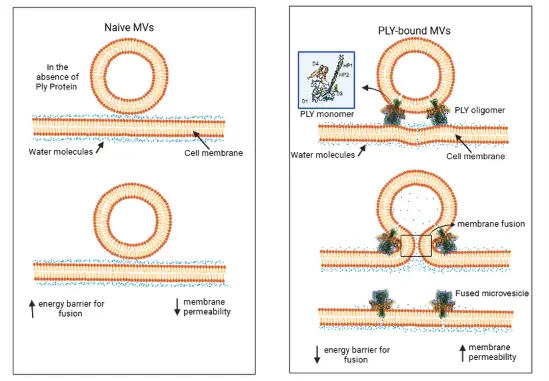
We wanted to understand whether a cellular defence mechanism could inadvertently become another route for toxin-mediated damage. Specifically, we investigated how pneumolysin carried on extracellular vesicles interacts with neighbouring cells and whether it can damage their membranes without direct contact with bacteria.
Cells attempting to eliminate bacterial toxins may inadvertently spread their damaging effects, revealing an unexpected dimension of host–pathogen interactions.” — Dr. Karthik Subramanian, PI and Corresponding Author
How did you go about solving this problem?
Our investigation began with an intriguing observation: pneumolysin was preferentially associated with microvesicles shed from toxin-exposed immune cells. This raised an important question: could these vesicles carry biologically active toxin to other cells?
We combined experiments using human immune cells with molecular simulations, advanced microscopy and membrane-fusion assays. The computational studies helped us understand how vesicle-bound pneumolysin interacts with cell membranes at the molecular level, while cryo-electron microscopy and experimental membrane models provided supporting structural and functional evidence.
We then examined whether toxin-bearing microvesicles could interact with healthy immune cells. We found that these vesicles could fuse with recipient cell membranes, transfer pneumolysin and compromise membrane integrity. Importantly, vesicles carrying a less active mutant form of the toxin produced significantly less damage.
Together, these approaches allowed us to connect molecular interactions with their consequences for human immune cells.
How would you explain your research outcomes (Key findings) to the non-scientific community?
Imagine a cell trying to protect itself from a bacterial toxin by packaging the toxin into tiny membrane-bound particles and releasing them. This helps the cell remove the toxin, but what if those particles reach other healthy cells?
That is the unexpected phenomenon our study uncovered.
We found that these tiny particles, called extracellular vesicles, can carry the pneumonia-causing bacterial toxin pneumolysin on their surface. Rather than being harmless waste, some of these toxin-bearing vesicles can interact with neighbouring cells, fuse with their membranes and cause damage.
Interestingly, not all immune cells were equally affected. CD4-positive T cells, which play an important role in coordinating immune responses, were more susceptible to toxin-associated damage than monocytes under our experimental conditions.
Our findings show that a bacterial toxin can remain harmful even after being released from the originally affected cell. This reveals an additional route through which bacterial toxins may affect surrounding tissues.
What are the potential implications of your findings for the field and society?
Our findings extend the understanding of how bacterial toxins cause cellular injury. Pneumolysin has traditionally been studied for its ability to form pores directly in cell membranes. We show that when associated with host-derived microvesicles, it can also promote membrane interactions, toxin transfer and damage through an additional mechanism.
This has broader implications for understanding how the effects of bacterial toxins may extend beyond the cells initially exposed to them, potentially contributing to immune-cell dysfunction during infection.
Importantly, our study also identifies new questions for therapeutic research. Could blocking toxin-vesicle interactions or vesicle-mediated membrane fusion help protect healthy cells?
Although these possibilities require further investigation, understanding this mechanism provides a foundation for exploring strategies to limit toxin-mediated injury during bacterial infections.
What was the exciting moment during your research?
One of the most exciting moments was seeing toxin-bearing microvesicles interact with healthy immune cells and observing the resulting membrane damage. It was fascinating to realise that vesicles released as part of a cellular response to toxin exposure could themselves carry harmful activity.
The experiments comparing normal pneumolysin with a less active mutant were particularly revealing. Vesicles carrying the mutant toxin caused substantially less damage, strengthening our understanding of the toxin’s role.
Another striking observation was that CD4-positive T cells were more vulnerable than monocytes under the same experimental conditions.
For me, the excitement came from connecting these observations with the molecular simulations and structural studies. What initially appeared to be a simple cellular toxin-removal process turned out to involve a much more complex interaction between bacterial toxins, extracellular vesicles and healthy cells.
Paper reference: Sagilkumar, A. C., A. L. Kushwaha, A. Shitut, et al. 2026. “ Extracellular Vesicle-Bound Bacterial Toxin Pneumolysin Triggers Membrane Engagement and Damage Beyond Canonical Pore Formation.” Journal of Extracellular Vesicles 15, no. 10: e70387. https://doi.org/10.1002/jev2.70387