



New Multi-Equilibria Platform Enables Precise Carboxylic Acid Engineering in Proteins
Research Summary: A chemical-driven multi-equilibria platform enables pathway selectivity and switching. It offers a new comprehensive platform for chemoselective, site-selective, and modular modification of carboxylates to render protein bioconjugates.
First authors: Rajib Molla, Rohith Singudas, and Dwaipayan Biswas.
First author description in third person narrative (20-30 words):
Dr. Rajib Molla completed his B.Sc. and M.Sc. in Chemistry from West Bengal State University, India. He gained early research experience at IISER Mohali before joining IISER Bhopal for his Ph.D. under Prof. Vishal Rai, focusing on chemical biology and protein bioconjugation. His research aimed to develop new chemical strategies for selective bioconjugation platforms with therapeutic potential. He is currently a postdoctoral fellow at Boston College with Prof. Jianmin Gao.
Linkedin: RAJIB MOLLA – Boston College | LinkedIn
Lab PI name: Prof. Vishal Rai, Indian Institute of Science Education and Research, Bhopal
Lab social media: VR Group, Twitter (https://x.com/vishal_iiserb)
What was the core problem you aimed to solve with this research?
In general, organic chemistry has developed under industrial demands, prioritizing efficiency, high yields, and irreversible transformations, whereas biological systems operate through dynamic multi-equilibria pathways that enable reversibility, adaptability, and pathway switching. However, multi-equilibria systems in organic chemistry have remained largely restricted to combinatorial pathways, where their inherent complexity limits access to chemically pure products and has discouraged their translation into bioconjugation. This lack of controllable pathway selection represents a key barrier to translating multi-equilibria systems into precise protein modification.
How did you go about solving this problem?
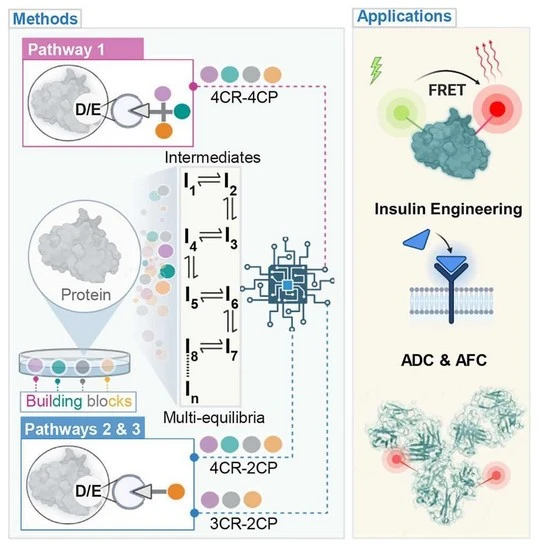
Inspired from biological systems, we developed a multi-equilibria platform that provides access to a milieu of intermediates capable of generating selectively labeled bioconjugates. This platform exclusively switches on three distinct pathways without interference from others. It enables chemoselective and site-selective labeling of carboxylate residues and allows carboxylate engineering of insulin, as well as the formation of homogeneous antibody–fluorophore and antibody–drug conjugates (AFCs and ADCs). Overall, this work establishes the capability of multi-equilibria systems to convert complexity into simplicity and opens new avenues for chemical biology discovery.
“Inspiration from living systems redefines chemistry, empowering pathway selection and switching in response to chemical signals – a completely new playground.” – Prof. Vishal Rai
How would you explain your research outcomes (Key findings) to the non-scientific community?
Multi-equilibria systems provide a conceptual shift from traditional organic chemistry, which is dominated by irreversible, single-pathway transformations, to dynamic systems capable of generating multiple controllable reaction outcomes. In protein bioconjugation, existing methods are often limited by low selectivity and reliance on irreversible chemistry, especially for challenging residues such as carboxylates. Here, we demonstrate a reagent-driven multi-equilibria platform that enables pathway-selective control and switching, allowing chemoselective, site-selective, and modular modification of protein carboxylates. This approach converts chemical complexity into programmable outcomes, enabling precise protein labeling and expanding opportunities for homogeneous bioconjugates and next-generation biomolecular engineering.
What are the potential implications of your findings for the field and society?
This platform introduces a new way to control chemical reactions in complex biological environments, enabling precise and programmable modification of proteins. In chemical biology, it expands the toolkit for selective bioconjugation, especially for challenging targets such as carboxylates. It also enables pathway switching, offering a new conceptual framework for reaction design. This work impacts drug development by enabling homogeneous antibody conjugates and selective protein-based therapeutics, potentially improving efficacy and supporting the pharmaceutical industry.
What was the exciting moment during your research?
One of the most exciting moments in our research was observing that, by applying a chemical-driven multi-equilibria system that initially seemed uncontrollable, we were able to succeed by tuning the reaction parameters to obtain highly pathway-selective and pathway-switching protein bioconjugates. This multi-equilibria-based system taught us to think beyond textbook chemistry and explore new ways to achieve selectivity. Overall, this demonstrated that chemical complexity can be transformed into precise control, which was both unexpected and highly rewarding.
Paper reference: Molla, R.;# Singudas, R.; # Biswas, D.; # Ojha, L.; Bindra, D.; Rai, S.; Ragendu, V.; Mukherjee, S.; Mishra, R. K.; Rai, V.* Switchable pathways for precise carboxylic acid modification in proteins and antibodies. Cell Rep. Phys. Sci., 2026; 7. https://doi.org/10.1016/j.xcrp.2026.103340