



Multifaceted effects of N-glycosylation on amyloidogenic κ light chains in AL amyloidosis
Research Summary: In this work, we show that N-glycosylation enhances the structural stability, proteolytic resistance, and extracellular secretion of amyloidogenic κappa light chains, promoting LC accumulation in the extracellular matrix and potentially contributing to aggregation in patients with AL amyloidosis.
Researcher Spotlight
Sarita Puri is a DST INSPIRE Faculty fellow in Biology department at IISER Pune.
What was the core problem you aimed to solve with this research: Here we established how post-translational modification, specifically N-glycosylation can contribute to amyloidogenic behaviour of antibody light chains associated with AL amyloidosis.
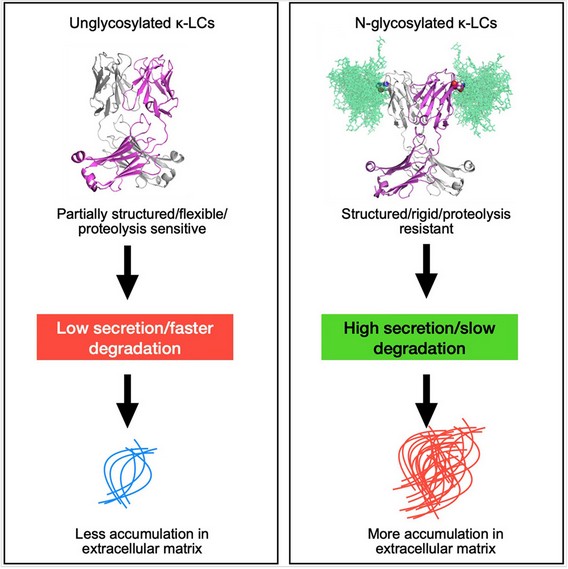
How did you go about solving this problem: We combined biophysical and structural biology approaches using recombinantly expressed unglycosylated and N-glycosylated patient derived light chains to solve the above stated problem.
We shall pay more attention to the role of post-translational modifications in establishing structure-function relationships in proteins.
How would you explain your research outcomes (Key findings) to the non-scientific community: Generally amyloidogenic light chains are less stable, highly dynamic and sensitive to proteolysis but N-glycosylated LCs do not follow their canonical aggregation signatures. However, they are highly efficient in secretion in extracellular matrix and their accumulation in large amounts contribute to their aggregation.
What are the potential implications of your findings for the field and society: In the AL amyloidosis field, it has been established for the first time how N-glycosylation can contribute to the disease. For society, the obtained information is highly useful for clinicians for tackling those AL patients where N-glycosylated LCs accumulated in vital organs and they can modify their treatment strategies seeing non-canonical behaviour of these LCs.
What was the exciting moment during your research: Getting completely opposite results than what we expected in terms of stability and dynamics of amyloidogenic LCs and then slaving the project for good one year and then testing the secretion assays in HEK293 free-style cells which was instrumental in understanding their amyloidogenic behaviour.
Paper reference 10.1016/j.str.2026.05.011