


One Probiotic, Different Outcomes: Gut Microbiome Predicts Probiotic Success
Research Summary: A global analysis of 51,244 gut microbiomes identifies the microbial communities that support or resist Bifidobacterium colonization and introduces a measure to personalize probiotic therapy.
Researcher Spotlight

Sourav Goswami is currently pursuing his Ph.D. at the Microbiome Informatics Lab, IIIT-Delhi, under the supervision of Dr. Tarini Shankar Ghosh. He completed his Bachelor’s degree in Chemistry (Hons.) from the University of Calcutta and subsequently earned his Master’s degree in Computational Biology from the Jawaharlal Nehru University, New Delhi. His research interests focus on functional metagenomics, microbiome community interactions, and gut microbiome-based disease risk prediction using explainable machine learning approaches.
LinkedIn: https://www.linkedin.com/in/sourav-goswami-840617159/
X handle: https://x.com/Sourav_IIITD

Alisha Ansari is currently pursuing her Ph.D. in the Microbiome Informatics Lab under the supervision of Dr. Tarini Shankar Ghosh at IIIT-Delhi. She has completed her bachelor’s in Biomedical Science (Hons.) from University of Delhi and later on moved to Department of Computer Science, Jamia Millia Islamia, New Delhi to complete her Master’s in Bioinformatics. Her research focuses on gut microbiome analysis, probiotic response prediction, and applying machine learning based approaches to understand host-microbiome interactions.
LinkedIn: https://www.linkedin.com/in/alisha-ansari-76a9091ab
X handle: https://x.com/Alisha_Ansari24
Lab: Dr. Tarini Shankar Ghosh, Indraprastha Institute of Information Technology
LinkedIn: https://www.linkedin.com/in/dr-tarini-shankar-ghosh-3b211868/
Twitter: https://x.com/tarini_ghosh
Lab website: https://microbiome.iiitd.edu.in/
What was the core problem you aimed to solve with this research?
Whenever we take a probiotic, we generally expect it to ‘stick’ or persist in our gut. But the reality is that probiotics work for some people and not for others even in carefully controlled clinical trials where everyone receives the same dose of the same bacteria. This inconsistency has been an enigma for microbiome science for years.
Bifidobacterium species are among the world’s most widely consumed probiotic bacteria, linked to immune regulation, pathogen resistance, anti-inflammation, and gut health across every stage of life. Yet controlled trials consistently show a wide spread of responses- some participants show stable long-term colonization of the administered probiotic, others show none at all. A study, published in 2016 (by Maldonado-Gómez et. al)1 suggested that a person’s existing gut microbiome, the microbes already living in their gut may determine whether a newly introduced Bifidobacterium probiotic can successfully establish itself or not. However, this observation was based on a limited study focused on a single probiotic species, highlighting the need for larger and more comprehensive investigations.
We wanted to investigate whether there is a pattern across different Bifidobacterial species, how far it extended across different Bifidobacterium species and stratified by different age groups, sequencing strategies, lifestyles, and disease contexts, and whether we could identify in whom a given Bifidobacteria had a better chance of persisting than others.
How did you go about solving this problem?
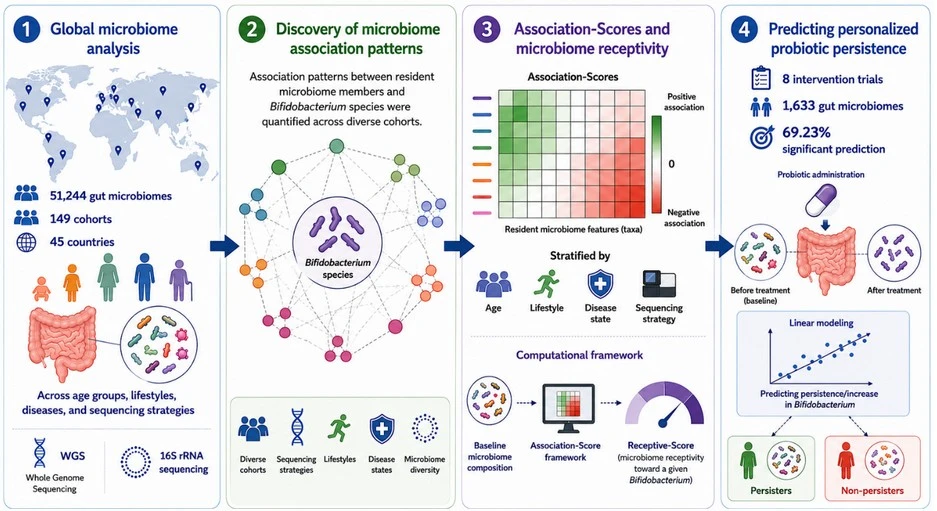
The scale of the question required a large dataset. We collated 51,244 gut microbiome samples from 149 different study-cohorts spanning 45 countries and six continents, covering infants, adults, and seniors; industrialized-urban, rural-tribal and urban-rural mixed communities; and data from both 16S rRNA and whole-genome sequencing approaches.
For each of the eight consistently detected Bifidobacterium species, we used Random Forest machine-learning models to identify which non-Bifidobacterial members of the gut community were the most informative predictors. We then computed the direction and consistency of these relationships, whether a given taxon tends to appear alongside a given Bifidobacterium or to be absent when that Bifidobacterium was present, across cohorts stratified by age, lifestyle, sequencing method, and disease status. From this, we derived what we call Association-Scores, quantitative summaries of how strongly each gut bacterium is linked to each Bifidobacterium species.
We then utilized those Association-Scores to construct a measure, Receptive-Score, which translates an individual’s microbiome profile into a single score estimating how permissive their gut environment is to the growth or persistence of a target Bifidobacterium. We validated this framework prospectively in eight independent probiotic intervention trials encompassing 1,633 microbiome samples.
“The same ecological-association-framework can essentially be utilized to predict future microbiome behaviour, enabling evaluation of any microbiome-linked therapeutic effectiveness.” — Dr. Tarini Shankar Ghosh, Corresponding author, IIIT-Delhi
How would you explain your research outcomes (Key findings) to the non-scientific community?
Think of your gut as a neighborhood. When a new member, the probiotic Bifidobacterium moves in, whether it thrives depends enormously on who is already living there. Some neighbors are welcoming and they share resources, build symbiotic relationships, and make the environment hospitable. Others are territorial and they compete for the same food, crowd out newcomer, or actively make the neighborhood unwelcoming.
We mapped those neighborhood dynamics for eight of the most common probiotic Bifidobacterium species across the >50,000 gut microbiomes worldwide. We found that certain health-associated bacteria, particularly the butyrate-producing Firmicutes, a group linked to gut health and immune balance, consistently make the neighborhood friendlier to B. adolescentis and B. longum. By contrast, pathobiont bacteria and oral-associated microbes tended to push these same species out. Interestingly, these associations are stable even after adjusting for confounding factors linked to host like diet, medications and clinical characteristics as well as microbiome properties like alpha diversity (shows how diverse the community is) and microbial load (number of microorganisms present).
What makes this practically useful is the Receptive-Score. While the associations computed above act as proxies to identify the different friends and foes of Bifidobacteria across populations. These patterns can also be utilized to compute a ‘status of receptivity’ of your gut microbiome (from a stool sample) for a given Bifidobacteria given its friends and foes status. That means we can compute a score that estimates how welcoming your gut currently is to a specific Bifidobacterium. Higher score, better chance the probiotic will persist and grow. Lower score, it may not persist. In a few studies with clinical information, people with higher Receptive-Scores tended to experience fewer gut-related symptoms and lower inflammation.
What are the potential implications of your findings for the field and society?
The most immediate implication of this work is for improving how probiotic clinical trials are designed. Different people have very different gut microbiomes, which means the same probiotic may work well in some individuals but not in others. When all participants are analyzed together, these differences can hide the true benefits of the probiotic. Receptive-Scores provide a way to identify and group participants based on how supportive their gut microbiome is likely to be for a given probiotic or whether a probiotic will persist or not, helping make future clinical trials more accurate and informative.
Looking further ahead, this work lays a conceptual foundation for personalized probiotic prescribing. Rather than a one-size-fits-all recommendation, a clinician or a consumer could use a gut microbiome profile to identify which Bifidobacterium is most likely to take hold in their specific gut environment. This is still a future scenario, extensive further validation is needed, but the analytical infrastructure now exists.
The Association-Scores and Receptive-Score framework are publicly available- all data, codes, and results are deposited on GitHub, Zenodo, and Code Ocean, ready for other researchers to apply to their own probiotic trial datasets or to use as a structured starting point for studying Bifidobacterium ecology.
What was the exciting moment during your research?
There were a few moments that genuinely surprised us. The first was when we mapped the Association-Score network across all four analytical variants: overall, disease-stratified, microbiome-property-adjusted, and diet-and-medication-adjusted. We expected some variations, associations that look clean in raw data often dissolve once accounted for confounders. Instead, the core structure was remarkably stable. B. adolescentis and B. catenulatum aligned with health-associated Firmicutes across every layer of analysis; B. breve and B. dentium consistently sat on the opposite side. Seeing that convergence across independent analytical approaches was more convincing than any single statistic.
The second was the very first validation of the Receptive-Score in the Maldonado-Gomez cohort1. Receptive-Scores computed entirely from our large discovery dataset, with no trial-specific information, were able to significantly separate people whose gut retained the probiotic vs people whose gut did not retain. Small sample, one species, but the concept held in real data.
And finally, the emergence of the cross-feeding pattern in functional analysis. The machine learning models repeatedly flagged the same genomic signatures carbohydrate transport, butyrate synthesis pathways, fructo-oligosaccharide breakdown, across multiple non-Bifidobacterial taxa and multiple Bifidobacterium species. It was one of those moments where biology and data form a coherent story rather than just a list of associations.
Reference
1. Maldonado-Gómez, M. X. et al. Stable Engraftment of Bifidobacterium longum AH1206 in the Human Gut Depends on Individualized Features of the Resident Microbiome. Cell Host & Microbe 20, 515–526 (2016).
Paper reference: Goswami, S., Ansari, A., Saraf, C., O’Toole, P.W., Shanahan, F., Ahuja, V. & Ghosh, T.S. Gut microbiome features associated with Bifidobacterium colonization predict personalized probiotic persistence patterns. Nature Communications (2026). https://doi.org/10.1038/s41467-026-72289-9
New Book Launched – Molecules, Mentors & Mindsets: Building Indian Biopharma
Buy your copy today: https://biopatrika.com/science-society/book-molecules-mentors-mindsets-building-indian-biopharma-biocon/
Book Launch: Molecules, Mentors & Mindsets: Building Indian Biopharma | Biocon Focus