


PATZ1 Clears DNA-Packaging Beads From Injured Neurons
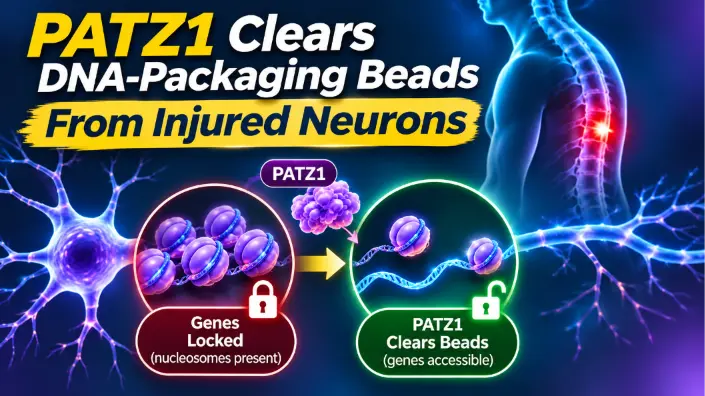
Research Summary: PATZ1, a protein, relaxes tightly packed DNA in injured adult neurons by moving DNA-packaging machinery aside, opening growth-related genes that normally stay locked after spinal cord injury.
Researcher Spotlight
First Authors: Netra Krishna, Anisha S. Menon
Netra Krishna, a one-year project-based student trainee at CSIR-CCMB, supported the doctoral work of Anisha S. Menon, who studies the correlation between Epigenetics and axon regeneration in adult mammals.
Linkedin: Netra Krishna, Anisha S Menon
Twitter: @netrakrish, @AnishaSumith
Instagram: @netrakrish, @epigenie_girl
Lab PI name: Dr Ishwariya Venkatesh
Institute: CSIR–Centre for Cellular and Molecular Biology (CSIR-CCMB), Hyderabad, India
Social media: @Ishwariya13
Lab websitehttps://venkateshlab.science/
What was the core problem you aimed to solve with this research?
The spinal cord is like a highway that carries messages between the brain and the body, letting us move and feel. When it is injured, this highway is cut, and adult neurons, situated in the brain, in mice and humans alike, struggle to regrow their long fibres (axons) to repair it. One reason lies inside the neurons: the DNA holding growth instructions is tightly packaged and hard to access. We previously found that a protein called PATZ1 can open these regions in injured neurons. In this study, we asked “how”.
How did you go about solving this problem?
Identifying PATZ1 was only the beginning. We wanted to know how it changes DNA packaging. Imagine DNA as a long thread wound around millions of tiny beads called nucleosomes. To loosen it, you could slide the beads along the thread, making some stretches tighter and others looser, or take some beads off altogether. Does PATZ1 reposition the beads, or remove them?
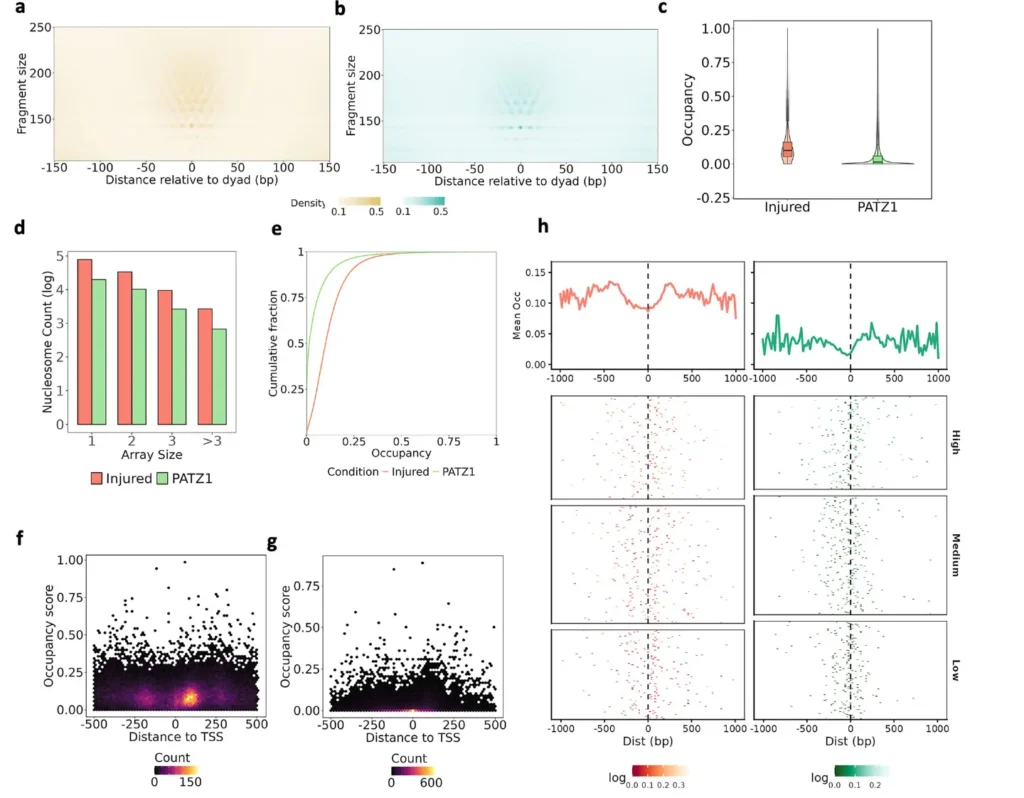
To find out, we studied injured mouse neurons with and without PATZ1. We mapped where the beads sit, measuring how many were present (occupancy) and how precisely they were positioned (fuzziness). We then checked the findings with an independent method that directly detects histone H3, the protein core of the beads.
“The growth programme of the adult neurons is not lost for good. Much of it is packed away and PATZ1 can clear some of that away”– Dr Ishwariya Venkatesh, corresponding author
How would you explain your research outcomes (Key findings) to the non-scientific community?
Think of DNA as a thread wound around tiny beads. When the beads crowd a gene, the cell cannot read it. We asked what happens to the beads after injury, and what PATZ1 does to them.
Just comparing what happened before and after spinal cord injury gave a clue. Injury alone changes almost nothing. One week after spinal cord injury, the beads (nucleosomes) in these neurons sit essentially where they did before.
PATZ1 changes this dramatically. By adding PATZ1, the typical chance of finding a bead at any given spot fell from about 10% to about 1%, a drop of roughly 86%, and the beads that remained sat in neater, more precise positions.
This clearing is not random. It was concentrated at gene hubs for development and regeneration, including those involved in axon guidance, nervous system development and synapse formation.
It also reaches the enhancers, the switches that act like a volume knob for genes. Active enhancers expanded more than three-fold, from about 1,100 to about 3,700, and PATZ1 was found sitting at many of them.
What we have yet to show is whether this opening is enough to make axons grow. That is the next step.
What are the potential implications of your findings for the field and society?
For decades, scientists have been trying to find ways to make these stubborn neurons regenerate, with targeted approaches especially sought after. Our earlier work showed that PATZ1 opens growth-related DNA in injured neurons. This study shows “how”, by clearing the DNA-packaging beads, especially at enhancers. Knowing the mechanism matters because it points to a concrete target. Instead of simply asking whether a gene is on or off, now we can ask whether the beads covering it have been moved or evicted.
It also suggests that clearing beads and tagging histones with acetylation are partly separate steps. At growth-related loci, PATZ1 kept DNA open even when acetylation was blocked in a neuronal cell line. That gives future therapies more than one route to work with.
This is early, basic science. We have not yet shown that clearing these beads is enough to make axons regrow, or whether the effect lasts. Those are the next questions.
What was the exciting moment during your research?
When we saw the first plot, showing absolutely no change in the beads before and after injury, and then the dramatic change once PATZ1 was added, we gasped. For the first time, we could actually see how PATZ1 does what it does.
Paper reference/citation (with link)
Krishna, N., Menon, A. S., Kumaran, M., Kesireddy, D. K. & Venkatesh, I. PATZ1 remodels the nucleosome landscape to promote chromatin accessibility in injured neurons. Communications Biology (2026), published online 20 October 2026. https://doi.org/10.1038/s42003-026-11196-7