



PIMT-mediated Protein Repair Mechanism Offers New Path to Disease-Resistant Rice
Research Summary: Study reveals that PIMT protects rice from sheath blight by repairing damaged proteins that defend against fungal infection. This repair maintains antifungal activity, controls oxidative damage, and improves disease resistance.
Researcher Spotlight
Shikha Gautam is PhD scholar at BRIC-NIPGR, Delhi, where she works on protein repair mechanism against fungal infection. Beyond the lab, she enjoys participating in science communication and reading books.
Linkedin: linkedin.com/in/shikha-gautam-636b72378
Twitter: @Shikhahere_
Instagram: _shikha_gautam_
Lab PI name: Dr Manoj Majee
University: BRIC-National Institute of Plant Genome Research
Lab social media: Twitter: @mm_lab_nipgr
What was the core problem you aimed to solve with this research?
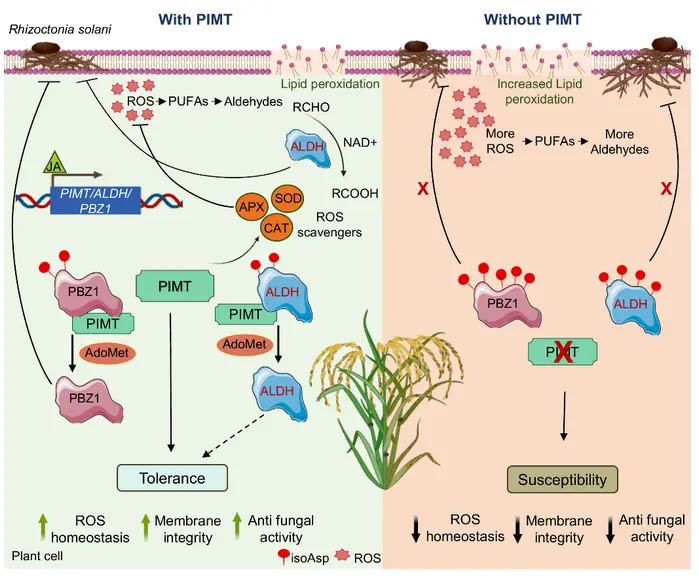
Rice sheath blight, caused by the fungus Rhizoctonia solani, is a severe global threat to rice harvests. When attacked, rice activates complex defense strategies, relying heavily on proteins to drive these responses. Unfortunately, high stress levels trigger reactive oxygen species, which damage vital proteins and create abnormal modifications like isoaspartate. To fix this, plants utilize protein repair enzymes like PIMT. While previously linked to seed survival and abiotic stress, our study uncovers how PIMT boosts rice immunity against sheath blight by restoring damaged defense proteins.
How did you go about solving this problem?
By utilizing genetically modified rice lines, we established that PIMT enzymes significantly boost plant resistance, hindering fungal penetration and colonization in plant tissues. Through mass spectrometry analysis, we identified several defense related targets of PIMT during infection. This allowed us to establish antifungal properties of defense related targets. Ultimately, our findings highlight a vital repair mechanism where PIMT protects damaged proteins to preserve their essential defense functions against fungal attacks.
“Our study uncovers a novel mechanism by which PIMT protects rice against sheath blight disease by repairing infection-induced protein damage” – Dr. Manoj Majee
How would you explain your research outcomes (Key findings) to the non-scientific community?
Rice plants living in a field are vulnerable to many things, but what happens when rice is attacked by a nasty fungus. Plants go into defense mode, producing free radicals in cell i.e, reactive oxygen species, which might cause damage when overaccumulated. This damage manifests as isoaspartyl modification in proteins. This is exactly what the current study explores, understanding how rice plants fight back against these fungal invaders, specifically looking at the intricate world of protein damage and repair.
Using various molecular and microscopic techniques, we discovered that PIMT, a protein repairing enzyme, fixes the isoaspartyl damages in defense related proteins, keeping them healthy and functioning during fungal attack. We saw that extra PIMT activity made it hard for the fungus to even get inside the rice plant. It was like having a protein-powered security system.
What are the potential implications of your findings for the field and society?
As a vital global dietary staple, rice feeds over two-thirds of the human population, with India acting as a leading producer and exporter. However, biotic infestations routinely trigger severe agricultural losses, reducing the yields by up to 20-40% globally. Our work reveals that preserving protein integrity is just as vital as synthesizing defense proteins, offering a novel target to engineer disease resistance. We learned that by understanding the genetic mechanisms behind protein repair, we can potentially breed rice varieties that are naturally equipped to fight off pathogens, leading to healthier crops and a more sustainable future for rice farming.
What was the exciting moment during your research?
During the course of this study, there were several exciting moments that deepened my fascination with plant systems, but one moment stands out. Observing the fungus inside the plant cells through confocal microscopy was truly an awe-inspiring moment for me. Seeing the intricate details of fungal colonization at the cellular level was thrilling in itself, but what made it even more rewarding was witnessing the effect of PIMT protein in reducing fungal hyphae penetration. This observation strongly supported and aligned so clearly with what I had observed in whole plants.
Paper reference/citation (with link) Gautam S, Kamble NU, Achary RK, Chandan RK, Varshney V, Hazra A, Laha S Mahawar S, Mehendiratta S, Singh Sarvanand, Gopaljee Jha* & Majee M* (2026) Rice PROTEIN L-ISOASPARTYL METHYLTRANSFERASES provides tolerance against sheath blight disease and repairs ALDH and and PBZ1. Nature communications 17-8901 https://www.nature.com/articles/s41467-026-75618-0