

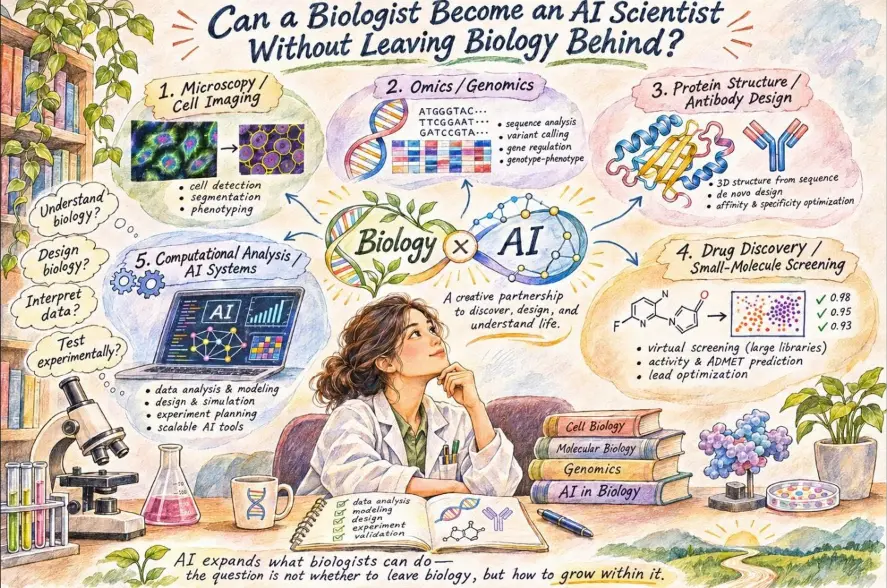
How experimental biologists can embrace AI, explore de novo antibody design, and combine computational tools with biological expertise to shape the future of research.
Artificial intelligence is no longer confined to traditionally computational disciplines. A recent analysis of more than 80 million publications across more than 170 scientific fields shows how widely AI has entered research [1]. In biology, it is being used in omics, microscopy, and protein science, although questions about benchmarking and experimental data quality remain [2,3].
For experimental biologists, the question is no longer whether AI belongs in our field. It is how much we need to understand to use it well [4].
When the Question Changed
My path into AI began with antibodies. During my training in structural and computational biology, I worked on neutralizing antibodies against influenza and HIV. I wanted to understand why an antibody recognized one antigen and not another: the shape of the interface, the position of a loop, the contacts that made binding possible.
Back then, if someone had suggested starting with an epitope and designing an entirely new antibody against it, I probably would have said no.
That assumption began to change when I moved into industry and joined Thermo Fisher Scientific in 2018. I became interested in AI and de novo antibody design. Much of the engineering I encountered still began with something known: an antibody sequence, a framework, or an existing binder. We could improve a molecule, but designing recognition from the epitope outward was another challenge.
AbDiffuser later showed that antibody sequences and three-dimensional structures could be generated together. Its HER2 validation, however, drew on CDR H3 mutations of the known antibody trastuzumab [5]. It was a genuine advance, but not quite the epitope-first design I had doubted.
Antibody-tuned RFdiffusion went further. It generated candidate antibodies against specified epitopes; experimental screening identified binders, and cryo-electron microscopy confirmed the predicted binding poses of designed VHHs against influenza haemagglutinin and Clostridium difficile toxin B [6].
I had spent years studying how antibodies recognize influenza proteins. Now the direction of the question had reversed: could we use that understanding to design recognition ourselves?
I had underestimated what was possible. But possibility and reliability are different things.
What Does a Success Rate Really Measure?
The original RFdiffusion work reported a 19% experimental success rate for protein binders. That meant an experimentally tested design produced, at 10 μM, a biolayer interferometry response at least half that of a positive control [7].
The antibody-specific work reported target-dependent rates of 0–2%. Some campaigns screened 9,000 VHH designs per target by yeast display; others tested 95 designs per target through expression and single-concentration surface plasmon resonance [6].
AbDiffuser illustrates the problem within one study. Of 16 tested HER2 designs, 37.5% bound. The paper also reported binding rates of 22.2% among randomly selected generated designs and 57.1% among designs subjected to additional computational filtering [5]. These are an overall result and two subgroup rates, not three interchangeable measures.
So when I see a hit rate, I want to know which candidates were counted, which were filtered out, how binding was measured, and what qualified as success. Cost or time per validated binder meeting predefined affinity and developability criteria would tell us even more.
A percentage can be accurate and still conceal most of the story.
Biology Does Not End at Binding
There are good reasons antibody design remains difficult. Antibody–antigen pairs generally lack the paired evolutionary signals available for many stable protein complexes, and the CDR H3 loop is exceptionally variable [8,9].
In one AlphaFold3 evaluation using a single prediction seed, high-accuracy docking was achieved for 10.2% of antibody complexes and 13.3% of nanobody complexes; the authors also reported about 65% docking failure [9]. Those are structural-prediction metrics, not experimental binding rates.
Even a binder that recognizes the intended epitope may never become a therapeutic. Stability, aggregation, self-interaction, formulation, and manufacturability all matter [10]. Engineered proteins can also provoke unwanted immune responses [11].
As computational generation improves, deciding which candidates deserve further work becomes more consequential. That requires biological judgment, not just faster models.
What Expertise Is For
I once thought epitope-directed antibody design was beyond our reach. The experimental structures proved me wrong about that possibility; the low hit rates reminded me why I had been skeptical.
Experience helps us recognize constraints and anticipate failure modes. It is less reliable when we use it to declare what future methods will never accomplish. A surprising prediction deserves neither automatic trust nor immediate dismissal. It deserves a test.
Learning AI Without Leaving Biology
Can a biologist become an AI scientist? Certainly. But most biologists do not need to develop machine-learning architectures to benefit from AI.
What they do need is computational fluency: statistics and experimental design, enough Python or R to explore data, an understanding of validation, uncertainty, and data leakage, and habits of reproducible research [4]. It also means knowing when to collaborate with people who develop the models.
My journey did not begin with the ambition to become a computer scientist. It began with wanting to know why an antibody recognized an antigen. I still care about that question. I now also care about how to design a new interaction and establish whether it works.
If a model proposes something I doubt, I do not want to choose between trusting it and trusting my experience. I want to know what experiment would settle the question.
References
- Bianchini S, Di Girolamo V, Ravet J, Arranz D. AI in science: When and where it makes a difference. Research Policy. 2026;55(6):105478. doi:10.1016/j.respol.2026.105478.
- Embedding AI in biology. Nature Methods. 2024;21(8):1365–1366. doi:10.1038/s41592-024-02391-7.
- Embedding AI in biology—part 2. Nature Methods. 2026;23:1659. doi:10.1038/s41592-026-03234-3.
- Carey MA, Papin JA. Ten simple rules for biologists learning to program. PLoS Computational Biology. 2018;14(1). doi:10.1371/journal.pcbi.1005871.
- Martinkus K, Ludwiczak J, Liang W-C, et al. AbDiffuser: full-atom generation of in-vitro functioning antibodies. Advances in Neural Information Processing Systems. 2023;36:40729–40759. doi:10.52202/075280-1774.
- Bennett NR, Watson JL, Ragotte RJ, et al. Atomically accurate de novo design of antibodies with RFdiffusion. Nature. 2026;649:183–193. doi:10.1038/s41586-025-09721-5.
- Watson JL, Juergens D, Bennett NR, et al. De novo design of protein structure and function with RFdiffusion. Nature. 2023;620:1089–1100. doi:10.1038/s41586-023-06415-8.
- Gaudreault F, Corbeil CR, Sulea T. Enhanced antibody-antigen structure prediction from molecular docking using AlphaFold2. Scientific Reports. 2023;13:15107. doi:10.1038/s41598-023-42090-5.
- Hitawala FN, Gray JJ. What does AlphaFold3 learn about antibody and nanobody docking, and what remains unsolved? mAbs. 2025;17(1):2545601. doi:10.1080/19420862.2025.2545601.
- Mieczkowski C, Zhang X, Lee D, Nguyen K, Lv W, Wang Y, Zhang Y, Way J, Gries J-M. Blueprint for antibody biologics developability. mAbs. 2023;15(1):2185924. doi:10.1080/19420862.2023.2185924.
- Carter PJ, Quarmby V. Immunogenicity risk assessment and mitigation for engineered antibody and protein therapeutics. Nature Reviews Drug Discovery. 2024;23(12):898–913. doi:10.1038/s41573-024-01051-x.
About the Author
Sharad Vashisht, PhD
Scientist | Antibody/Protein Engineering | AI-Driven Antibody/Protein Design
Manager, R&D – New Product Development
Proteintech Group Inc. | Chicago, USA
With a background in structural and computational biology, Sharad works at the intersection of antibody engineering, protein science, and biotechnology innovation. His interests include de novo protein and antibody design, artificial intelligence in biological discovery, and translating computational advances into experimentally useful technologies.
Beyond his industry research, he shares scientific insights and emerging developments in AI-driven biology through his platform, BioIntuitionAI.
Connect & Explore
Website: www.sharadvashisht.com
LinkedIn: www.linkedin.com/in/sharad-vashisht
YouTube: @BioIntuitionAI
Email: sharadvashisht07@gmail.com
Join the Scientific Conversation
Interested in exchanging ideas beyond the article? Join our LinkedIn communities for open scientific discussions, knowledge sharing, and collaboration.
AI for Antibody & Protein Design
Explore the latest developments in generative AI, de novo antibody and protein design, molecular modelling, and experimental validation. Share research papers, discuss emerging models, and exchange ideas on bridging computational design with biological experiments.
Statistics for AI, ML & Biologics
Discuss statistical methods, experimental design, AI/ML model evaluation, benchmarking, uncertainty, and data interpretation in biological research. A space to challenge assumptions, ask methodological questions, and improve the reliability of scientific conclusions.
Biopharma Industry Intelligence
Stay engaged with developments in biotechnology, biopharmaceutical R&D, emerging technologies, drug discovery, and industry trends. Exchange perspectives on scientific innovation, translational research, and the challenges of bringing discoveries from the laboratory to real-world applications.
Whether you work in academia, biotechnology, or industry, your questions, experiences, and perspectives are welcome. Meaningful scientific progress begins with open conversation.