



From Precision Chemistry to Selective Bacterial Targeting
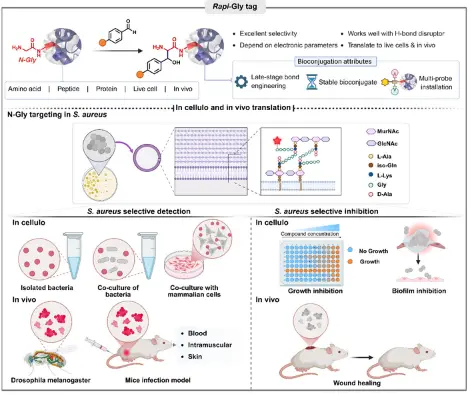
Research Summary: We developed rapi-Gly-tag, an electronically tunable chemical technology for selective modification of peptides and proteins, enabling species-specific detection and targeting of Staphylococcus aureus in living systems.
Researcher Spotlight
Mohan Kumar is a chemical biologist whose research focuses on developing chemical technologies for protein engineering and applying them to address challenges in precision therapeutics.
Facebook: https://www.facebook.com/Mohan.k95
LinkedIn: https://www.linkedin.com/in/mohan-kumar-phd-980026145/?isSelfProfile=true
Instagram: https://www.instagram.com/MOHANKUMAR14795/
X (Twitter): https://x.com/iam_kmohan
Lab PI name: Prof. Vishal Rai, Indian Institute of Science Education and Research (IISER) Bhopal, India
What was the core problem you aimed to solve with this research?
Precisely modifying a specific site on a biomolecule within complex biological environments remains challenging. We aimed to develop a rapid and selective chemical strategy for targeting N-terminal glycine and translate this chemistry into a biological application. In particular, we sought to exploit a distinctive molecular signature in the cell wall of Staphylococcus aureus to selectively detect and target this important bacterial pathogen, including drug-resistant strains.
How did you go about solving this problem?
We designed electronically tuned small-molecule reagents to achieve rapid, selective, and stable covalent modification of N-terminal glycine. We established the technology using peptides and proteins and investigated its selectivity, reaction mechanism, and stability under biologically relevant conditions. We then applied this chemistry to exploit the pentaglycine motif in the cell wall of S. aureus, evaluating selective bacterial labeling and targeting in complex biological samples and experimental models.
“Control over bond engineering with proteins empowers chemical technology for precision therapeutics.” – Prof. Vishal Rai
How would you explain your research outcomes (Key findings) to the non-scientific community?
We developed a chemical tool that can recognize and modify a specific molecular feature found at the beginning of certain peptides and proteins. By applying this chemistry to a distinctive feature of S. aureus, we demonstrated selective bacterial detection in living systems, including fruit fly larvae and mouse infection models. The approach also showed activity against drug-susceptible and drug-resistant strains, including MRSA and VRSA, and inhibited biofilm formation. In simple terms, this research demonstrates how precise molecular design can help us identify and target a particular bacterial pathogen.
What are the potential implications of your findings for the field and society?
This work expands the scope of precision bioconjugation and demonstrates how fundamental chemical development can address important biological challenges. By establishing a molecular feature of S. aureus as a target for selective chemical modification, the study opens new possibilities for developing bacterial detection methods and targeted antimicrobial strategies. Further research will be needed to evaluate its safety, effectiveness, and potential for clinical translation.
What was the exciting moment during your research?
One of the most exciting moments was seeing our chemistry move beyond modifying peptides and proteins in the lab to selectively targeting S. aureus in living systems. Demonstrating that the method could distinguish the target bacterium in complex biological environments and retain activity against drug-resistant strains was particularly rewarding. It showed us how fundamental advances in chemical reactivity can translate into meaningful biological applications. Additionally, designing control experiments to unambiguously confirm the mechanism by which N-Gly targeting leads to S. aureus inhibition was real fun.
Paper reference: Kumar, M., Bindra, D., Verma, A. et al. “Electronically tuned N-terminal glycine selective bioconjugation enables in vitro and in vivo species-specific Staphylococcus aureus targeting.” Nature Communications (2026). https://doi.org/10.1038/s41467-026-77959-2