



RNA processing defect: an unexpected signal of cellular danger
Research Summary: Our findings reveal that mild perturbation of cellular processes like RNA cap methylation can activate protective immune responses, suggesting that precisely altering key cellular activities may enhance the immune system’s ability to fight infections.
Researcher Spotlight
Annesha Ghosh is a PhD scholar in Dr. Jogender Singh’s lab at IISER Mohali. Her research focuses on characterizing damage-driven immune surveillance mechanisms in Caenorhabditis elegans.
Linkedin https://www.linkedin.com/in/annesha-ghosh-93a24118b/
Twitter https://x.com/AnneshaGhosh14
Lab: Dr. Jogender Singh, IISER Mohali
Lab social media: https://x.com/Jogender_Singh7
What was the core problem you aimed to solve with this research?
Organisms are continuously exposed to microbial threats and have therefore evolved multiple strategies to detect and respond to infection. In addition to recognizing pathogens directly, they can also sense disruptions in their cellular homeostasis as indicators of danger. These damage-driven surveillance mechanisms are triggered by mild perturbations of essential cellular processes, enabling the host to indirectly detect infection through their impact on cellular integrity. This strategy provides a broad and effective means of defense, as it does not rely on recognizing individual pathogens. Consequently, even in the absence of infection, cellular damage can activate or prime immune responses. To identify pathways that enhance host immunity, we performed a forward genetic screen in Caenorhabditis elegans to isolate mutants exhibiting elevated intestinal immune activation.
How did you go about solving this problem?
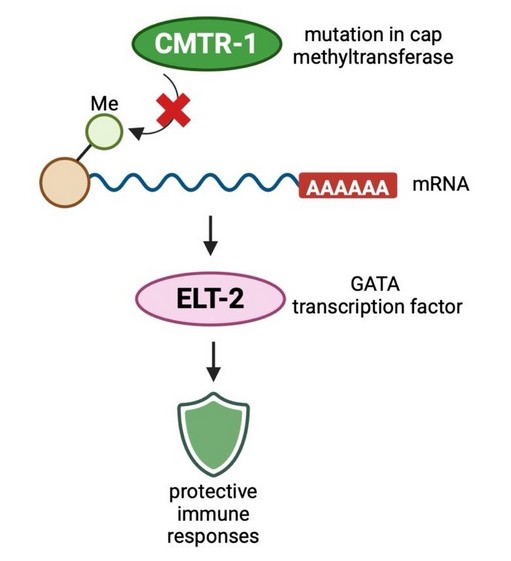
To address the question, we utilized a fluorescence-based immune reporter stain in C. elegans to isolate mutants that enhance host immune responses even in the absence of pathogens. We found that a loss-of-function mutation in the cap methyltransferase CMTR-1 triggered immune activation, leading to increased resistance to pathogens. To further explore genome-wide transcriptional changes associated with the loss of cmtr-1, we conducted RNA sequencing, which revealed upregulation of innate immune response genes and downregulation of translation-related genes in the mutants. Additionally, we performed a comprehensive transcription factor library screen and identified the evolutionarily conserved GATA transcription factor ELT-2 as a regulator downstream of CMTR-1 loss. Ultimately, our findings indicate that ELT-2 orchestrates a broad immune transcriptional program activated both during P. aeruginosa infection and upon CMTR-1 inhibition.
“Our findings reveal that disruption of RNA cap methylation can serve as a danger signal that activates protective innate immunity.”
– Dr. Jogender Singh
How would you explain your research outcomes (Key findings) to the non-scientific community?
We live in an environment teeming with microbes. Where some have beneficial roles, others are harmful. Organisms have developed strategies to detect and respond to such harmful microbes to combat infection. These microbes, in turn, have evolved to escape detection. Accordingly, the host body has evolved alternative strategies that do not directly recognize microbes but instead detect disturbances in key cellular functions, generally induced by pathogen infections, to activate innate immunity.
Therefore, we aimed to identify novel ways the host can detect internal disturbances as potential threats and activate its immune system to prime itself against infections. We used the tiny worm C. elegans for these studies, as it lacks detectors to recognize harmful microbes and relies solely on surveilling its cellular functions.
To mimic internal cellular disturbances, we introduced random changes into the DNA of C. elegans. We found that altering a gene involved in RNA processing was enough to activate protective immune responses. When we measured the relative gene expression of these mutants, we found that they had highly expressed immune genes and drastically reduced expression of genes involved in protein synthesis. The activation of immunity was sufficient for the mutant to survive the infection better.
Next, we aimed to identify the factor responsible for activating a broad range of immune genes. Interestingly, we found that an evolutionarily conserved regulator is essential for relaying altered RNA processing as a danger signal, which, in turn, activates immune genes against infection. The immune genes activated in the mutant were common with those activated during infection.
Overall, our results indicate that the host organism can sense internal damage as a potential threat, even in the absence of an infection, priming the body against future attacks.
What are the potential implications of your findings for the field and society?
Owing to the diversity in microbial pathogens, the host has evolved multiple defense strategies to defeat them. Higher organisms possess distinct pathogen recognition receptors (PRRs) to recognize microbial ligands and initiate immune responses. But in an evolutionary arms race, pathogens have adapted to evade the host’s detection system by modifying their ligands. Consequently, the host has adopted strategies that focus on monitoring cellular homeostasis rather than directly detecting microbes, as many microorganisms are known to disrupt these processes. Thus, surveillance of core cellular processes is critical to host defense against bacterial infections.
We performed an unbiased forward genetic screen using a reporter strain for immune activation and discovered that the host detects disturbances in processes such as RNA processing as signals of cellular danger. This study exemplifies the effective use of a suitable reporter strain to address fundamental questions about danger-driven activation of innate immunity. Similar screens could be carried out to identify more defense strategies that detect host cellular integrity to trigger immune responses.
We further use a reverse genetic approach and identify that an evolutionarily conserved intestinal transcription factor is required to activate protective immune responses in mutants with perturbed RNA processing. These mutants show increased expression of immune genes typically induced by infection, suggesting that RNA processing disturbances can be sensed as cellular damage, triggering protective immune responses, such as those against pathogens.
Furthermore, RNA processing is essential for maintaining cellular integrity, and defects in these processes are linked to several diseases. Thus, understanding how such cellular perturbations modulate innate immunity, not only during infections but also in diseases, can be used to develop immunotherapies to treat these conditions.
What was the exciting moment during your research?
The mutant isolated from our forward genetic screen exhibited increased expression of immune-responsive genes, but a reduced expression of genes involved in protein translation. Initially, we hypothesized that the mutants might activate their innate immunity via a previously described transcription factor, ZIP-2. Earlier, ZIP-2 has been shown to activate immunity during the inhibition of protein translation, another prominent cellular danger. However, ZIP-2 proved dispensable for activating these immune responses. The most exciting moment for us was when we conducted a comprehensive transcription factor library screen and identified a distinct factor, ELT-2, that activated innate immunity. This illustrates how specific transcription factors regulate innate immunity by detecting identical cellular disturbances, thereby underscoring the molecular diversity of the host.
Another exciting moment came when we compared the expression of immune genes in our mutants with those in wild-type worms exposed to a pathogen. We found that the same immune genes were upregulated in both cases. Furthermore, it was under the control of the same conserved intestinal transcription factor. These observations suggest that the host activates an identical set of protective immune genes in response to cellular damage, even in the absence of infection. Consequently, mechanisms of damage-induced surveillance represent effective strategies for priming the host against bacterial infections.
Figure Caption: Disruption of mRNA cap methyltransferase activates a GATA transcription factor-mediated protective immune response.
Paper reference: Ghosh, A., & Singh, J. (2026). RNA methyltransferase CMTR-1 inhibition activates a GATA transcription factor-mediated protective immune response. PLOS Pathogens, 22(6), e1014375. https://journals.plos.org/plospathogens/article?id=10.1371/journal.ppat.1014375