



Immune Cells Rewire Pancreatic Function During Diabetes Progression
Research Summary: Using single-cell multi-omics, we generated a temporal atlas revealing how pancreatic endocrine, immune, and stromal cells remodel during obesity-induced diabetes progression, identifying mechanisms underlying β-cell dysfunction and disease progression.
Researcher Spotlight
First authors: Simran Singh, Musale Krushna Pavan, Luiz F. Barella
Simran Singh is a doctoral researcher at IIT Kanpur whose work focuses on immunometabolism, pancreatic islet biology, GPCR signaling, and single-cell multi-omics to understand diabetes progression.
Musale Krushna Pavan is a doctoral researcher at IIT Kanpur whose work focuses on Computational Biology where he develops advanced computational methods for Single cell lineage reconstruction, Omics Data Integration, and Analysis.
Lab:
Dr. Sai Prasad Pydi: Molecular Metabolism & Cell signaling lab, Department of Biological Sciences & Bioengineering
Dr. Hamim Zafar: CoSmic Lab, Department of Computer Science & Engineering, Department of Biological Sciences & Bioengineering
University: Indian Institute of Technology Kanpur (IIT Kanpur)
Website
https://sites.google.com/view/cosmiclab-iitk/home
What was the core problem you aimed to solve with this research?
Type 2 diabetes develops gradually over several years, but we still have limited understanding of how different cell types within the pancreatic islets change throughout disease progression. Most previous studies examined only a single stage of diabetes or focused primarily on β-cells. We wanted to create a comprehensive, time-resolved map of the pancreas to understand how endocrine, immune, vascular, and stromal cells interact during the transition from healthy metabolism to diabetes.
How did you go about solving this problem?
Rather than capturing the pancreas at a single point in time, we wanted to watch diabetes unfold as it progressed. Working closely with our supervisors, Dr. Sai Prasad Pydi and Dr. Hamim Zafar, we combined single-cell RNA sequencing and single-cell ATAC sequencing to profile thousands of individual pancreatic islet cells across multiple stages of obesity-induced diabetes in mice. By integrating these complementary datasets, we mapped how different cell types changed over time, uncovered dynamic changes in gene regulation, and revealed how immune, endocrine, endothelial, and stromal cells communicate during disease progression. To ensure that our computational findings reflected real biological mechanisms, we performed complementary in vitro experiments to validate key observations. Finally, we integrated our data with published mouse and human datasets to determine which cellular programs are conserved and potentially relevant to human diabetes.
“Our study provides a roadmap of pancreatic remodeling that will accelerate discovery of therapeutic targets for diabetes prevention and treatment.”
– Dr. Sai Prasad Pydi & Dr. Hamim Zafar
How would you explain your research outcomes (Key findings) to the non-scientific community?
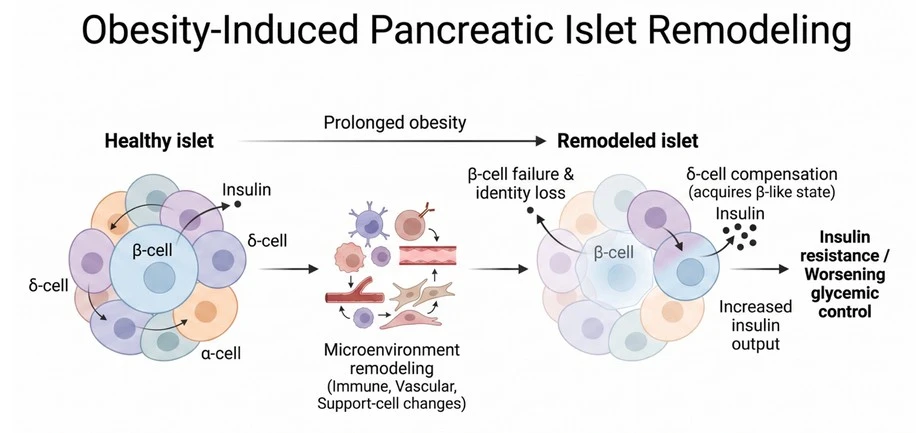
Our pancreas contains different types of cells that work together to keep blood sugar under control. We found that during obesity, these cells change gradually over time. Immune cells become more inflammatory, blood vessels and support cells are remodeled, and insulin-producing β-cells progressively lose their normal function.
We also discovered that during prolonged obesity, δ (delta) cells begin to behave like insulin-producing β-cells. This may be a protective response that helps clear excess glucose when the body is still sensitive to insulin, but if insulin levels remain high for too long, it could contribute to insulin resistance and worsen diabetes. Overall, our study provides a timeline of how the pancreas changes during obesity, revealing potential opportunities for earlier intervention before irreversible damage occurs.
What are the potential implications of your findings for the field and society?
Our study provides one of the most comprehensive temporal single-cell maps of pancreatic islet remodeling during diabetes progression, along with an extensive single-cell RNA-sequencing (scRNA-seq) and single-cell ATAC-sequencing (scATAC-seq) dataset spanning multiple stages of disease. This resource can be used by researchers to generate and test new hypotheses about diabetes biology. By revealing key cellular interactions and molecular pathways driving β-cell dysfunction and inflammation, our findings may help guide the development of therapies that preserve β-cell function, slow diabetes progression, and improve outcomes for people with diabetes. More broadly, this atlas serves as a valuable reference for the diabetes research community.
What was the exciting moment during your research?
The most exciting moment was when we realized that integrating single-cell transcriptomic and epigenomic data had revealed a clear timeline of pancreatic remodeling during diabetes progression. Instead of isolated observations, we could see how endocrine, immune, endothelial, and stromal cells evolved together over time. Watching these cellular interactions unfold, discussing the findings as a team, and uncovering previously unrecognized mechanisms made the years of experimental and computational work especially rewarding.
Paper reference: Singh S, Pavan MK, Barella LF, et al. Temporal single-cell transcriptional dynamics of murine pancreatic islet remodeling during hyperglycaemia progression. Molecular Metabolism. 2026;110:102387. https://doi.org/10.1016/j.molmet.2026.102387