



Unmasking the shield: how West Nile virus exploits TRIM71 to silence antiviral immune response in human microglial cells
Research Summary
West Nile virus (WNV) employs sophisticated mechanisms to evade the host immune response, yet its effects on antiviral responses in human microglial cells remain inadequately characterised. Our research identifies TRIM71 as a novel regulator of innate antiviral immunity. We demonstrate that WNV triggers the proteasomal degradation of TRIM71, thereby disrupting the TRIM71-AGO2-type I interferon and TRIM71-STING-IRF3-type I interferon signalling pathways. This disruption leads to decreased interferon production and antiviral gene expression, fostering a cellular environment conducive to viral replication. Notably, the restoration of TRIM71 mitigated these immune defects and substantially reduced viral replication, highlighting TRIM71 as a potential target for host-directed antiviral strategies.
Researcher Spotlight
Apoorva is a PhD scholar working under supervision of Prof. Sunit K. Singh at the Molecular Biology Unit, Institute of Medical Sciences, Banaras Hindu University. Her research focuses on understanding the molecular mechanisms of viral neuropathogenesis, with particular emphasis on how neurotropic viruses exploit and manipulate host innate antiviral responses within human microglial cells.
LinkedIn: https://linkedin.com/in/apoorva-0479611a3
Twitter: https://x.com/apoorva11_
Principal Investigator (PI): Prof. Sunit K. Singh, Director, Dr. B.R. Ambedkar Center for Biomedical Research, University of Delhi and Professor, Molecular Biology Unit, Institute of Medical Sciences, Banaras Hindu University, Varanasi, India
LinkedIn: https://www.linkedin.com/in/prof-sunit-k-singh-a7926a57/
Twitter: https://x.com/DrSunitKSingh
Website: https://www.bhu.ac.in/site/FacultyProfile/2_2246?FA000946
What was the core problem you aimed to solve with this research?
Every viral infection begins with a race against time. Upon viral entry into a cell, the host initiates its primary defence mechanism by synthesising type I interferons (IFN-α and IFN-β). These molecules swiftly activate numerous antiviral genes that collaboratively inhibit viral replication. Microglia, the resident immune cells of the central nervous system, are among the first responders that continuously monitor their surroundings for invading viral pathogens. However, despite robust defences, West Nile virus often successfully establishes infection. Prior research indicated that the virus inhibits interferon responses; however, the mechanisms by which it achieves this in human microglial cells were not well understood. We aimed to uncover how West Nile virus disarms the antiviral defenses of human microglial cells. This led us to one key question: Which host protein does the virus target to silence antiviral immunity?
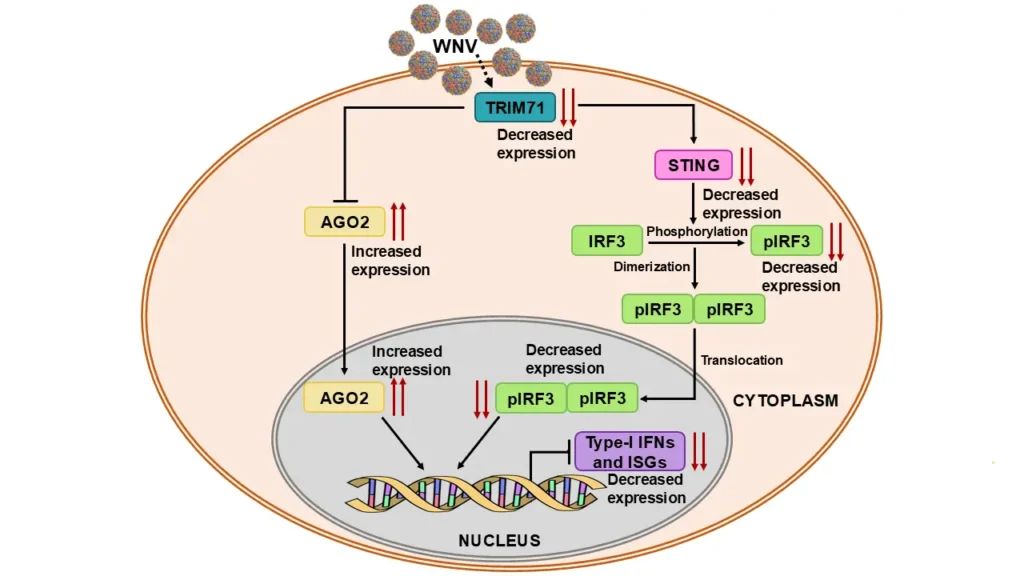
WNV infection. WNV infection inhibits TRIM71, an E3 ubiquitin ligase in human
microglial cells. Reduced TRIM71 expression upregulates AGO2 and downregulates
STING, thereby suppressing the type-I IFN response and ISG production in WNV-
infected human microglial cells.
How did you go about solving this problem?
We systematically investigated the mechanisms by which West Nile virus suppresses antiviral immunity in human microglial cells. During the course of the study, TRIM71 emerged as a promising candidate because its role in viral infection had not been explored previously. Although several members of the TRIM family are established regulators of innate immunity, the antiviral function of TRIM71 remained unexplored. To define its functional role during West Nile virus infection, we first examined whether WNV altered TRIM71 expression and then determined how the virus regulated this protein. After establishing that TRIM71 was degraded during infection, we asked whether its loss contributed to the impaired antiviral response. We therefore examined the consequences of TRIM71 depletion, investigated whether restoring TRIM71 could rescue antiviral signalling, and identified the domains required for its function. Finally, we assessed whether these molecular changes influenced viral replication. Each experiment answered one question while raising another, and together they helped us uncover how TRIM71 regulates antiviral signalling in human microglial cells during West Nile virus infection.
“Viruses consistently evolve mechanisms to evade host immune responses. This study identifies TRIM71 as a novel regulator of antiviral signalling in human microglial cells, offering insights into the mechanisms by which West Nile virus circumvents immune responses. It underscores the potential for host-directed antiviral therapies in addressing neurotropic viral infections.” – Prof. Sunit K. Singh
How would you explain your research outcomes (key findings) to the non-scientific community?
Imagine a high-security building protected by surveillance cameras, alarm systems, and security guards. As soon as an intruder enters, the control room coordinates every part of the building’s defense. But instead of disabling each alarm individually, the intruder quietly knocks out the control room. The alarms never sound, the guards are never alerted, and the intruder moves freely.
Our study suggests that West Nile virus uses a similar strategy. Instead of directly shutting down every antiviral defense, it targets TRIM71, a host protein that helps regulate antiviral immunity in human microglial cells. By promoting the degradation of TRIM71, the virus simultaneously disrupts two major antiviral pathways, suppressing interferon production and antiviral gene expression. Restoring TRIM71 reactivated antiviral signaling, restored interferon production, and significantly reduced viral replication.
What are the potential implications of your findings for the field and society?
Most antiviral drugs target viral proteins, but viruses can rapidly mutate and develop resistance. Our findings suggest an alternative approach -strengthening the host’s own antiviral response. We identified TRIM71 as a previously unrecognized regulator of antiviral immunity in human microglial cells and showed that West Nile virus degrades TRIM71 to suppress type I interferon signalling. Preserving or restoring TRIM71 function may therefore represent a potential host-directed therapeutic strategy. Although this study focused on West Nile virus, many neurotropic viruses target similar innate immune pathways. We hope our findings encourage further investigation of TRIM71 and other host factors as potential therapeutic targets against neurotropic viral infection
What was the most exciting moment during your research?
Scientific discoveries are rarely a single eureka moment. More often, they emerge gradually, with each experiment adding another piece to the puzzle. That was exactly how this project unfolded. Our study began with a simple question: How does West Nile virus suppress the antiviral response in human microglial cells? We knew that WNV efficiently dampens the type I interferon response, but the underlying mechanism remained unclear. When we observed that TRIM71 expression consistently decreased following infection, it was an intriguing finding. However, at that stage, we did not know whether TRIM71 was simply affected by infection or whether the virus was actively targeting it. As the study progressed, the evidence gradually came together. Proteasome inhibition experiments showed that WNV actively degrades TRIM71, while CRISPR-mediated depletion of TRIM71 reproduced many of the immune defects observed during infection. We also found that TRIM71 regulates two complementary antiviral pathways: the AGO2-type I interferon axis and the STING-IRF3-type I interferon pathway, revealing a broader role than we had initially anticipated. The most exciting moment came with the TRIM71 overexpression experiments. Restoring TRIM71 reduced AGO2 levels, restored STING-IRF3 signalling, increased type I interferon production, reactivated multiple interferon-stimulated genes, and significantly reduced West Nile virus replication. At that point, the individual findings came together into a single mechanistic model explaining how West Nile virus suppresses antiviral immunity in human microglial cells.
Reference
Apoorva and Sunit K. Singh. West Nile Virus inhibits type I interferon response via TRIM71 in human microglial cells. Antiviral Research, 106448. DOI: 10.1016/j.antiviral.2026.106448