


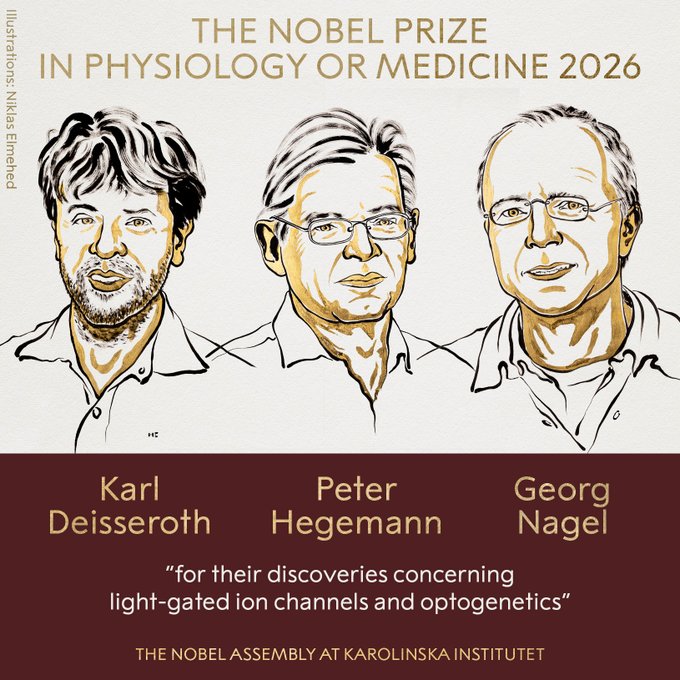
2026 Nobel Prize in Physiology or Medicine Awarded for Optogenetics
Karl Deisseroth, Peter Hegemann and Georg Nagel recognized for discoveries that transformed our ability to control and study nerve cells with light
October 5, 2026 — The Nobel Assembly at Karolinska Institutet has awarded the 2026 Nobel Prize in Physiology or Medicine jointly to Karl Deisseroth, Peter Hegemann and Georg Nagel for their discoveries concerning light-gated ion channels and optogenetics.
The laureates will share the prize of 12 million Swedish kronor equally.
From Light-Sensing Algae to Controlling Neurons
The story behind this year’s Nobel Prize began with a simple biological question: How does a single-celled alga sense and move toward light?
Peter Hegemann and Georg Nagel studied Chlamydomonas, a light-sensitive single-celled alga. In the early 2000s, they discovered channelrhodopsin, a remarkable protein located on the cell surface.
When exposed to blue light, channelrhodopsin opens a channel through which charged ions can flow, generating an electrical signal. Importantly, the researchers demonstrated that introducing the protein into other cells could make those cells light-sensitive.
This discovery provided the molecular tool that would later enable researchers to control the electrical activity of neurons with light.
Turning Light Into a Neural Switch
Karl Deisseroth took the discovery a major step further.
In 2005, Deisseroth and colleagues introduced the gene encoding channelrhodopsin into rat nerve cells. When blue light was applied, the neurons generated nerve signals.
In 2007, his team demonstrated that the same principle could be used to control nerve cells inside the brains of living mice.
This work established the foundation of what is now known as optogenetics—the use of genetically introduced light-sensitive proteins to control the activity of specific cells using light.
Why Optogenetics Matters
For decades, scientists could identify brain regions associated with particular functions, but it was difficult to establish whether specific groups of neurons actually caused a particular behaviour or response.
Optogenetics changed this.
By selectively activating or inhibiting defined populations of neurons, researchers can investigate neural circuits involved in:
- Memory
- Emotions
- Behaviour
- Neurological disorders
- Psychiatric disorders
The technology has therefore transformed neuroscience by providing researchers with an unprecedented way to investigate how specific neural circuits function in living organisms.
Optogenetics is also being explored in clinical medicine, including approaches aimed at restoring vision in people with visual impairment.
From Algal Biology to a New Era of Neuroscience
The 2026 Nobel Prize highlights a remarkable scientific journey: a biological mechanism that evolved in a microscopic alga became a powerful tool for understanding the most complex organ in the human body.
As the Nobel Committee notes, optogenetics has provided opportunities to map and manipulate the brain that researchers could once only dream of.
Peter Hegemann and Georg Nagel uncovered the light-sensitive molecular machinery, while Karl Deisseroth transformed that discovery into a tool for controlling neural activity.
Together, their work has helped open a new era in neuroscience—and brought scientists closer to understanding one of humanity’s greatest mysteries: how the brain works.
Source: Nobel Prize in Physiology or Medicine 2026 – Official Press Release