



Biomimetic V₂O₅ Nanozymes Offer a Sustainable Solution for Marine Antifouling
Research Summary: We developed two-dimensional V₂O₅ nanozymes that mimic natural haloperoxidase enzymes to prevent bacterial attachment and biofilm formation, providing an eco-friendly strategy for marine antifouling coatings.
Researcher Spotlight
Navya G. Praveen is an MS by Research student at IISER Thiruvananthapuram, India, whose research focuses on biomimetic nanomaterials, nanozymes, and sustainable antimicrobial and antifouling technologies.
Linkedin: http://www.linkedin.com/in/navyapraveen48
Lab: Dr. Rajendra Kurapati, Indian Institute of Science Education and Research (IISER), Thiruvananthapuram, India
What was the core problem you aimed to solve with this research?
Marine biofouling begins with the attachment of microorganisms to submerged surfaces, eventually leading to biofilm formation and the accumulation of larger organisms. This increases fuel consumption, maintenance costs, greenhouse gas emissions, and the spread of invasive marine species. Although conventional antifouling coatings are widely used, many rely on toxic biocides that pose environmental risks. Our objective was to develop a sustainable, biocide-free antifouling strategy by designing a nanozyme capable of mimicking the natural defense mechanisms found in marine organisms.
How did you go about solving this problem?
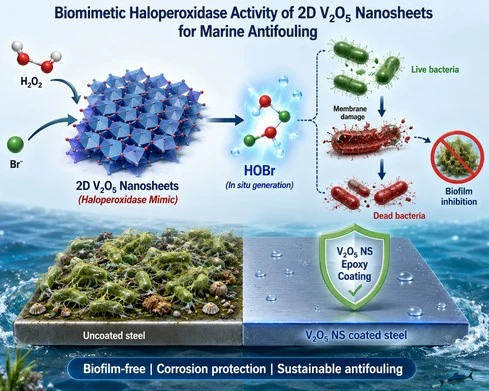
We synthesized ultrathin two-dimensional V₂O₅ nanosheets and investigated whether they could mimic the activity of the natural enzyme vanadium bromoperoxidase. The nanozymes catalyzed the in-situ generation of hypobromous acid (HOBr), a naturally occurring antimicrobial species in marine environments. We evaluated their catalytic activity, antibacterial activity against Escherichia coli and Bacillus subtilis and, finally, incorporated the nanosheets into commercial epoxy paint to examine their antifouling performance on stainless-steel surfaces.
“Nature-inspired nanozymes provide a sustainable route toward environmentally friendly antifouling technologies without relying on toxic biocides.”
– Dr. Rajendra Kurapati
How would you explain your research outcomes (Key findings) to the non-scientific community?
Imagine a ship that can naturally resist the buildup of slimy microorganisms without releasing harmful chemicals into the ocean. We developed a smart nanomaterial that behaves like an enzyme found in marine algae. Instead of killing everything with toxic chemicals, it produces tiny amounts of naturally occurring antimicrobial species that prevent bacteria from settling and forming biofilms. This keeps surfaces cleaner in a more environmentally friendly way.
What are the potential implications of your findings for the field and society?
Our study demonstrates that nanozymes can serve as environmentally friendly alternatives to conventional antifouling agents. Such coatings could reduce the dependence on toxic marine paints, lower maintenance costs for ships and marine infrastructure, decrease fuel consumption and associated carbon emissions, and help protect marine ecosystems.
What was the exciting moment during your research?
The most exciting moment was when we observed that the V₂O₅ nanosheets successfully mimicked the activity of natural haloperoxidase enzymes. Seeing the clear color change in the phenol red assay and later confirming that the nanozyme-coated surfaces significantly reduced bacterial attachment demonstrated that our biomimetic design worked as intended.
Paper reference: N. G. Praveen, M. M. Lalitha, J. Sahoo, and R. Kurapati, “Biomimicking Haloperoxidase by Two-Dimensional V2O5 Nanosheets for Marine Antifouling Applications.” Chemistry – An Asian Journal21, no. 12 (2026): e70855. https://doi.org/10.1002/asia.70855