


Harnessing two variety self-incompatibility system in Brassica rapa for breeding applications
Research Summary: This study identifies and characterizes a two-variety system in field mustard that harbors self-incompatibility and has potential for deployment in breeding applications.
Researcher Spotlight
Hemal Bhalla is a Ph.D. Scholar working with Prof. Subramanian Sankaranarayanan, at the Department of Biological Sciences and Engineering, Indian Institute of Technology, Gandhinagar. His work revolves around various plant species in the mustard family, integrating basic and translational biology.
Linkedin: https://www.linkedin.com/in/hemal-bhalla-8a8098223/
Twitter: https://x.com/bhallahemal
Instagram: https://www.instagram.com/hemal_bhalla
Lab: Dr. Subramanian Sankaranarayanan, Indian Institute of Technology Gandhinagar, Palaj, Gujarat-382355, India
Twitter: https://x.com/lab_sankar
LinkedIn: https://www.linkedin.com/in/subramanian-sankaranarayanan-p-hd-59755b51/
Lab website: https://www.sankarlab.com/
What was the core problem you aimed to solve with this research?
The mustard family is widely used as a food, oilseed, research, and condiment crop. One of the species, Brassica rapa (Field mustard), is known for its oil content, favorable fatty acid profile, protein composition, preservative properties, and use as a vegetable, flavoring agent, and condiment. Despite these favorable characteristics, it lacks high yield, robust disease resistance, and other agronomically important traits. These could be introgressed through hybrid breeding and exploitation of genetic diversity. Understanding the self-incompatibility trait is one way to achieve this, although it remains less explored in field mustard.
How did you go about solving this problem?
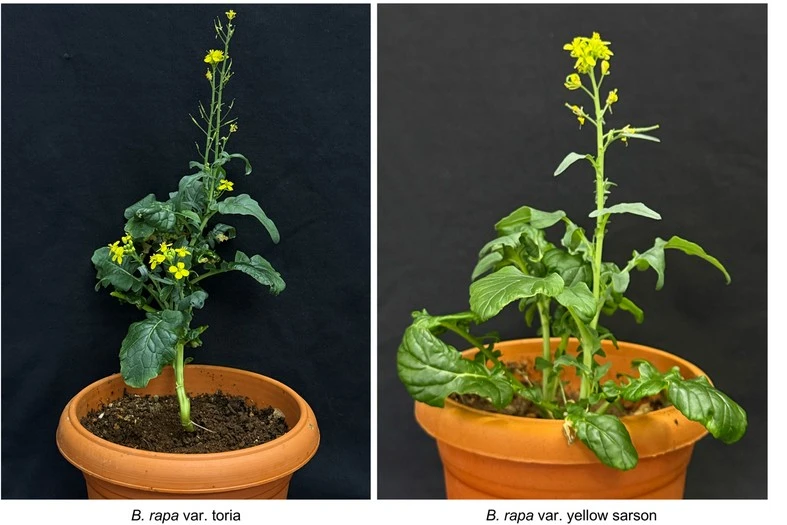
We utilized a naturally occurring two-variety system including Brassica rapa var. toria (self-incompatible) and yellow sarson (compatible). This system was characterized for key SI-regulatory genes in terms of their phylogenetic relationships, structure-function dynamics, expression patterns, and functional validations.
“By decoding the molecular basis of self-incompatibility in field mustard, we pave the way for more efficient hybrid breeding strategies.” – Dr. Subramanian Sankaranarayanan
How would you explain your research outcomes (Key findings) to the non-scientific community?
Plants have a special way to remain superior across other varieties. The way is to ensure they reproduce only with other varieties to maintain their diversity and inherit the “good traits” from them. One of the important ingredients of our kitchen is the mustard oil, derived from field mustard. Although it possesses good characteristics, some of them reproduce only within themselves, making them vulnerable to a decline in superior qualities.
This mechanism of reproducing only with other varieties is referred to as self-incompatibility. In this study, we have conducted various biological experiments to determine how this mechanism is controlled, so that it can be incorporated into crop species. This deployment would help them maintain the superior qualities by reproducing with other such varieties.
What are the potential implications of your findings for the field and society?
A long-standing gap in field mustard; is a way to ensure hybrid development and maintain it through generations. The two-variety system identified in this study has the potential to ensure their deployment in other species and their use in breeding applications. It could help harness SI to improve major economic traits through emerging biotechnology approaches.
What was the exciting moment during your research?
The most exciting part is that this is a one-of-a-kind study conducted in Brassica rapa, although most of the focus has previously been on Canola. Brassica rapa, or Field Mustard, has been on our shelves for a long time and has been the focus of research purposes and breeding applications for decades. Although with such concerted efforts, the naturally occurring SI system has not been exploited. This study is one of the first concerted efforts towards its deployment and would be a starting point for scientists working to improve its characteristics through breeding. Another integral part was the collaborative efforts of people with varying expertise, including my co-first author on the paper, Ankita Kumari, as well as Aman Ahlawat, Dr. Surabhi Rode, and Dr. Subramanian Sankaranarayanan from IIT Gandhinagar, and Dr. Kunwar Harendra Singh from ICAR-DRMR, Bharatpur, Rajasthan.
Paper reference: Bhalla H, Ankita K, Ahlawat A, Rode SS, Singh KH and Sankaranarayanan S (2026) Characterization of self-incompatibility genes in Brassica rapa var. toria and yellow sarson. Front. Plant Sci. 17:1857745. doi: 10.3389/fpls.2026.1857745