



Dual-Action Molecule from Plant Lipids
Research Summary: Pimelic acid primes defence against multiple pathogens while promoting plant growth across crops, breaking the defence-growth trade-off and offering a sustainable alternative to chemical pesticides.
Researcher spotlight
Ritu Godara is a PhD researcher at CSIR-IHBT investigating naturally occurring plant metabolites that improve crop protection and productivity for sustainable agriculture.
Twitter: @ritu_godar41418
Facebook: https://www.facebook.com/share/1SgcWUjhcD/
Lab: Dr. Vivek Dogra, CSIR-Institute of Himalayan Bioresource and Technology, Palampur, India
What was the core problem you aimed to solve with this research?
Plants constantly face attacks from pathogens and harsh environmental conditions. Although several natural molecules can boost plant immunity, they usually reduce growth, creating a long-standing defence-growth trade-off. We wanted to discover whether plants naturally produce molecules that could enhance disease resistance without compromising growth. This led us to investigate pimelic acid, a previously overlooked plant metabolite whose biological function was completely unknown.
How did you go about solving this problem?
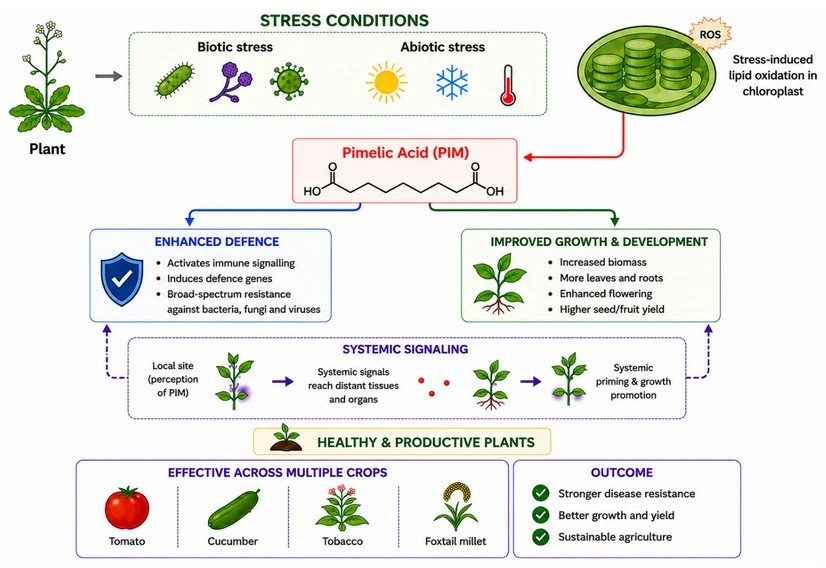
We began by asking a simple question: What is the role of pimelic acid in plants? Although this naturally occurring molecule accumulates under stress, its biological function was unknown. We first confirmed that pimelic acid is produced in Arabidopsis during both pathogen infection and abiotic stress, suggesting that it is a genuine stress-responsive metabolite. We then investigated whether pimelic acid could influence plant immunity and found that it rapidly activated defence signalling, leading to enhanced resistance against bacterial, fungal, and viral pathogens. During these studies, we made an unexpected observation—plants associated with pimelic acid were not only more resistant to stress but were also visibly larger and more productive, showing improvements in biomass, flowering, and seed yield. Unlike the closely related molecule azelaic acid, which is primarily known for defence priming, pimelic acid enhances both defence and growth simultaneously. To determine whether these effects were broadly applicable, we evaluated pimelic acid across several crop species, including tomato, cucumber, tobacco, and foxtail millet. The consistent results across diverse plants demonstrated that pimelic acid is a promising natural bioelicitor with potential for sustainable agriculture.
How would you explain your research outcomes (Key findings) to the non-scientific community?
We discovered that pimelic acid, a natural molecule already present in plants, performs two important jobs at the same time. First, it helps plants defend themselves against diseases caused by bacteria, fungi, and viruses. Second, it helps plants grow bigger and produce more leaves, roots, flowers, and seeds. This is important because most natural defence boosters come with a cost, they make plants more resistant but also slow their growth. Farmers often have to choose between healthier plants and higher yields. Pimelic acid appears to overcome this trade-off by providing both benefits simultaneously. Even more exciting, it worked across different crops, including tomato, cucumber, tobacco, and foxtail millet. A single spray during the early seedling stage was enough to provide protection and growth benefits that lasted until harvest.
What are the potential implications of your findings for the field and society?
Our findings have important implications for agriculture, the environment, and food security.
- For farmers, pimelic acid offers a simple, natural, and cost-effective way to protect crops against multiple diseases while increasing productivity. Its ability to simultaneously enhance plant health and yield makes it a promising alternative to conventional crop protection strategies.
- For the environment, pimelic acid could reduce dependence on chemical pesticides and fungicides. As a naturally occurring plant molecule, it is biodegradable and environmentally friendly, making crop production safer for beneficial organisms and surrounding ecosystems.
- For food security, crops that can better withstand disease and environmental stress while maintaining high productivity will become increasingly important under changing climate conditions.
- Scientifically, our work challenges the long-standing belief that plants must always compromise growth to achieve stronger defence. It also highlights that naturally occurring metabolites previously considered stress byproducts can play important biological roles with significant agricultural value.
- Ultimately, our study provides a promising foundation for developing sustainable crop protection strategies that improve both plant health and agricultural productivity.
What was the exciting moment during your research?
The most exciting moment came completely unexpectedly.
We had originally designed the experiments to compare pimelic acid with azelaic acid, a well-known defence molecule. We expected pimelic acid to behave similarly by improving disease resistance.
However, when we measured the plants several weeks later, we noticed something surprising. The pimelic acid-treated plants were not only healthier but also visibly larger.
When we analysed the data, we found that pimelic acid increased plant growth and yield by about 35-55%, while simultaneously improving resistance to both biotic and abiotic stresses.
We realised we had discovered a natural molecule capable of overcoming one of the biggest challenges in plant biology, the defence-growth trade-off. It was one of those rare moments in research when an unexpected observation opens an entirely new direction.
Paper reference: Godara, R., Mohapatra, S., Thakur, S., Roy, A., Vaishnavi, S., Anmol, Sharma, U., Hallan, V., Kumar, A., & Dogra, V. (2026). Membrane lipid-derived heptanedioic acid primes defence and systemic growth in plants. Plant Physiology, kiag425. https://doi.org/10.1093/plphys/kiag425