


From Months to Weeks: Accelerating Crop Improvement with SpeedSeed technology
Research Summary: We developed SPROUT, a field-mimicking phenotyping platform, and SpeedSeed, a rapid generation advancement technology that enables 8-10 chickpea generations annually, accelerates high-throughput phenotyping, and faster crop improvement.
Researcher Spotlight
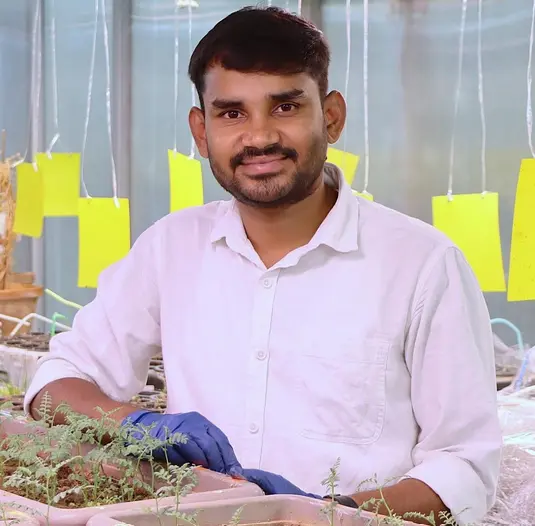
Sandeep Dulla is a Senior Research Fellow at DBT, BRIC-National Institute of Plant Genome Research (NIPGR) in New Delhi, working on rapid generation advancement and plant-microbe interactions in the plant stress biology lab under the supervision of Dr.Senthil-Kumar Muthappa.
Linkedin: https://www.linkedin.com/in/dulla-sandeep-1ab27b20a
Twitter: @Dulla_Sandeep25
Instagram: @dulla_sandeep
Facebook:@Dulla Sandeep
Lab PI name: Dr. Senthil-Kumar Muthappa
University: BRIC- National Institute of Plant Genome Research (NIPGR)
Lab social media Twitter: @SCIPdatabase
What was the core problem you aimed to solve with this research?
Crop improvement is often a race against time. For chickpea, conventional breeding/advancement is constrained by long growth cycles, seasonal dependence, and the difficulty of evaluating large populations under field-realistic stress conditions. A single generation can take several months, while developing improved cultivars will take years.
Our goal was therefore not simply to make chickpea plants grow faster. We wanted to ask a fundamental question: Can we accelerate the generation cycle without compromising the plant vigour under controlled stress-free conditions?
This question led us to develop an integrated platform that combines rapid generation advancement, field-mimicking plant growth, and precision phenotyping, enabling faster crop improvement.
How did you go about solving this problem?
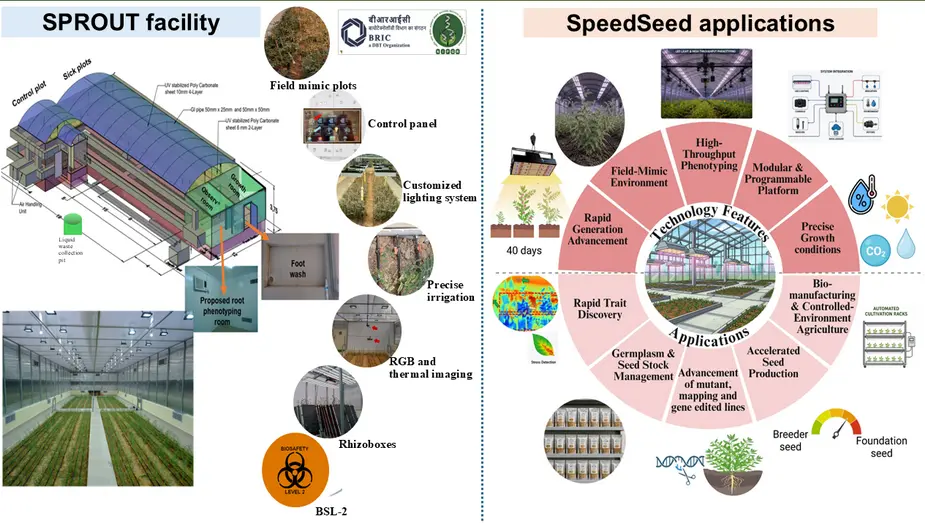
We developed SPROUT (SpeedSeed Phenotyping and Resource Optimization for Unified Trait-analysis) facility, a season-independent, field-mimicking platform for rapid generation advancement and precision phenotyping.
Within this platform, we developed SpeedSeed by systematically optimising the environmental and agronomic conditions that regulate plant growth and development. We explored light quality, far-red light, temperature, humidity, planting density, irrigation and crop nutrition to identify conditions that could accelerate development without compromising plant vigour and productivity.
We then integrated RGB and thermal imaging to enable non-invasive, repeated monitoring of plant growth, canopy temperature, disease-associated symptoms, and other traits.
An important feature of the system is that we use soil-based, field-mimicking mini-plots rather than relying entirely on conventional pots or artificial growth conditions. This makes the platform particularly useful for quickly studying plant responses and stress phenotypes in an environment that is more relevant to field performance.
“SPROUT is a versatile platform with immense potential across scientific research and agricultural applications” – Dr. Senthil-Kumar Muthappa
How would you explain your research outcomes (Key findings) to the non-scientific community?
Think of a crop improvement study, where researchers have to wait several months to see the next generation of plants.
With SpeedSeed, we reduced that waiting period to weeks. The chickpea plants can complete a generation within 40 days, corresponding to a 60-70% reduction in seed-to-seed. This represents the first reported chickpea platform to achieve this under environmentally controlled, field-plot conditions.
A researcher can grow a population, observe its development, phenotype stress responses, identify promising plants and advance them to the next generation much faster.
For example, dry root rot disease screening that normally required 50-60 days was reduced to 21-25 days, while integrated RGB and thermal imaging helped identify resistant material. By using this platform, we have identified highly resistant mutant lines.
“We are not just making plants grow faster. We are making plant research move faster”
What are the potential implications of your findings for the field and society?
From a plant biology perspective, SPROUT provides a controlled but biologically relevant environment in which researchers can study plant growth, development, stress physiology, disease responses and complex plant-environment interactions over multiple generations.
From a research perspective, the platform can accelerate mutant screening, germplasm evaluation, transgenic-line advancement, wild-relative utilization and tissue-culture explant production
From an industry perspective, the possibilities are particularly exciting. A technology that reduces generation time can support seed multiplication, trait screening, pre-breeding, genetic resource evaluation, tissue culture workflows, and controlled-environment crop research.
We therefore see SPROUT not simply as a research facility, but as a translational platform connecting plant biology, phenotyping, crop improvement and commercial agricultural technology.
In the longer term, technologies like this could help shorten the time required to develop crops capable of performing under drought, heat, disease and other stresses associated with a changing climate.
What was the exciting moment during your research?
There were several exciting moments throughout the project, but one of the most rewarding was seeing the technology deliver beyond the initial optimization experiments.
We began with a fundamental challenge: How can we shorten the generation cycle without compromising plant vigour? Once the system was established, however, its potential extended far beyond rapid generation advancement. We successfully used the platform to rapidly advance and phenotype a large mutant population, ultimately identifying three highly resistant lines to dry root rot disease.
Among these, Mutant NEM 1043 emerged as particularly promising. It exhibited substantially lower disease responses compared with the currently known tolerant variety, highlighting the potential of combining rapid generation advancement with high-throughput phenotyping to uncover valuable disease-resistance traits.
Figure Caption: SPROUT facility and SpeedSeed applications. The SPROUT platform integrates field-mimicking plots, customized lighting, precise irrigation, RGB and thermal imaging, root phenotyping, and BSL-2-compliant for rapid generation advancement and high-throughput phenotyping. SpeedSeed enables rapid trait discovery and generation advancement while supporting diverse applications, including germplasm and seed-stock management, mutant, mapping and gene-edited line advancement, accelerated seed production, biomanufacturing, controlled-environment agriculture, and rapid trait-based screening etc..,
Paper reference: Dulla, S., Durgadevi, A., Chilakala, A.R., Mukherjee, S., Pandey, P., Bariha, B., Parida, S.K. and Senthil-Kumar, M., 2026. SPROUT: Rapid generation advancement enabled phenotyping platform for chickpea improvement. Plant Stress, p.101426. https://doi.org/10.1016/j.stress.2026.101426