



Crowder-Induced Conformational Fluctuations Modulate the Phase Separation of the Yeast Sup35NM Domain
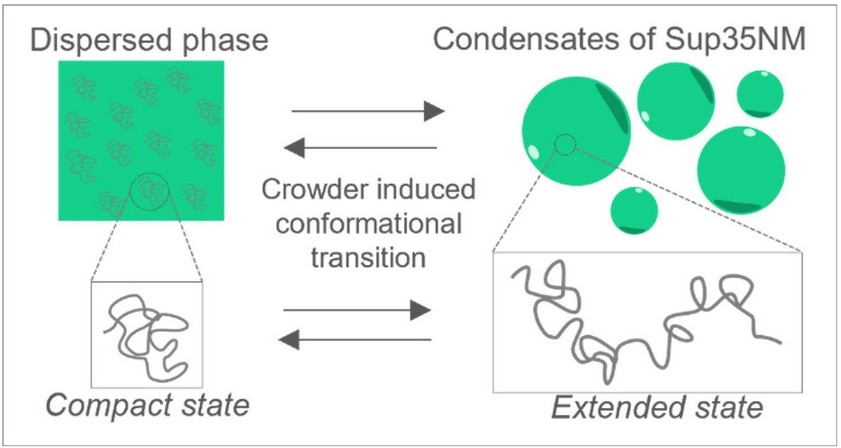
Research Summary: This study demonstrates that crowder size and shape regulate phase separation of a yeast prion protein fragment called Sup35NM, by altering protein conformations, with rod-like Dextran promoting condensate formation while spherical Ficoll suppresses it.
Researcher Spotlight
Sumangal Roychowdhury was a graduate student in CSIR-IICB working with Dr Krishnananda Chattopadhyay. His research interests revolve around biomolecular condensates, Single molecule Spectroscopy. Currently he is working as a Postdoctoral Research Associate in Texas A&M University, USA.
Twitter @SumangalRoycho1
Instagram sumangal_roychowdhury
Lab: Dr. Krishnananda Chattopadhyay, CSIR-Indian Institute of Chemical Biology
Lab social media: twitter
What was the core problem you aimed to solve with this research?
The core problem addressed by this paper is the lack of a molecular understanding of how the size, shape, and molecular weight of cellular crowding agents influence the conformational dynamics and liquid–liquid phase separation (LLPS) of intrinsically disordered proteins (IDPs). Although molecular crowding is known to promote biomolecular condensate formation, the mechanisms linking crowder-induced structural changes to phase separation remained unclear. Using the yeast Sup35NM protein as a model, the authors demonstrate how different crowders (Dextran and Ficoll) alter protein conformations, revealing that rod-like crowders promote LLPS by stabilizing extended conformations, whereas spherical crowders primarily induce compact states that suppress condensate formation.
How did you go about solving this problem?
We addressed the problem by combining experimental biophysics and computational simulations to investigate how molecular crowding regulates the phase separation of the intrinsically disordered protein Sup35NM. First, we choose two types of molecular crowders based on their geometry, Dextran (rod-like) and Ficoll (spherical) crowders with different molecular weights to mimic crowded cellular environments. Fluorescence Correlation Spectroscopy (FCS) was employed to measure changes in the protein’s hydrodynamic radius, revealing transitions between compact, intermediate, and extended conformations. Further, Confocal microscopy was employed to monitor liquid–liquid phase separation (LLPS) and condensate formation under varying protein and crowder concentrations. NMR spectroscopy confirmed that crowders did not directly bind the protein, while Thioflavin-T assays and Atomic Force Microscopy characterized condensate maturation into amyloid fibrils. Finally, coarse-grained molecular dynamics simulations modeled protein behavior at the molecular level, explaining how crowder size and shape alter intra- and intermolecular interactions. This integrated approach established a direct relationship between crowder-induced conformational changes and the propensity of Sup35NM to undergo phase separation.
“Molecular crowding, by altering the conformational states of the intrinsically disordered Sup35NM region of the yeast prion protein Sup35, influences its liquid–liquid phase separation and aggregation behavior linked to prion formation” – Dr. Krishnananda Chattopadhyay
How would you explain your research outcomes (Key findings) to the non-scientific community?
Scientists wanted to understand how proteins inside our crowded cells decide when to come together and form tiny liquid-like droplets, which are essential for many normal cell functions. Using yeast protein as a model, they showed that the surrounding molecules act like people in a crowded room. Long, flexible molecules encourage proteins to spread out and gather into droplets, while round molecules keep them compact and prevent droplet formation. These findings help explain how cells naturally regulate protein behavior and may improve our understanding of diseases, such as Parkinson’s and Alzheimer’s, where abnormal protein clumping plays a major role.
What are the potential implications of your findings for the field and society?
This study links protein conformation, cellular crowding, and aggregation pathways, offering insight into prion and neurodegenerative diseases. In prion disorders such as Creutzfeldt–Jakob disease, misfolded proteins self-template and propagate pathology. The findings suggest that crowded intracellular environments shift proteins between compact and extended conformations, influencing whether they undergo liquid–liquid phase separation (LLPS) or proceed to irreversible amyloid fibril formation. This mechanism is also relevant to Alzheimer’s disease and Parkinson’s disease, where proteins like tau, amyloid-β, and α-synuclein may first form dynamic condensates before transitioning into toxic aggregates. Cellular crowding therefore acts as a regulatory physical parameter that biases proteins toward functional or pathological states. Importantly, these shifts focus from protein sequence alone to the biophysical context of the cell. Therapeutically, modulating crowding, viscosity, or macromolecular composition could represent a novel strategy to delay or prevent neurodegeneration by stabilizing non-toxic condensates and reducing amyloid formation ultimately across complex cellular biological systems
What was the exciting moment during your research?
The exciting moment for me and my co-author Narattam Mandal was the contrasting conformational changes and phase behavior induced by the two crowding agents. Under identical conditions, Dextran produced three distinct populations and liquid-like droplets, whereas Ficoll showed only compact conformations with no droplet formation. This was later confirmed by computer simulations performed in close collaboration with Prof. Jagannath Mondal at TIFR Hyderabad and his team (Sneha Menon).
Paper reference: https://doi.org/10.1021/acs.biomac.6c00338