


The Antibody Atlas Reveals New Protective Targets for Tuberculosis Vaccines
Research Summary: We mapped IgG antibody responses across nearly the entire M. tuberculosis proteome in people and monkeys with different TB outcomes, uncovering shared antigens linked to protection that could guide next-generation vaccines.
Researcher Spotlight
Mehak Z. Khan is an immunologist specializing in antibody discovery, systems serology, and bacterial vaccine development. Trained at India’s National Institute of Immunology, India. She has worked at Ragon Institute of Mass General, MIT and Harvard; and at Moderna Tx, USA. Currently, she is Scientist III at Omniose, USA.
Lab: Prof. Galit Alter, Ragon Institute of Mass General, MIT and Harvard, Cambridge, MA, USA
What was the core problem you aimed to solve with this research?
Tuberculosis still kills over a million people every year, yet our only available vaccine (BCG) is a century old and newer candidates have struggled in trials. Part of the reason is that TB vaccine design has focused almost entirely on T cells, while the role of antibodies has been largely overlooked. We knew that some heavily exposed people never fall ill, and BCG when given intravenously can almost completely protect monkeys — but we did not know which pieces of the bacterium the antibodies of these protected individuals actually recognise. My central question was simple to state and hard to answer: across the entire TB proteome, which proteins do antibodies “see” when the immune system succeeds in controlling the infection?
How did you go about solving this problem?
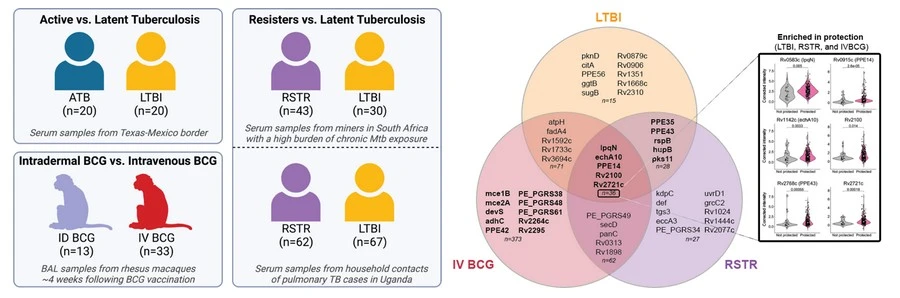
To look at the whole bacterium at once rather than one protein at a time, we used a proteome-wide microarray carrying roughly 4,000 M. tuberculosis proteins i.e. nearly the entire proteome and measured IgG antibody binding to every one of them. We compared five groups spanning the full spectrum of TB: people with active disease, people with controlled latent infection, highly exposed “resisters” who never test positive, and rhesus macaques vaccinated with either standard intradermal BCG or protective intravenous BCG. We then applied machine-learning models to find the smallest set of antigens that could tell these groups apart, and validated the top hits with purified recombinant proteins and functional antibody assays — testing whether those antibodies could actually drive immune cells to engulf the bacteria or trigger complement.
“Profiling T-dependent, class-switched antibody footprints across TB-resistant humans and primates uncovered novel protective antigens absent from failed vaccines that may be promising leads against TB” — Prof. Galit Alter
How would you explain your research outcomes (key findings) to the non-scientific community?
Think of antibodies as the immune system’s “wanted posters”…each one memorises the face of one specific piece of the bacterium. Tuberculosis has about 4,000 such faces, and we wanted to know which ones the immune system pins to the wall when it manages to keep the infection in check. When we looked across people, and even monkeys, that controlled TB well, they kept flagging the same small set of faces – proteins that sit on the surface of the bacterium. The twist: those were not the proteins used in today’s TB vaccines. In other words, we may have been printing the wrong faces on the poster, and this study hands the field a better shortlist.
What are the potential implications of your findings for the field and society?
The biggest implication is a shortlist. Out of thousands of proteins, we narrowed down to a handful that are consistently targeted by antibodies across very different states of protection and several of these are barely represented in current vaccines. That gives vaccine and antibody-drug developers concrete, rational targets to test rather than guess at. The full dataset is also a resource the whole TB community can mine. And because the antibody signatures of active versus latent infection were so distinct, the same approach could feed into better blood-based diagnostics. For a country like India, which carries a large share of the world’s TB burden, sharper tools on any of these fronts could matter enormously.
What was the exciting moment during your research?
The moment that was most exciting was when the three “protected” groups lined up together. These samples are immunologically wildly different; human resisters from South African gold mines and Ugandan households, people with latent infection, and intravenous-BCG-vaccinated macaques, collected from different continents, different exposures, even a different species. And yet, when the analysis converged, they were flagging an overlapping set of antigens. Watching that shared signature emerge from such disparate biology felt like the bacterium’s hidden vulnerabilities were finally coming into focus.
Paper reference: Khan MZ†, Irvine EB†, Cizmeci D†, Davies LRL, Randall AZ, Pablo J, et al., Alter G. A proteome-wide atlas of humoral immunity to Mycobacterium tuberculosis across the spectrum of disease. Front Immunol. 2026;17:1810894. †Equal contribution (co-first authors). https://www.frontiersin.org/journals/immunology/articles/10.3389/fimmu.2026.1810894/full